Operational Amplifier Fundamentals
Introduction to Operational Amplifiers
The Amplifier on a Chip
At the heart of many analog electronic circuits is a tiny but powerful component called the operational amplifier, or op-amp. Think of it as a versatile, high-performance amplifier packed into a small integrated circuit. Its main job is to amplify the difference between two input voltages.
An op-amp has two inputs and one output. The inputs are called the non-inverting input, marked with a plus sign (+), and the inverting input, marked with a minus sign (–). The output voltage, , is a massively amplified version of the voltage difference between these two inputs: . The term is the open-loop gain, which we'll explore shortly.
The names "inverting" and "non-inverting" refer to how the inputs affect the output. A positive voltage at the non-inverting input (+) will drive the output positive. A positive voltage at the inverting input (–) will drive the output negative.
From Vacuum Tubes to ICs
Op-amps weren't always tiny silicon chips. The first ones were built in the 1940s using bulky vacuum tubes. They were used in early analog computers to perform mathematical operations like addition, subtraction, and integration, which is where the name "operational" amplifier comes from.
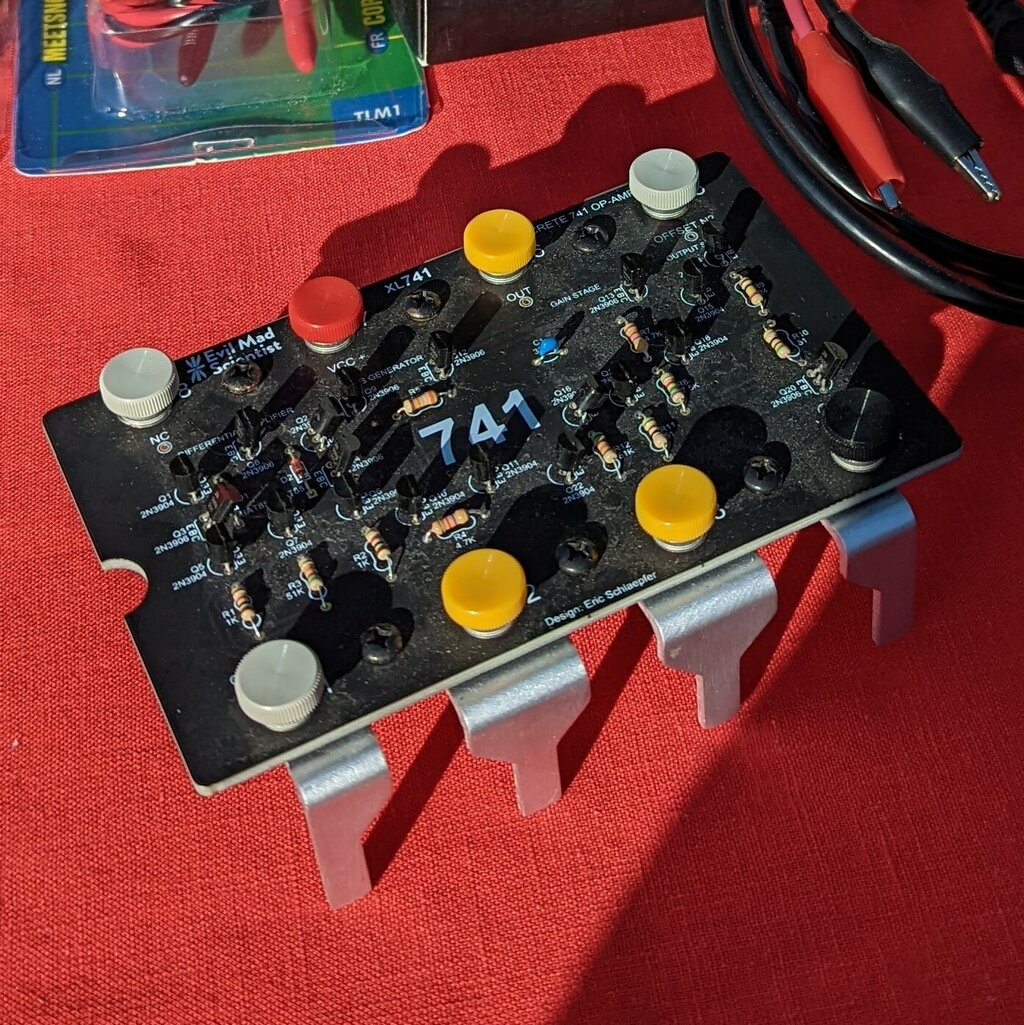
The invention of the transistor and later the integrated circuit (IC) revolutionized electronics. In the 1960s, the first op-amp was put onto a single chip. This made them cheap, small, and reliable, turning them into one of the most common building blocks in electronics, found in everything from audio amplifiers to sensor interfaces.
The Ideal Op-Amp
To make designing with op-amps easier, engineers start with a simplified model: the ideal op-amp. This model has three key characteristics that, while not perfectly achievable in the real world, are closely approximated by modern op-amps and make circuit analysis much simpler.
The ideal op-amp model is a powerful tool for understanding how op-amp circuits work without getting bogged down in complex physics.
- Infinite Open-Loop Gain ()
Open-loop means there's no connection feeding the output signal back to one of the inputs. In this state, an ideal op-amp has infinite gain. This implies that any tiny, non-zero voltage difference between the inverting and non-inverting inputs will cause the output to swing to its maximum or minimum possible voltage (limited by its power supply). In practice, this high gain is what allows op-amps to work so effectively when feedback is used.
- Infinite Input Impedance ()
Impedance is essentially resistance to current. Infinite input impedance means that an ideal op-amp draws zero current from the input circuit. It acts like a perfect sensor, measuring the input voltages without disturbing them. This is crucial because it ensures the op-amp doesn't alter the behavior of the components connected to its inputs.
- Zero Output Impedance ()
Zero output impedance means the op-amp can supply any amount of current to the load without its output voltage changing. It behaves like a perfect voltage source, providing a stable output voltage regardless of what it's connected to. The output voltage depends only on the input difference and the gain, not on the load.
| Characteristic | Ideal Value | Practical Implication |
|---|---|---|
| Open-Loop Gain () | Infinite | A tiny input difference produces a huge output. |
| Input Impedance () | Infinite | Draws no current from the input source. |
| Output Impedance () | Zero | Output voltage is stable, regardless of the load. |
These three rules are the foundation for analyzing op-amp circuits. While real op-amps have very high (but not infinite) gain and input impedance, and very low (but not zero) output impedance, the ideal model works remarkably well for most applications.
Time to check your understanding.
What is the primary function of an operational amplifier (op-amp)?
Which of the following is NOT a characteristic of an ideal op-amp?
Understanding these ideal properties is the first step. Next, we'll see how adding feedback components turns this simple amplifier into a powerful and precise circuit element.