Operating System Types Explained
Introduction to Operating Systems
The Computer's Conductor
Think of an operating system (OS) as the conductor of an orchestra. The hardware—the processor, memory, and storage drives—are the musicians. The software applications are the sheet music. Without a conductor, the musicians wouldn't know when to play, how loudly, or in what order. The result would be noise, not music. The OS is the essential software that manages all the hardware and software resources, translating your requests into actions the computer can understand.
An Operating System (OS) is the essential software layer that bridges the gap between a computer's hardware and its users.
Essentially, you don't talk directly to the hardware, and the hardware doesn't talk directly to you. The OS sits in the middle, creating a usable environment where you can run programs like web browsers, text editors, and games. It provides a consistent way for applications to deal with the hardware, without having to know the specific details of every component.
Core Responsibilities
An operating system has several key jobs it must perform constantly to keep everything running smoothly. Think of it as a master juggler, keeping many different balls in the air at once.
Process Management: When you run multiple applications at once, like a web browser, a music player, and a word processor, the OS manages the computer's processor (CPU) to share its time among them. It decides which process gets to run and for how long, creating the illusion that they're all running simultaneously.
Memory Management: Your computer has a finite amount of memory (RAM). The OS is responsible for allocating this memory to applications that need it and freeing it up when they're done. It ensures one program doesn't interfere with the memory of another, preventing crashes and errors.
File System Management: The OS organizes data into a hierarchical structure of files and folders, making it easy to store, find, and retrieve information. It handles the details of how files are physically stored on a disk drive.
Device Management: From your keyboard and mouse to your printer and Wi-Fi card, the OS communicates with all connected devices. It uses special programs called drivers to translate generic commands from your applications into specific instructions for each piece of hardware.
Security: The OS acts as a gatekeeper, controlling access to system resources. It handles user accounts, permissions, and passwords to ensure that users and programs can only access the data and functions they're authorized to use.
Inside the Machine
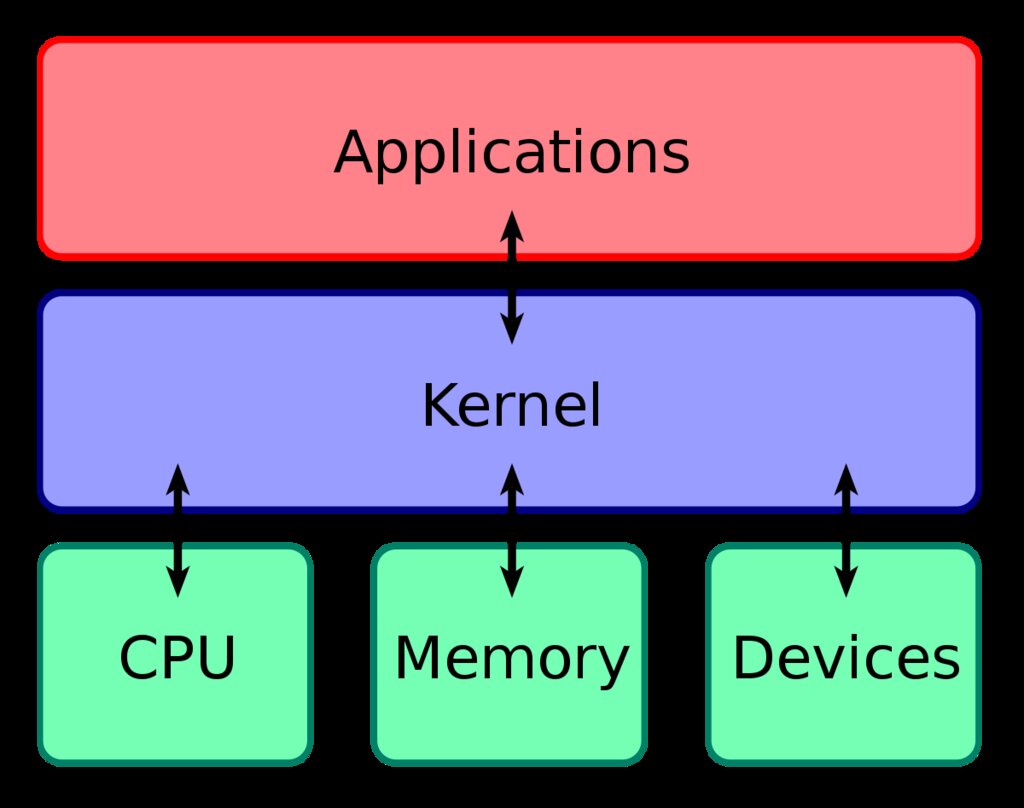
While operating systems can be incredibly complex, we can simplify their architecture into a few key parts. The most fundamental part is the kernel.
kernel
noun
The core component of an operating system that has complete control over everything in the system. It manages the CPU, memory, and devices at the lowest level.
The kernel is the heart of the OS. It's the bridge between applications and the actual data processing done at the hardware level. When a program needs to perform an action that involves the hardware, it can't do it directly. Instead, it makes a request to the kernel through a system call.
A system call is a programmatic way that a computer program requests a service from the kernel. For example, when you want to save a file, your word processor makes a system call to the OS, which then handles the complicated business of writing the data to the hard drive.
Finally, there's the user interface (UI). This is the part of the OS you interact with. It can be a command-line interface (CLI), where you type commands, or a graphical user interface (GUI) with windows, icons, and pointers, like the ones on most modern computers and smartphones.
Let's check your understanding of these foundational concepts.
Using the analogy of an orchestra, what does the operating system represent?
The ________ is the core component of the operating system that directly manages the hardware.
Without an operating system, every application developer would have to write code to manage memory, talk to every possible type of hardware, and handle files. The OS provides a crucial layer of abstraction, making computers powerful and easy to use.