Operating System Essentials
Introduction to Operating Systems
The Computer's Conductor
Think of a symphony orchestra. You have dozens of musicians, each playing a different instrument. Without a conductor, you'd just have a chaotic mess of sound. The conductor tells everyone when to start, how fast to play, and how loud to be. They manage the entire group to create beautiful music.
An operating system, or OS, is the conductor for your computer. It's the master program that manages all the other software and hardware. When you press a key, click a mouse, or open an application, the OS is what makes it all work together smoothly. It's the crucial layer between you and the physical components of your device.
An operating system (OS) serves as the critical interface between computer hardware and the user, managing system resources and providing services to programs.
Without an OS, your phone, laptop, or gaming console would just be a collection of silent, inactive parts. It provides the fundamental services that allow applications to run, making it the foundation for everything you do on a computer.
Inside the OS
An operating system isn't a single, monolithic thing. It's made up of several key components that work together. Let's look at the main players.
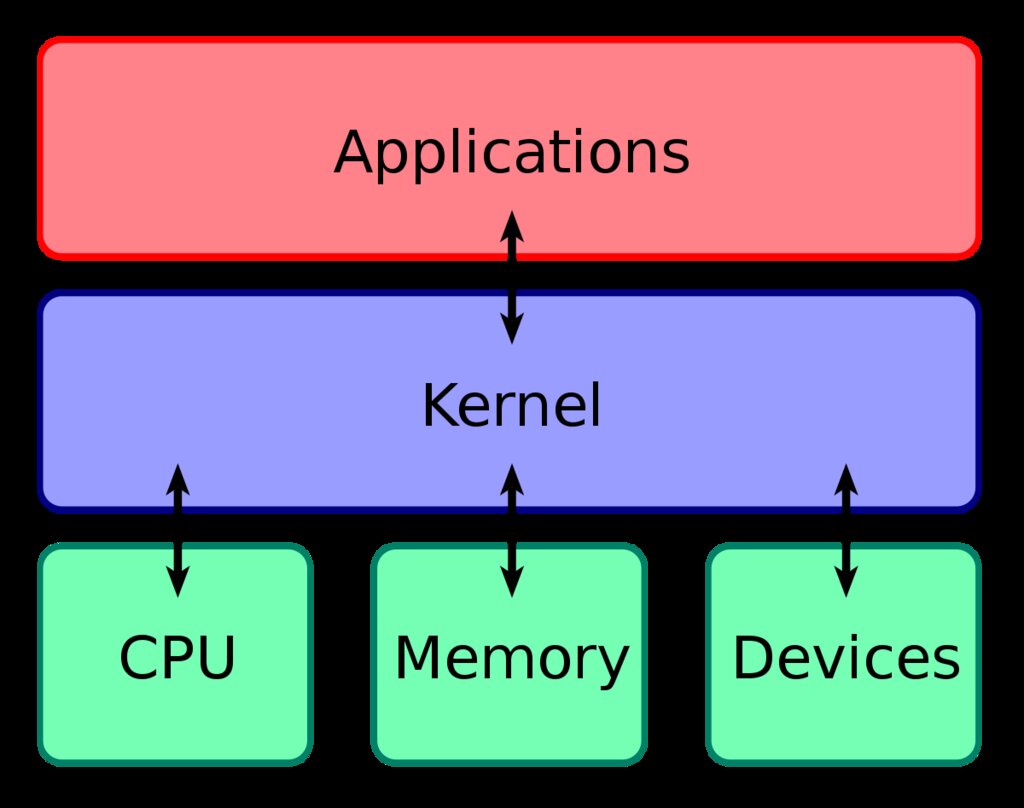
The Kernel: This is the heart of the operating system. The kernel has direct control over the hardware, like the CPU and memory. When an application needs to use a piece of hardware, it doesn't access it directly. Instead, it sends a request to the kernel, which then handles the task. This prevents conflicts and keeps the system stable.
The User Interface (UI): This is the part of the OS you actually interact with. It can be a Graphical User Interface (GUI), with windows, icons, and pointers, like you see in Windows or macOS. Or it can be a Command-Line Interface (CLI), where you type commands, common in systems like Linux. The UI's job is to translate your actions into commands the OS can understand.
System Utilities: These are programs that help manage and maintain the computer. Think of tools for formatting disks, managing files, or configuring network settings. They aren't part of the core kernel, but they provide essential functions that make the OS useful.
Types of Operating Systems
Not all operating systems are built for the same purpose. Over the years, different types have been developed to handle specific tasks and environments. Here are a few major categories.
| Type | Description | Example |
|---|---|---|
| Batch | Executes jobs in batches, one after another, without user interaction. | Mainframe systems processing payroll or bank statements overnight. |
| Multitasking | Allows multiple programs to run seemingly at the same time on a single computer. | Modern desktop and laptop OSs like Windows, macOS, and Linux. |
| Real-Time (RTOS) | Must process data and events within a strict, guaranteed timeframe. | Systems controlling industrial robots, car engines, or medical devices. |
| Distributed | Manages a group of independent computers and makes them appear to be a single computer. | Large-scale web services or scientific computing grids. |
The OS on your phone or laptop is a multitasking system. It juggles the web browser, your music player, and background notifications so seamlessly that it feels like they're all running at once. In reality, the OS is rapidly switching the CPU's attention between them, creating the illusion of parallel execution.
The Resource Manager
Perhaps the most important job of an operating system is resource management. A computer has limited resources: CPU time, memory (RAM), and storage space. When you have multiple programs running, they all have to share.
The OS acts as the ultimate gatekeeper. It decides which program gets to use the CPU and for how long. It allocates chunks of memory to each application and ensures they don't interfere with each other's space. It manages access to the hard drive, making sure data is written and read in an orderly fashion.
This management is what allows a computer to be a powerful, general-purpose machine. By fairly and efficiently distributing its resources, the OS enables a single device to handle everything from writing an email to playing a graphics-intensive video game.
Understanding these core functions is the first step toward seeing how computers truly work. The operating system is the unsung hero, the invisible force that brings the machine to life.
Ready to check your understanding?
Based on the symphony orchestra analogy, what does the conductor represent in a computer system?
What is the primary responsibility of the operating system's kernel?
Now that you have a grasp of what an operating system is and what it does, you're ready to dive deeper into its specific functions.