Ohm's Law Fundamentals
Defining V-I-R Relationships
The Core Relationship
Voltage, current, and resistance are the three fundamental quantities in electricity. They don't exist in isolation; they are locked in a constant, predictable relationship. Understanding this relationship is the key to understanding how all electrical circuits work, from a simple flashlight to a supercomputer.
The easiest way to grasp this is with an analogy. Think of electricity flowing through a wire like water flowing through a pipe.
- Voltage (V) is like the water pressure. The higher the pressure, the more force is pushing the water through the pipe.
- Current (I) is like the flow rate, or how much water is moving through the pipe per second.
- Resistance (R) is like the narrowness of the pipe. A narrow pipe resists the flow of water more than a wide one.
More voltage (pressure) creates more current (flow). More resistance (a narrower pipe) reduces current (flow).
Putting Numbers on It
To work with these concepts, we need units of measurement. You've likely heard of them before:
- Voltage is measured in (V).
- Current is measured in Amperes (A), often called "Amps."
- Resistance is measured in Ohms (Ω).
Ohm
noun
The standard unit of electrical resistance. One ohm is the resistance between two points of a conductor when a constant potential difference of one volt, applied to these points, produces a current of one ampere.
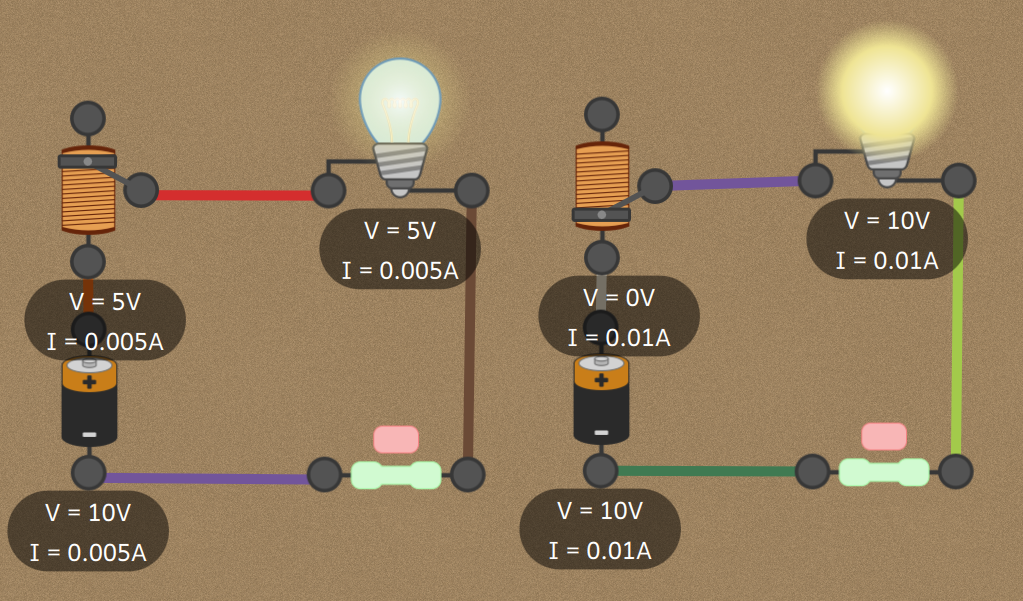
A circuit with 1 Volt of pressure pushing 1 Amp of current is facing exactly 1 Ohm of resistance. If you increase the voltage to 2 Volts while the resistance stays at 1 Ohm, the current will double to 2 Amps. Conversely, if you keep the voltage at 1 Volt but double the resistance to 2 Ohms, the current will be cut in half, to 0.5 Amps.
Ohm's Law in Action
This reliable relationship is formalized in a simple but powerful equation known as
This formula shows that voltage and current are directly proportional. If you double the voltage, you double the current, assuming resistance stays the same. It also shows that current and resistance are inversely proportional. If you double the resistance, you halve the current, assuming voltage stays the same.
A Handy Tool
The Ohm's Law formula can be rearranged to solve for any of the three variables. A simple way to remember these variations is the Ohm's Law triangle.
To use it, just cover the variable you want to find:
- To find Voltage (V): Cover V. You're left with I next to R, so .
- To find Current (I): Cover I. You see V over R, so .
- To find Resistance (R): Cover R. You see V over I, so .
This simple relationship is the foundation for analyzing almost any electrical circuit you'll encounter.