Offline LLMs for Low-Power Devices
Introduction to Small Language Models
Meet the Small Language Model
You've likely heard about Large Language Models, or LLMs. They're the massive AI systems behind tools like ChatGPT, trained on enormous amounts of text from the internet. But there's another, quieter revolution happening with their smaller cousins: Small Language Models (SLMs).
In contrast, small language models (SLMs) offer a lightweight, locally deployable alternative.
Think of an LLM as a giant, comprehensive encyclopedia containing nearly all of human knowledge. It's incredibly powerful but also requires a huge library (a data center) to house it. An SLM, on the other hand, is like a specialized, pocket-sized field guide. It doesn't know everything, but it's an expert on a specific topic, and you can carry it anywhere.
Technically, the main difference is size. SLMs are built with fewer "parameters"—the internal variables the model uses to make predictions and generate text. This smaller architecture means they require less data to train and far less computational power to run.
Big vs. Small
The choice between an LLM and an SLM always involves trade-offs. While LLMs can handle a vast range of complex, general-purpose tasks, SLMs shine in specific, focused applications where efficiency is key. Their smaller size makes them faster, cheaper to run, and more adaptable for particular jobs.
| Feature | Large Language Model (LLM) | Small Language Model (SLM) |
|---|---|---|
| Parameters | Billions to Trillions | Millions to a few Billion |
| Training Data | Vast, internet-scale datasets | Smaller, often specialized datasets |
| Resource Needs | Requires powerful servers in data centers | Can run on local devices (phones, laptops) |
| Best For | Complex reasoning, creative writing, broad Q&A | Specific tasks, on-device assistance, real-time processing |
| Cost | Expensive to train and operate | Cheaper to train and operate |
Because they are less complex, SLMs can be fine-tuned more easily for niche tasks. A company could train an SLM specifically on its internal documentation to create a highly accurate help bot, a task that would be inefficient and costly with a massive, general-purpose LLM.
Power on the Edge
The most exciting applications for SLMs are in "edge computing." This just means processing data directly on your device—your phone, your car, your smart watch—instead of sending it to a remote server in the cloud for analysis.
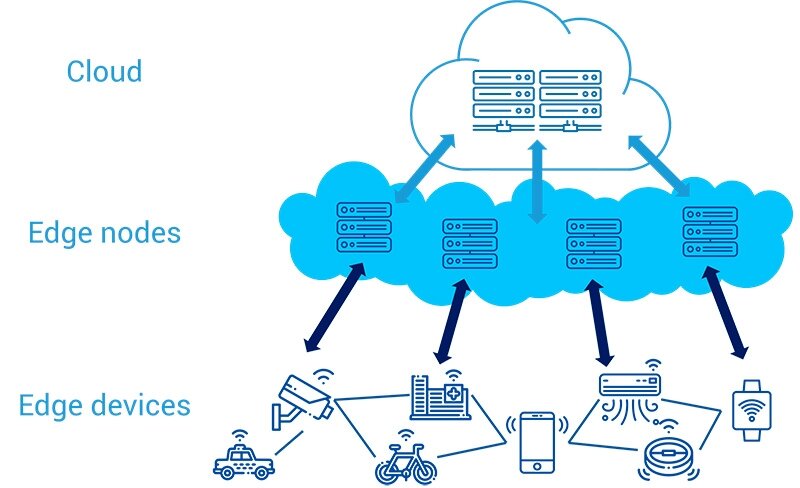
Running AI on the edge has huge benefits. It's faster because there's no delay from sending data back and forth. It works offline. And it's more private, since your personal data never has to leave your device.
Here are a few places you might find SLMs at work:
- Smart keyboards: Suggesting the next word or correcting your grammar instantly.
- On-device voice assistants: Responding to commands like "Set a timer for 10 minutes" without needing an internet connection.
- Real-time translation: Translating a conversation as it happens directly within an app on your phone.
- Camera features: Identifying objects or text in a photo right after you take it.
By running locally, SLMs provide quick, reliable AI features while keeping your data secure and private.
The Hurdles of Going Small
Deploying SLMs on low-power devices isn't without its challenges. These devices, like smartphones or IoT sensors, have limited memory, processing power, and battery life. An SLM might be small compared to an LLM, but it's still a complex piece of software that can strain these resources.
The central challenge is balancing performance with efficiency. A model needs to be powerful enough to be useful but lean enough not to drain the battery or make the device sluggish. This involves a delicate trade-off:
- Model Size vs. Accuracy: A smaller model uses less memory but might make more mistakes or give less nuanced answers.
- Computational Load vs. Speed: A more complex model might give better results but could take too long to run, making it useless for real-time applications.
- Power Consumption: Running the processor constantly for an AI task can quickly deplete a device's battery.
Engineers work to optimize these models, stripping away non-essential parts and designing them to run efficiently on specific hardware. As hardware improves and optimization techniques get better, we can expect to see these powerful little models become even more integrated into our daily lives.
Let's check your understanding of these core concepts.
What is the primary technical difference between a Small Language Model (SLM) and a Large Language Model (LLM)?
In which scenario would an SLM be a more suitable choice than an LLM?