Ocean Currents Explained
Introduction to Ocean Currents
Rivers Within the Ocean
The ocean looks like a vast, still expanse from the shore, but it's constantly in motion. Beneath the surface, huge streams of water are moving in predictable paths, like rivers flowing through the sea. These are ocean currents.
current
noun
The continuous, directed movement of seawater generated by a number of forces acting upon the water.
Ocean currents are a critical part of Earth's climate system. They transport warm water from the equator toward the poles and cold water from the poles back to the tropics. Without them, regional temperatures would be much more extreme. But what gets these massive underwater rivers moving?
The Driving Forces
Several powerful forces work together to stir the ocean. The most influential is the wind. As wind blows across the ocean's surface, it pulls the water along with it through friction. Persistent winds, like the trade winds that blow toward the equator, create steady surface currents that can span thousands of miles.
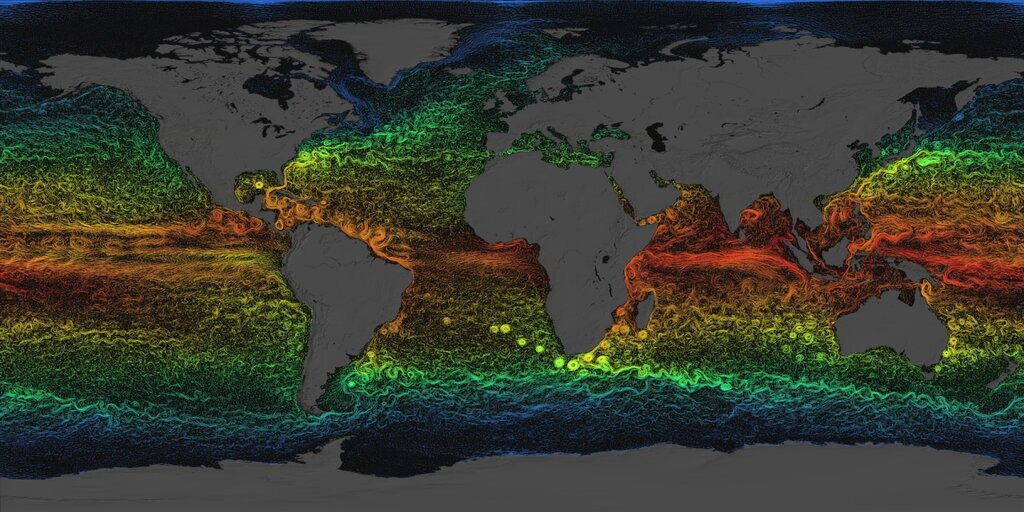
Another key factor is the Earth's rotation. Because our planet is spinning, moving objects—including water—don't travel in a straight line. They get deflected. This is known as the Coriolis effect.
In the Northern Hemisphere, currents are deflected to the right of their path. In the Southern Hemisphere, they're deflected to the left. This effect is what causes large-scale currents to form circular patterns called gyres.
Finally, the properties of the water itself play a major role. Temperature and salinity (the amount of salt dissolved in the water) determine its density. Cold water is denser than warm water, and salty water is denser than fresh water.
This might seem like a small detail, but it has huge consequences. Denser water sinks, while less dense water rises. These differences in density create slow but powerful movements in the deep ocean, as water constantly seeks to find its equilibrium.
In short, wind drives the currents on the surface, while density differences caused by temperature and salinity drive the currents deep below.
Two Types of Currents
Based on these driving forces, we can classify ocean currents into two main categories: surface currents and deep currents.
Surface currents occur in the upper 400 meters (about 1,300 feet) of the ocean. They make up about 10% of all the water in the ocean. These currents are primarily driven by wind and follow predictable patterns largely shaped by the Coriolis effect and the position of the continents.
Deep currents, on the other hand, are found below 400 meters. They make up the other 90% of the ocean's water. These are driven by differences in water density, a process known as thermohaline circulation (thermo- for temperature, -haline for salt).
This process begins in the cold polar regions. As sea ice forms, it leaves the salt behind, making the remaining water saltier and denser. This cold, salty water sinks to the ocean floor and begins to move slowly toward the equator, displacing warmer, less dense water. This circulation acts like a global conveyor belt, moving water around the entire planet over very long timescales.
Together, these two types of currents create a complex, three-dimensional circulation system that moderates our climate and supports marine life by distributing heat and nutrients around the globe.
Time to check your understanding of the forces that move our oceans.
What is the primary role of ocean currents in Earth's climate system?
The circular patterns of surface currents, known as gyres, are primarily caused by the wind and the __________ effect.
Understanding these fundamental drivers is the first step to seeing how the ocean shapes our world.