Numerical Relativity Explained
Introduction to General Relativity
A New View of Gravity
For centuries, Isaac Newton's law of universal gravitation reigned supreme. It described gravity as a force, an invisible rope pulling objects toward each other. This idea works remarkably well for most situations, from calculating the trajectory of a baseball to predicting the orbits of planets. But it wasn't the complete picture.
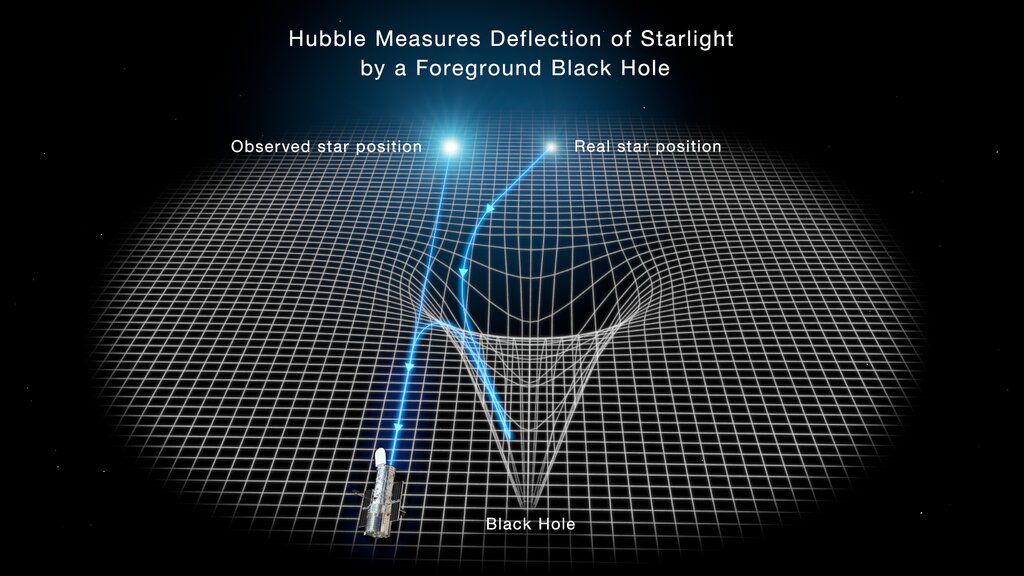
Albert Einstein proposed a radical new idea. He suggested that gravity isn't a force at all. Instead, it's a consequence of the geometry of the universe itself. According to his theory of general relativity, space and time are woven together into a single, four-dimensional fabric called spacetime. Massive objects don't pull on other objects; they warp and curve this fabric.
Imagine a bowling ball placed on a stretched-out rubber sheet. The ball creates a dip in the sheet. Now, if you roll a marble nearby, it won't travel in a straight line. It will follow the curve created by the bowling ball. This is the essence of general relativity: matter tells spacetime how to curve, and curved spacetime tells matter how to move.
The Equivalence Principle
Einstein's journey to this new understanding of gravity began with a simple thought experiment. Imagine you are in a windowless elevator in deep space, far from any gravitational influence. When the elevator accelerates upwards, you feel pressed against the floor, just as you would on Earth.
If you drop a ball, it will fall to the floor. From your perspective inside the accelerating elevator, there's no experiment you could perform to tell the difference between this acceleration and the force of gravity. This insight is the foundation of the equivalence principle.
The equivalence principle states that the effects of gravity are locally indistinguishable from the effects of acceleration. This was a crucial link, allowing Einstein to generalize his theory of special relativity, which deals with constant motion, to include acceleration and, therefore, gravity.
Paths in Curved Spacetime
So, if gravity isn't a force pulling planets around the Sun, why do they orbit? In general relativity, objects moving under the influence of gravity are simply following the straightest possible path through curved spacetime. This path is called a geodesic.
A geodesic is the shortest distance between two points, but in a curved space, this path isn't what we typically think of as a straight line. Think about an airplane flying from New York to Tokyo. On a flat map, the shortest path looks like a straight line. But on the curved surface of the Earth, the shortest route is actually a great circle arc that appears curved on the map.
Planets orbiting the Sun are doing the same thing. They are following their geodesics, the most natural paths through the spacetime that the Sun has curved. What we perceive as the force of gravity is simply the experience of traveling along these curved paths.
The Equations of Spacetime
The mathematical heart of general relativity is a set of ten interconnected equations known as the Einstein field equations. They are famously complex, but their meaning can be summarized beautifully.
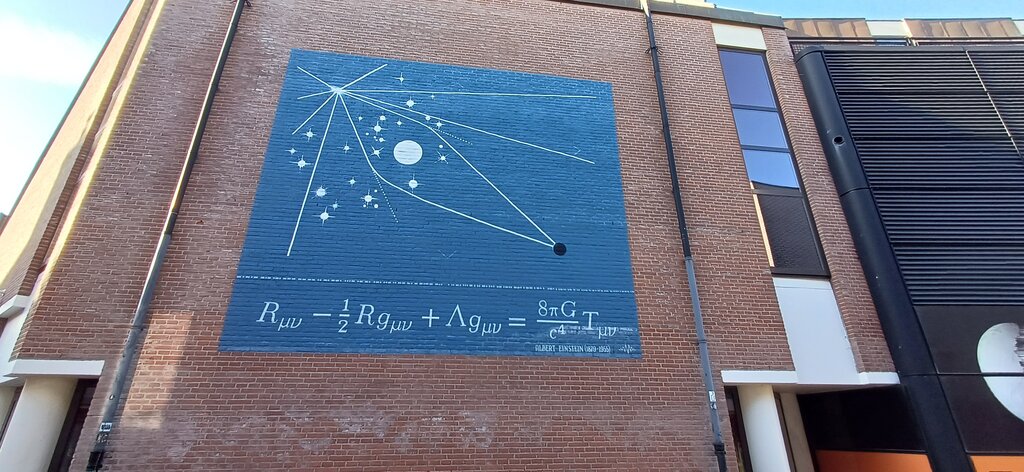
The equations relate the geometry of spacetime to the energy and matter within it. The left side of the equation describes the curvature of spacetime, while the right side describes the distribution of mass, energy, momentum, and pressure, what's known as the stress-energy tensor.
In essence, the equation says that the amount of matter and energy in a region determines the geometry of spacetime there. It is the precise mathematical expression of the idea that matter tells spacetime how to curve.
Solving these equations is incredibly difficult, and can only be done exactly in a few special cases. One of the first and most important exact solutions was found by Karl Schwarzschild in 1916, just months after Einstein published his theory.
The Schwarzschild solution describes the geometry of spacetime outside a single, spherical, non-rotating mass, like a star or a planet. It accurately predicted the orbits of planets in our solar system, even explaining a small, persistent anomaly in Mercury's orbit that Newton's theory couldn't account for. More dramatically, it also predicted the existence of black holes, regions of spacetime so severely curved that nothing, not even light, can escape.
According to Albert Einstein's theory of general relativity, what is gravity?
The equivalence principle is a key concept in general relativity. It states that an observer cannot distinguish between the effects of gravity and the effects of __________.
General relativity reshaped our understanding of the universe, revealing gravity as an intimate property of spacetime itself. This geometric view of gravity is fundamental to modern cosmology and astrophysics.