Number Systems Explained
Introduction to Number Systems
A Language for Numbers
A number system is a way of writing down numbers. Think of it as a special language for quantities. Just like we use alphabets to write words, we use number systems to write down how many of something there is. Without a shared system, counting, measuring, or even telling time would be chaotic.
number system
noun
A systematic method for representing numbers using a set of symbols and rules.
These systems allow us to perform calculations, represent data, and communicate precise amounts. From the price of a coffee to the speed of a spacecraft, number systems provide the structure we need to make sense of the world quantitatively. They are a fundamental tool in both everyday life and complex fields like mathematics and computer science.
From Tally Marks to Place Value
The earliest ways of counting were simple. People used tally marks, where one mark represented one object. This is a basic non-positional system. Each symbol has a fixed value, no matter where it's placed. Five tally marks (|||||) means five, and that's it.
Roman numerals are a more famous non-positional system. The symbol V always means five, and X always means ten. While their order can matter for addition or subtraction (like IV for four vs. VI for six), the symbol's core value doesn't change based on its column.
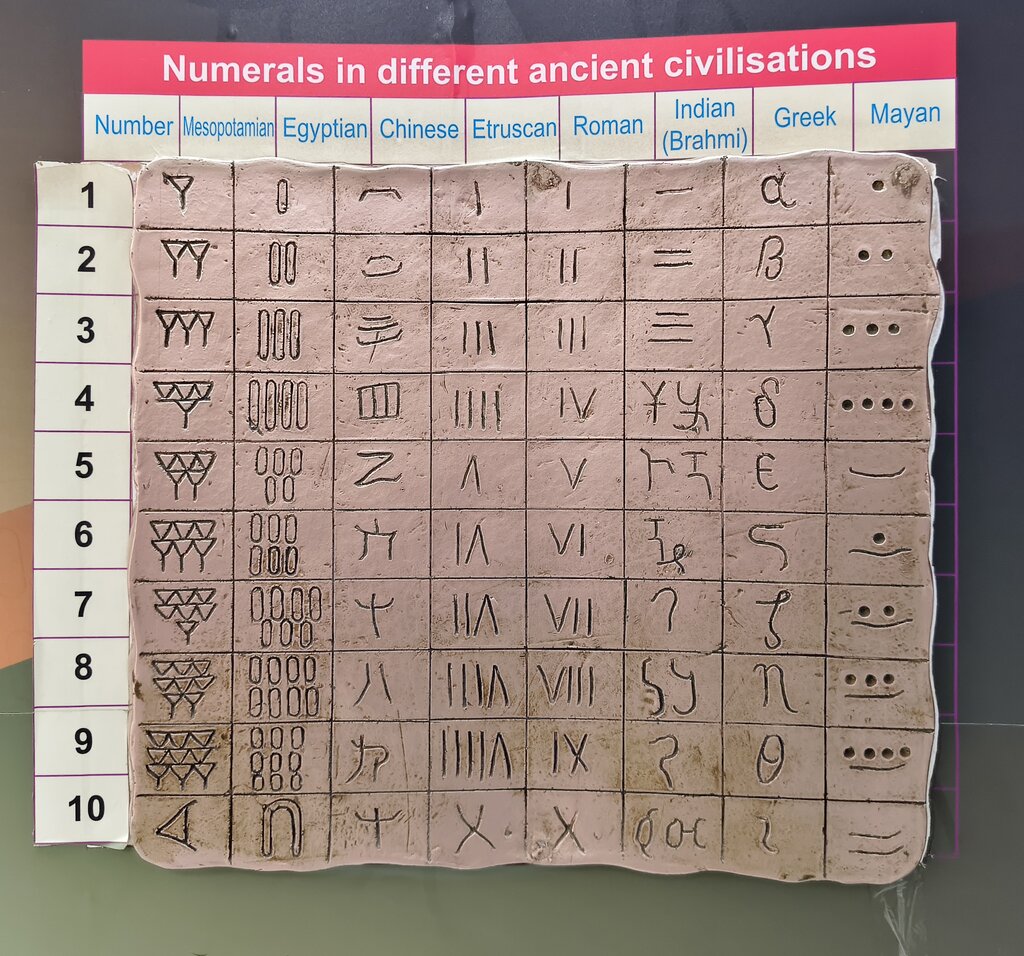
Non-positional systems get very clumsy for large numbers and complicated math. Imagine trying to multiply CXXIII by XLVII. It's not intuitive.
The big breakthrough was the invention of positional number systems. In these systems, a symbol's value depends on its position, or "place." This is the system we use every day, called the decimal or base-10 system. It uses ten symbols: 0, 1, 2, 3, 4, 5, 6, 7, 8, and 9.
In the number 252, the first '2' means two hundred, but the last '2' means just two. Same symbol, different value, all because of its position.
Why It Matters
Positional systems, especially the concept of zero as a placeholder, revolutionized mathematics. They made arithmetic much simpler and paved the way for advanced concepts like algebra and calculus. This structure is what makes carrying the one in addition or borrowing in subtraction work so smoothly.
In computer science, number systems are everything. Computers don't think in words or our base-10 numbers. They operate on a much simpler system: the binary or base-2 system. It uses only two symbols, 0 and 1, to represent electrical signals being off or on.
# In binary, every number is a combination of 0s and 1s.

Decimal 5  -> Binary 101
Decimal 10 -> Binary 1010
Decimal 42 -> Binary 101010
Every piece of data on your computer—this text, your photos, the operating system itself—is stored and processed as long strings of these ones and zeros. Understanding different number systems like binary is fundamental to understanding how digital technology works.
Let's check your understanding of these foundational ideas.
What is the primary purpose of a number system?
In a positional number system, the value of a digit is determined by its position.
From ancient tally marks to the binary code running our modern world, number systems are a powerful human invention for describing quantity and creating logic.