Nuclear Transmutation Elements Alchemy
Atomic Structure
The Building Blocks of Matter
Everything around you, from the air you breathe to the screen you're reading this on, is made of elements. The smallest unit of any element is an atom. For a long time, people thought atoms were the smallest things possible, but we now know they are made of even tinier components called subatomic particles.
There are three main particles that make up an atom: protons, neutrons, and electrons. Protons and neutrons are packed together in the center of the atom, forming a dense core called the nucleus. The electrons are much smaller and orbit the nucleus in specific layers, or shells.
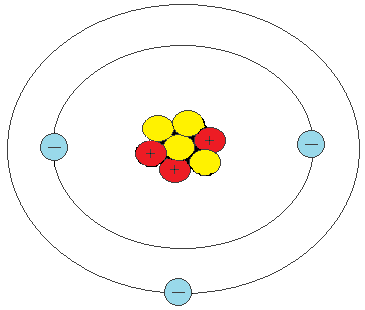
Each particle plays a unique role:
- Protons have a positive electric charge (+1).
- Neutrons have no charge at all; they are neutral.
- Electrons have a negative electric charge (-1).
The positive charge of the protons in the nucleus attracts the negatively charged electrons, holding them in their orbits and keeping the atom together.
Reading an Atom's Identity
So how do we tell one element from another? We can identify any atom by two key numbers: the atomic number and the mass number.
Atomic Number
noun
The number of protons in an atom's nucleus. It is represented by the symbol Z.
The atomic number is what defines an element. Every atom with six protons is a carbon atom, and every atom with eight protons is an oxygen atom. No exceptions. In a neutral atom, the number of electrons is equal to the number of protons, balancing the overall charge.
Mass Number
noun
The total count of protons and neutrons in an atom's nucleus. It is represented by the symbol A.
Protons and neutrons have roughly the same mass, while electrons are so light that their mass is usually ignored when calculating the mass number. The mass number gives us a good idea of the total mass of an atom.
The relationship is simple: Mass Number (A) = Number of Protons (Z) + Number of Neutrons (N).
This means if you know an atom's mass number and atomic number, you can easily figure out how many neutrons it has just by subtracting: .
Family Variations
While the number of protons for a given element is always the same, the number of neutrons can vary. Atoms of the same element that have different numbers of neutrons are called isotopes.
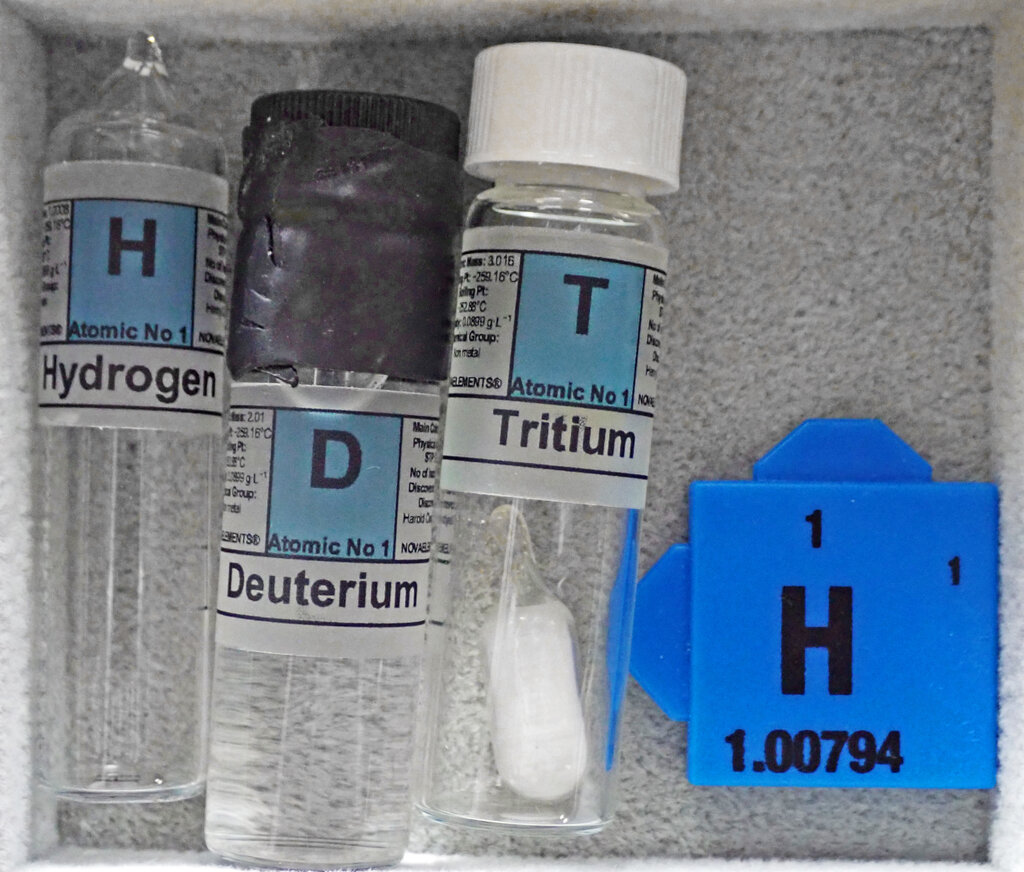
Let's look at hydrogen, the simplest element. It always has one proton. But it can have zero, one, or two neutrons.
Because they have the same number of protons and electrons, isotopes of an element have the same chemical properties. Their only difference is their mass.
| Isotope Name | Protons | Neutrons | Mass Number |
|---|---|---|---|
| Hydrogen-1 (Protium) | 1 | 0 | 1 |
| Hydrogen-2 (Deuterium) | 1 | 1 | 2 |
| Hydrogen-3 (Tritium) | 1 | 2 | 3 |
Another common example is carbon. All carbon atoms have 6 protons. The most common isotope, Carbon-12, has 6 neutrons. But there's also Carbon-13 (7 neutrons) and Carbon-14 (8 neutrons). These variations are crucial in fields like archaeology, where Carbon-14 is used for dating ancient objects.