Nuclear Science and Reactor Operations
Atomic Structure
The Building Blocks of Matter
Everything around you, from the air you breathe to the screen you're reading this on, is made of atoms. Think of them as the fundamental LEGO bricks of the universe. For a long time, people thought atoms were the smallest possible things, but we now know they're made of even tinier components called subatomic particles.
At the center of every atom is a dense core called the nucleus. This is where you'll find two types of particles: protons and neutrons. Whizzing around the nucleus in a cloud-like region are the third type, electrons. Protons have a positive electric charge, neutrons have no charge at all (they're neutral), and electrons have a negative charge. In a neutral atom, the number of positive protons is perfectly balanced by the number of negative electrons.
The number of protons is the atom's most important feature. It's called the atomic number, and it defines the element. An atom with one proton is always hydrogen. An atom with six protons is always carbon. Change the number of protons, and you change the element itself.
| Particle | Charge | Location in Atom | Relative Mass |
|---|---|---|---|
| Proton | Positive (+) | Nucleus | ~1 |
| Neutron | Neutral (0) | Nucleus | ~1 |
| Electron | Negative (-) | Orbiting Nucleus | ~1/1836 |
Atomic Variations
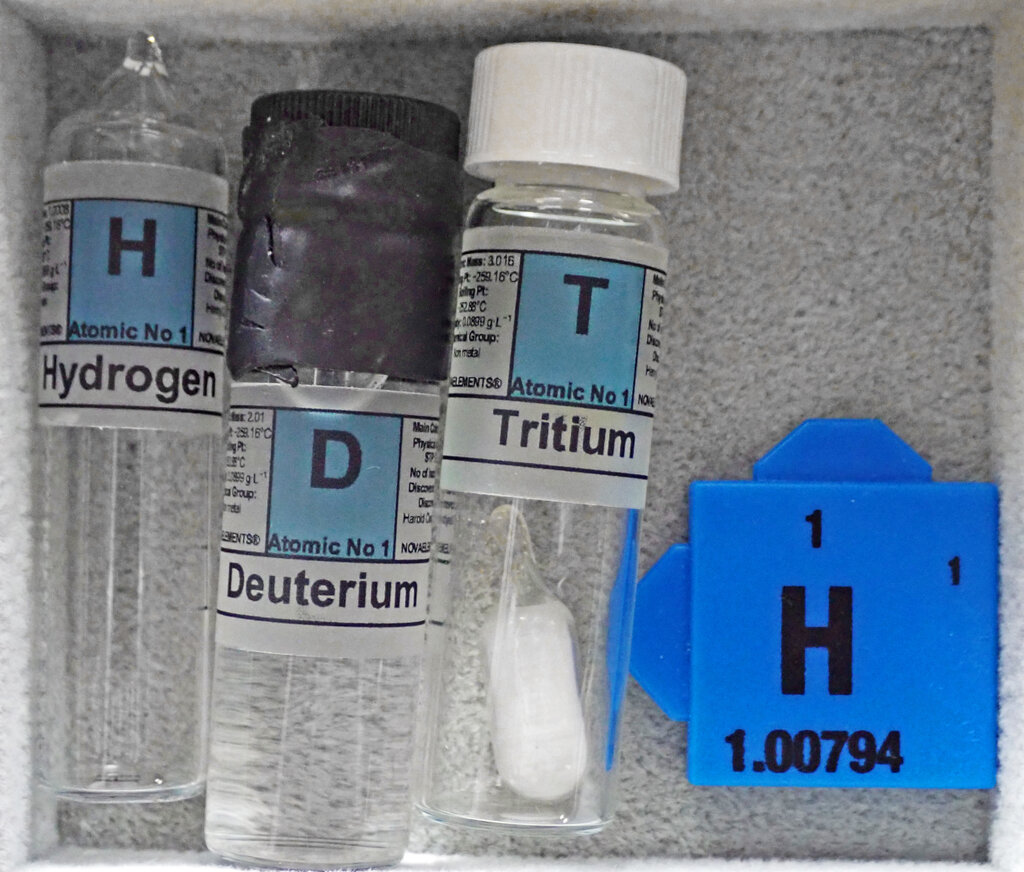
While the number of protons defines an element, the number of neutrons can vary. Atoms of the same element that have different numbers of neutrons are called isotopes. Since neutrons don't have a charge, isotopes of an element have the same chemical properties. They're the same element, just with a slightly different weight.
Hydrogen is a great example. Most hydrogen atoms are just a single proton and an electron. But some have a neutron, and a very rare few have two. They're all still hydrogen, but they have different masses.
Isotope
noun
One of two or more forms of a chemical element with the same number of protons but with different numbers of neutrons in their nuclei.
This concept is vital in nuclear science. The balance of protons and neutrons in a nucleus determines its stability. Some isotopes have a very stable nucleus, while others are unstable and will spontaneously change, releasing energy in a process called radioactive decay. These unstable versions are known as radioisotopes.
The Force Holding It Together
This leads to a puzzle. The nucleus is packed with positively charged protons. If you've ever played with magnets, you know that like charges repel each other. So why doesn't the nucleus instantly fly apart from the intense repulsion between all those protons?
There must be another force at work, one that's much stronger than the electromagnetic repulsion, but only over very short distances.
This is the strong nuclear force. It's one of the four fundamental forces of nature, and as its name suggests, it's incredibly powerful. It acts like a superglue, binding protons and neutrons together. However, its reach is extremely short, effectively limited to the size of an atomic nucleus. Outside of that tiny range, it has no effect. This force is what makes stable atomic nuclei possible and is the ultimate source of nuclear energy.
If protons repel each other, yet are bound together, then there must be some other force of nature! NUCLEAR FORCES!
Understanding these atomic building blocks, their variations as isotopes, and the powerful force that binds them is the first step to understanding the world of nuclear science.