Nuclear Reactor Fundamentals and Operation
Nuclear Physics Basics
Inside the Atom's Core
At the heart of every atom is a tiny, dense nucleus. This is where the action happens in nuclear physics. The nucleus is packed with two types of particles: positively charged protons and neutral neutrons. Together, they're called nucleons. Whizzing around the nucleus are negatively charged electrons, but for now, our focus is on that central core.
The number of protons determines what element an atom is. An atom with one proton is always hydrogen; an atom with six protons is always carbon. The number of neutrons, however, can vary. Atoms of the same element with different numbers of neutrons are called isotopes. For example, Uranium-235 and Uranium-238 are both isotopes of uranium. They both have 92 protons, but U-235 has 143 neutrons while U-238 has 146.
The Forces That Bind
If you remember that like charges repel, the nucleus presents a puzzle. It's crammed full of positively charged protons pushing away from each other. So why doesn't the nucleus just fly apart? The answer is a powerful, invisible glue called the strong nuclear force.
This force is the strongest of the four fundamental forces of nature, but it only works over incredibly short distances, about the diameter of a proton. It pulls protons and neutrons together, overcoming the electrical repulsion between the protons. The neutrons act like spacers, helping to keep the protons from pushing each other away too strongly.
There's another force at play, too: the weak nuclear force. It's weaker than both the strong force and the electromagnetic force, and it's responsible for certain types of radioactive decay where one type of subatomic particle changes into another.
The stability of a nucleus is a delicate balancing act between the repulsive electric force between protons and the attractive strong nuclear force holding nucleons together.
When Nuclei Decay
Not all atomic nuclei are stable forever. When the balance of forces is off, a nucleus can spontaneously change to become more stable. This process is called radioactivity, or radioactive decay. The unstable nucleus releases energy by emitting radiation in the form of particles or high-energy waves.

There are three main types of radioactive decay:
- Alpha Decay: The nucleus ejects an alpha particle, which is made of two protons and two neutrons (basically, a helium nucleus). This reduces the nucleus's mass and changes it into a different element.
- Beta Decay: A neutron in the nucleus transforms into a proton, and an electron (called a beta particle in this context) is ejected at high speed. This also changes the atom into a new element.
- Gamma Decay: After alpha or beta decay, the nucleus might still have some excess energy. It releases this energy as a high-energy photon called a gamma ray. This doesn't change the number of protons or neutrons, it just lowers the nucleus's energy state.
Nuclear Fission
Beyond decay, nuclei can undergo more dramatic transformations called nuclear reactions. Unlike chemical reactions that only involve an atom's electrons, nuclear reactions change the nucleus itself. The most famous of these is nuclear fission.
Fission is the process of splitting a heavy, unstable nucleus into two or more smaller nuclei. This split doesn't just produce smaller atoms; it also releases a tremendous amount of energy. The source of this energy is mass itself, as described by Albert Einstein's famous equation, . During fission, a tiny amount of mass is converted directly into a large amount of energy.
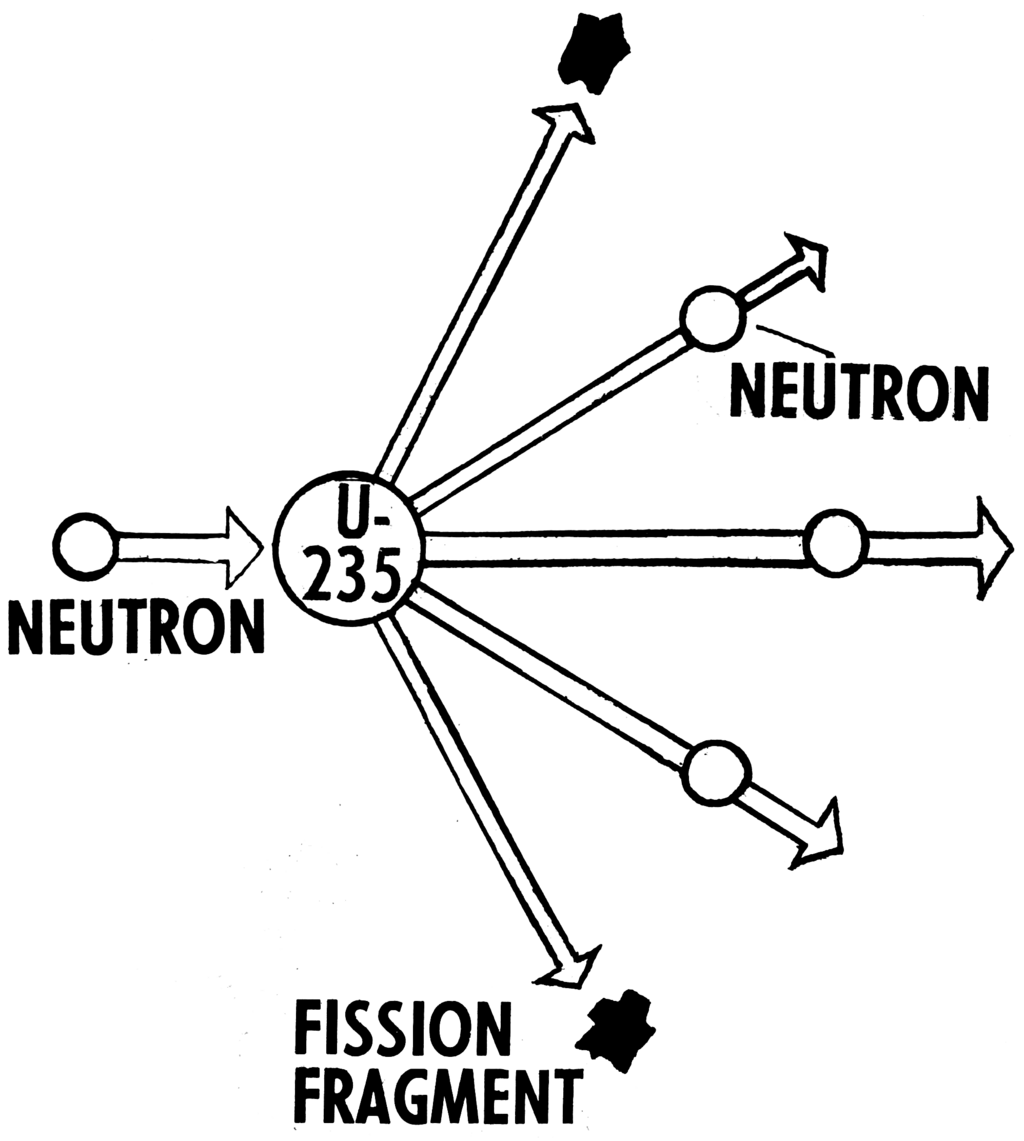
Fission can happen spontaneously, but it's more commonly induced. This happens when a heavy nucleus like Uranium-235 absorbs a slow-moving neutron. The extra neutron makes the nucleus highly unstable, causing it to wobble and split apart almost instantly.
The key products of this split are two smaller nuclei (called fission fragments), a burst of energy, and two or three new neutrons. These new neutrons are crucial because they can go on to strike other Uranium-235 nuclei, causing them to split and release even more neutrons and energy. This process, where one reaction triggers the next, is called a chain reaction.
When the reactor is running, high-speed particles called neutrons strike the uranium atoms and cause them to split in a process known as nuclear fission.
Understanding these fundamental principles of the atom's core, from the forces that hold it together to the reactions that split it apart, is the first step to understanding how we can harness the power within.
Time to check your understanding.
What are the particles found inside an atom's nucleus collectively called?
What is the primary force responsible for holding the protons and neutrons together in an atomic nucleus?