Nuclear Reactor Aging Management
Radiation Induced Degradation
The Atomic Billiard Game
Inside a nuclear reactor, the environment is far from gentle. The steel components, particularly the reactor pressure vessel (RPV), are bombarded by a relentless stream of high-energy neutrons produced during fission. When one of these fast neutrons collides with an atom in the steel's crystal lattice, it's like a cue ball striking a tightly packed rack of billiard balls. The neutron transfers a significant amount of kinetic energy to the atom it hits, knocking it violently from its fixed position. This initial displaced atom is called a primary knock-on atom (PKA).
The PKA doesn't stop there. Now energized, it careens through the lattice, colliding with and displacing other atoms in a chain reaction known as a This process creates a localized region of chaos within the otherwise orderly crystal structure. The cascade happens incredibly fast, over picoseconds, and leaves behind a flurry of atomic-scale defects.
The primary types of defects created are vacancies, which are empty lattice sites where an atom used to be, and interstitials, which are the displaced atoms now squeezed into spaces between other atoms. Together, a vacancy and an interstitial are known as a Frenkel pair. While many of these defects recombine and annihilate each other shortly after the cascade, a significant number remain, permanently altering the material's microstructure.
Measuring the Damage
The extent of radiation damage isn't measured by a single event, but by the cumulative effect of trillions of these collisions over years of operation. We quantify this exposure using a metric called neutron fluence, which is the total number of neutrons that have passed through a square centimeter of material over a given time. While useful, fluence doesn't tell the whole story, as neutrons of different energies cause different amounts of damage.
A more direct measure is (dpa). This unit quantifies the average number of times each atom in a material has been knocked out of its lattice site. For example, a dpa value of 1 means that, on average, every single atom in the material has been displaced from its original position once. For the reactor pressure vessel, a key structural component, the accumulated damage over a 60-year lifespan might reach 0.1 dpa in its most heavily irradiated regions. This standardized unit allows engineers to compare damage across different reactors and predict material performance.
From Defects to Hardening
Isolated vacancies and interstitials are just the beginning. Over time, these point defects can migrate through the crystal lattice. They begin to clump together, forming larger defect structures like vacancy clusters (voids) and interstitial loops. More importantly, they can interact with impurity atoms, or solutes, that are already present in the steel.
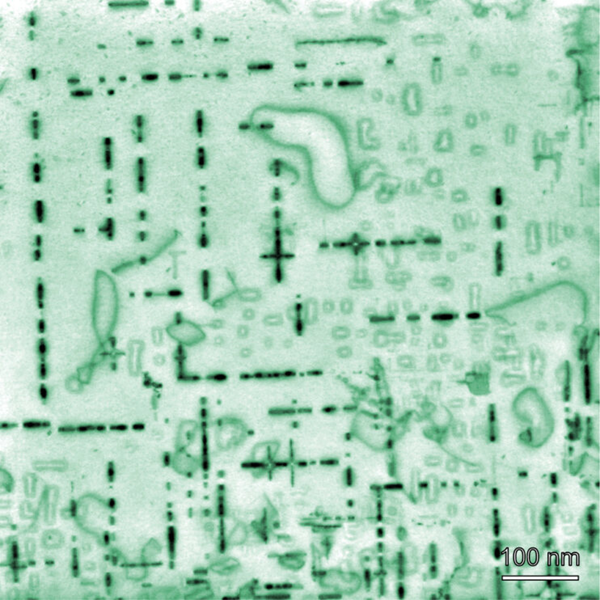
Even tiny amounts of certain elements can have a huge impact. In RPV steels, trace amounts of copper are particularly troublesome. Copper atoms are not very soluble in the iron lattice, and the radiation damage provides both the nucleation sites (defect clusters) and the enhanced diffusion to allow them to precipitate out of the solution, forming tiny, copper-rich clusters. Other elements like nickel can enhance this effect, while phosphorus can segregate to grain boundaries, weakening them.
These newly formed solute clusters and defect loops act as obstacles, pinning the movement of dislocations—the line defects that allow metals to deform plastically. When dislocations can't move, the material becomes harder and stronger, but also less ductile. This is known as radiation hardening.
The Shift to Brittle Behavior
The most dangerous consequence of this hardening is embrittlement. All steels have a temperature below which they behave in a brittle manner (like glass) and above which they behave in a ductile manner (like taffy). This is called the or DBTT. A ductile material will deform and absorb a lot of energy before it breaks, while a brittle material fractures suddenly with little warning.
Radiation damage increases the DBTT. This means a reactor vessel that was ductile at its normal operating temperature might become brittle over time. A 'DBTT shift' means the safety margin has shrunk. A once-tough material might now be susceptible to catastrophic failure from a sudden thermal shock, like an emergency core cooling event.
Understanding this connection between microscopic defects, hardening, and the macroscopic shift in DBTT is fundamental to ensuring nuclear reactors can operate safely for their intended lifespan and beyond. By controlling the purity of the steel, especially the levels of copper and nickel, and by carefully monitoring the effects of radiation, engineers can manage the degradation and ensure the RPV remains tough and reliable.
What is the direct, initial result of a high-energy neutron striking an atom within the steel's crystal lattice?
Why is "displacements per atom" (dpa) considered a more accurate measure of radiation damage in materials compared to "neutron fluence"?