Nuclear Physics and Reactor Operations
Atomic Structure
The Building Blocks of Matter
Everything you see around you, from the air you breathe to the screen you're reading this on, is made of atoms. Atoms are the smallest units of an element that still have the properties of that element. Think of them as the fundamental Lego bricks of the universe. But what are these bricks made of?
Atoms themselves are composed of even smaller pieces called subatomic particles. There are three main types you need to know: protons, neutrons, and electrons.
Protons and neutrons are packed together in the center of the atom, forming a dense core called the nucleus. Electrons are much smaller and orbit the nucleus.
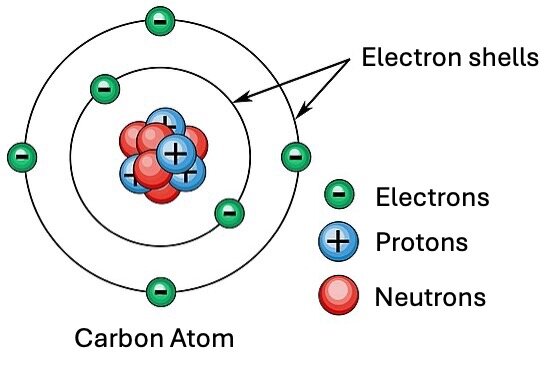
Each particle has a distinct electrical charge. Protons have a positive charge (+1), electrons have a negative charge (-1), and neutrons, as their name suggests, are neutral (0). In a neutral atom, the number of protons always equals the number of electrons, so their charges cancel each other out. Here’s a quick comparison:
| Particle | Relative Charge | Location in Atom |
|---|---|---|
| Proton | +1 | Nucleus |
| Neutron | 0 | Nucleus |
| Electron | -1 | Orbiting Nucleus |
An Element's Identity
What makes an atom of gold different from an atom of oxygen? It all comes down to the number of protons. Every atom of a specific element has the exact same number of protons. This count is so important that it gets its own name: the atomic number, represented by the symbol .
An atom of hydrogen always has 1 proton (). An atom of helium always has 2 protons (). An atom of carbon always has 6 protons (). The number of protons is the element's unique identifier.
While the proton count is fixed for an element, the number of neutrons can vary. To get the total mass of an atom, we add up the protons and neutrons in the nucleus. This sum is called the mass number, represented by the symbol . Electrons are so tiny their mass is usually ignored in this calculation.
We often write elements using a special notation that includes both numbers. For example, a common form of carbon has 6 protons and 6 neutrons.
Here, the bottom number is the atomic number () and the top number is the mass number ().
isotope
noun
Atoms of the same element that have the same number of protons but a different number of neutrons.
Because they have different numbers of neutrons, isotopes of the same element have different mass numbers. For example, while most carbon atoms are Carbon-12 (6 protons, 6 neutrons), some are Carbon-13 (6 protons, 7 neutrons) or Carbon-14 (6 protons, 8 neutrons). They are all still carbon because they all have 6 protons.
Electron Energy Levels
Electrons don't just swarm around the nucleus randomly. They are arranged in specific energy levels, or shells, similar to planets orbiting the sun at different distances. Each shell can only hold a certain number of electrons. The first shell, closest to the nucleus, can hold up to 2 electrons. The second can hold up to 8, the third up to 18, and so on.
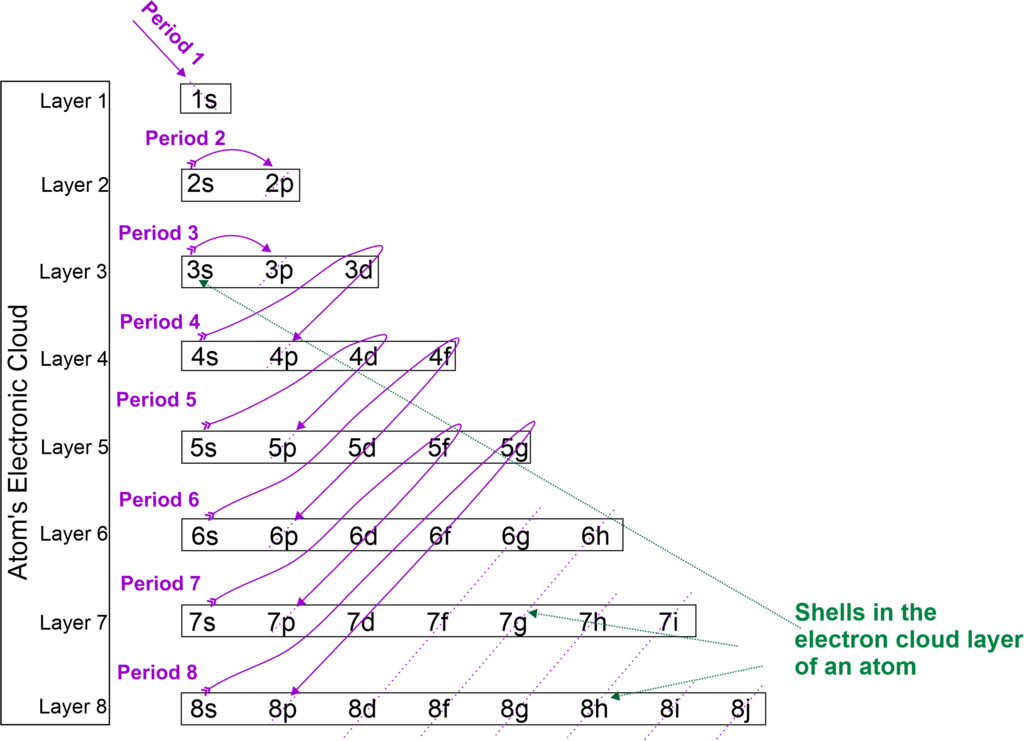
The arrangement of electrons in these shells is called the electron configuration. This configuration is key to understanding an element's chemical behavior, such as how it bonds with other atoms. The electrons in the outermost shell, called valence electrons, are the most important for chemical reactions. For example, sodium has one valence electron, which it can easily give away, making it highly reactive.
An atom is most stable when its outermost electron shell is full. This is why noble gases like Neon and Argon, which have full outer shells, are very non-reactive.
Let's review the key concepts.
Now, let's test your understanding of these atomic building blocks.
What does the atomic number (Z) of an element represent?
An atom has an atomic number of 17 and a mass number of 35. How many neutrons does this atom have?
This fundamental picture of the atom, with its nucleus and electron shells, is the foundation for almost all of chemistry and nuclear physics.