Nuclear Fission and Weapons
Atomic Structure
Inside the Atom
Everything you see is made of atoms. From the air you breathe to the chair you're sitting on, it's all just countless tiny atoms linked together. For a long time, people thought atoms were the smallest possible things, like indivisible little spheres. The word atom even comes from the Greek word atomos, which means "uncuttable."
But as we discovered, atoms can be cut. They have smaller pieces inside them, each with a specific job. Think of an atom as a tiny solar system. At the center is a dense core called the nucleus, and zipping around it are even tinier particles.
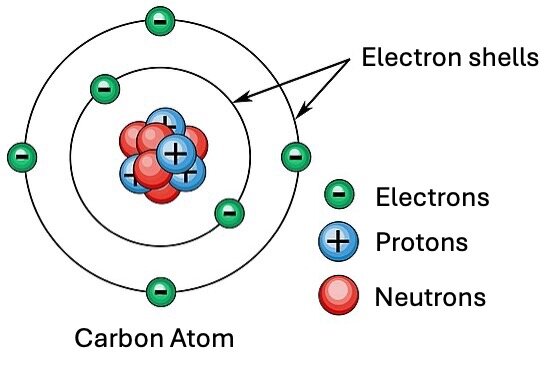
This central nucleus is packed with two types of particles: protons and neutrons. Swirling around the nucleus in a vast, mostly empty space is the third type of particle: the electron.
The Subatomic Trio
Let's meet the three particles that make up an atom. Their properties, especially their electrical charge, determine how an atom behaves.
Proton
noun
A subatomic particle found in the nucleus of every atom, with a positive electric charge.
Protons are what give an atom its identity. The number of protons in an atom's nucleus determines which element it is. An atom with one proton is always hydrogen. An atom with six protons is always carbon. Add one more proton, and you get nitrogen. The number of protons is called the atomic number.
Neutron
noun
A subatomic particle of about the same mass as a proton but without an electric charge, present in all atomic nuclei except ordinary hydrogen.
Neutrons are the neutral partners to protons in the nucleus. They have no charge, so they don't affect which element an atom is. Their main job is to act as a kind of nuclear glue, helping to hold the nucleus together. Atoms of the same element can have different numbers of neutrons; these variations are called isotopes.
Electron
noun
A stable subatomic particle with a charge of negative electricity, found in all atoms and acting as the primary carrier of electricity in solids.
Electrons are tiny, negatively charged particles that are incredibly light compared to protons and neutrons. They don't sit still but instead exist in a cloud of probable locations around the nucleus. In a neutral atom, the number of electrons is equal to the number of protons, balancing the electrical charge to zero. Electrons are responsible for all of chemistry, as they are the particles that interact when atoms form bonds.
The Nuclear Glue
There’s a puzzle at the heart of the atom. Protons are all positively charged, and basic physics tells us that like charges repel each other. So why doesn't the nucleus, packed with positively charged protons, fly apart?
The answer is a powerful, short-range force called the strong nuclear force. It's the strongest of the four fundamental forces of nature. It acts like an incredibly powerful glue, binding protons and neutrons together, but only over the tiny distances inside an atomic nucleus. This force is strong enough to overcome the electromagnetic repulsion between the protons.
The balance between the repulsive electromagnetic force and the attractive strong nuclear force determines whether a nucleus is stable or unstable. Neutrons play a key role here; they contribute to the strong force's attraction without adding any electromagnetic repulsion. This is why larger nuclei need more neutrons than protons to remain stable.
This delicate balance of particles and forces inside the atom is the key to everything that will follow. Understanding it is the first step toward understanding the immense power locked within the nucleus.
What particle determines the identity of an element?
In a neutral atom, the number of electrons is equal to the number of ______.