Nuclear Explosives Explained
Atomic Structure
The Building Blocks of Matter
Everything you see and touch is made of atoms. From the air you breathe to the screen you're reading this on, it's all collections of these tiny particles. But atoms themselves are made of even smaller pieces. Understanding these components is the first step to understanding how the universe works at a fundamental level.
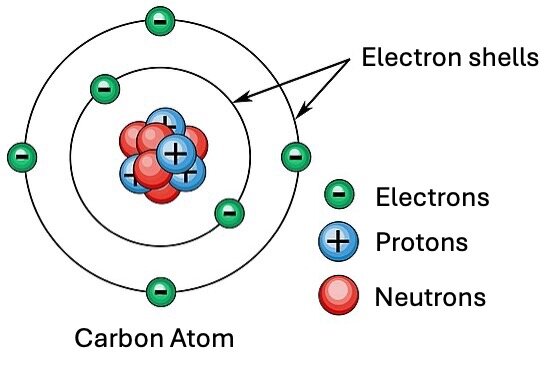
An atom has three main ingredients: protons, neutrons, and electrons. Each plays a distinct role in an atom's structure and behavior.
Proton
noun
A subatomic particle with a positive electric charge, found within the atomic nucleus.
Neutron
noun
A subatomic particle with no electric charge (it's neutral), found within the atomic nucleus.
Electron
noun
A subatomic particle with a negative electric charge that orbits the atomic nucleus.
Inside the Atom
Imagine a tiny, dense core with a vast, mostly empty space around it. That's a decent picture of an atom.
The core is called the nucleus, and it's where the protons and neutrons are packed together. Because protons and neutrons are about 2,000 times more massive than electrons, nearly all of an atom's mass is concentrated in its nucleus. The positive charge of the protons in the nucleus is what keeps the negatively charged electrons in orbit.
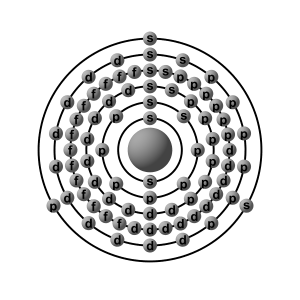
Electrons don't just wander aimlessly. They occupy specific energy levels called shells. Think of these like concentric spheres around the nucleus. Each shell can only hold a certain number of electrons. The first shell, closest to the nucleus, holds up to two. The second holds up to eight, and so on. The arrangement of electrons in these shells is what dictates an element's chemical properties and how it interacts with other atoms.
Atomic Identity and Isotopes
What makes one element different from another? The answer is simple: the number of protons. Every single atom of hydrogen has one proton. Every atom of helium has two. If you change the number of protons, you change the element entirely. This defining number is called the atomic number.
But the number of neutrons can vary. Atoms of the same element that have different numbers of neutrons are called isotopes. For example, all carbon atoms have six protons. But they can have six, seven, or even eight neutrons.
The total number of protons and neutrons in an atom's nucleus is called its mass number. So, the carbon isotope with 6 protons and 6 neutrons is called carbon-12. The one with 6 protons and 8 neutrons is carbon-14.
While isotopes of an element have the same chemical properties (because they have the same number of electrons), their nuclear properties can be very different. Some isotopes are stable, while others are unstable and radioactive. This difference in nuclear stability is the key to understanding nuclear energy and radioactivity.
An element is defined by its number of protons. An isotope is defined by its number of neutrons.
Now that you've got the basics down, let's test your knowledge.
What are the three main subatomic particles that make up an atom?
The atomic number of an element is determined by the number of which particle?
With a solid grasp of atomic structure, we have the foundation needed to explore the powerful forces locked within the nucleus.