Nuclear Energy Explained
Atomic Structure
The Building Blocks of Matter
Everything you see is made of atoms. They are the fundamental building blocks of all matter. But atoms themselves are made of even smaller pieces called subatomic particles.
The center of an atom is the nucleus, a dense core packed with two types of particles: protons and neutrons. Protons have a positive electric charge, while neutrons have no charge at all. Swirling around the nucleus in a cloud-like region are electrons, which have a negative electric charge. An atom in its neutral state has an equal number of protons and electrons, balancing the charges out.
The number of protons defines what element an atom is. An atom with one proton is always hydrogen. An atom with six protons is always carbon. This number is called the atomic number. But what about the neutrons?
Atomic Variations
While the number of protons in an element is fixed, the number of neutrons can vary. Atoms of the same element that have different numbers of neutrons are called isotopes.
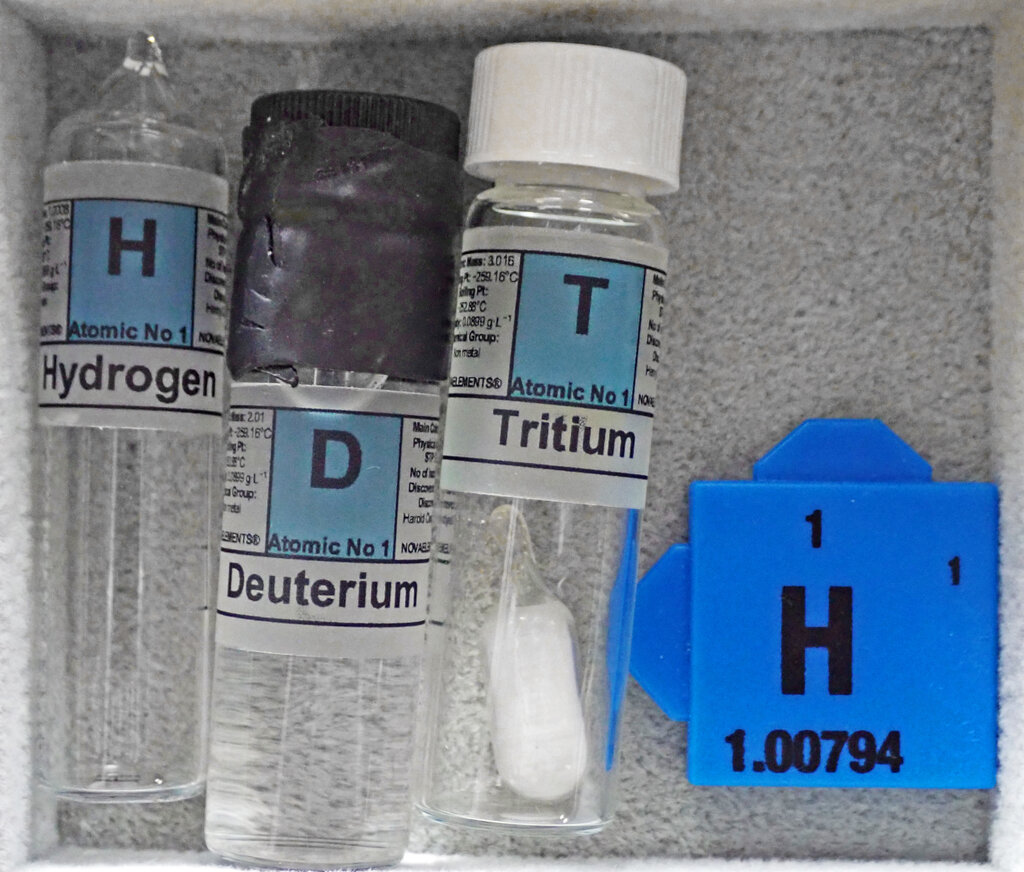
Take hydrogen, the simplest element. Most hydrogen atoms consist of just one proton and one electron, with no neutrons. But some hydrogen atoms have one neutron, and others have two. These isotopes are known as deuterium and tritium, respectively. They are all still hydrogen because they each have one proton, but their different neutron counts give them different masses and properties.
We identify isotopes by their mass number, which is the total count of protons and neutrons in the nucleus. For example, Uranium-235 and Uranium-238 are two isotopes of uranium. Both have 92 protons, but U-235 has 143 neutrons (), while U-238 has 146 neutrons (). This difference in neutron count is crucial because it affects the stability of the nucleus.
Holding It All Together
The nucleus is a very crowded place. If you remember that like charges repel, you might wonder how a bunch of positively charged protons can be packed so tightly together without flying apart. The answer is a powerful, fundamental force of nature.
strong nuclear force
noun
The fundamental force that binds protons and neutrons together in the atomic nucleus, overcoming the electrostatic repulsion between protons.
This force is incredibly strong, but only at the tiny distances found inside a nucleus. It acts like a superglue, holding the protons and neutrons (collectively called nucleons) together. Neutrons play a key role here. They contribute to the strong nuclear force, adding to the 'glue' without adding any of the electrostatic repulsion that pushes protons apart. The stability of an atom’s nucleus depends on the delicate balance between the repulsive force between protons and the attractive strong nuclear force holding everything together.
An imbalance in the number of protons and neutrons can make a nucleus unstable. Unstable nuclei have excess energy and may eventually break apart or change to become more stable, a process that is the basis for nuclear energy.
Let's review these core concepts before moving on.
Now, test your understanding of the atom's structure and the forces at play within it.
What are the three primary subatomic particles that make up an atom?
An atom's identity as a specific element is determined by its number of ______.
With this foundation, we're ready to explore what happens when that nuclear stability is pushed to its limits.