Nuclear Bomb Design Principles
Introduction to Nuclear Fission
Splitting the Atom
Imagine an atomic nucleus as a tightly packed cluster of protons and neutrons. For most elements, this cluster is stable and holds together firmly. But for some very heavy elements, the nucleus is so large and crowded that it's inherently unstable, like a precariously balanced tower of blocks.
fission
noun
The action of dividing or splitting something into two or more parts.
Nuclear fission is the process of splitting these heavy, unstable nuclei. It doesn't happen on its own. It needs a nudge. This nudge typically comes from a stray neutron. When a neutron with just the right amount of energy strikes the nucleus of a fissionable atom, the nucleus absorbs it. This extra particle makes the nucleus wobble violently and, within a fraction of a second, split into two or more smaller, lighter nuclei. These smaller nuclei are called fission fragments.
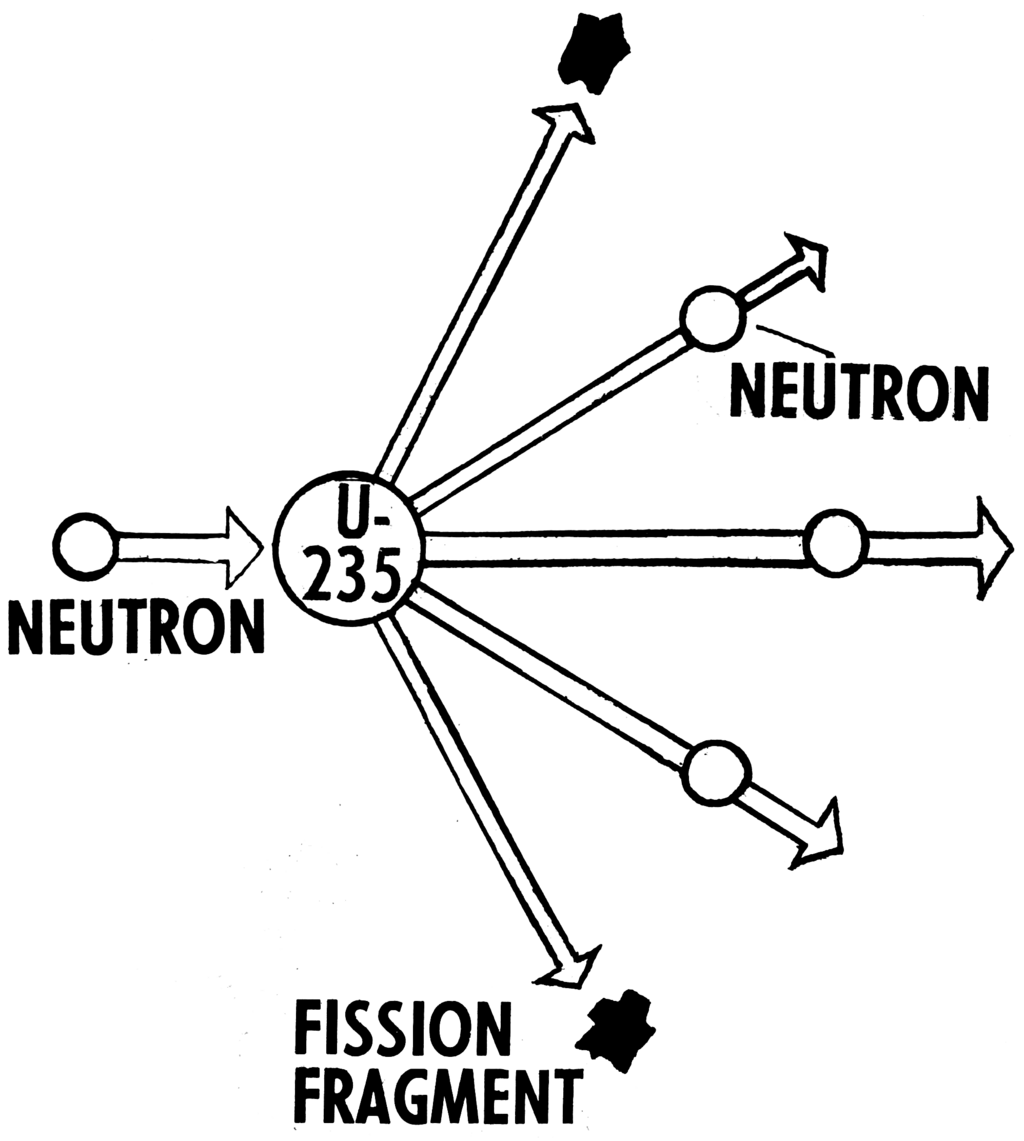
A common material used for this process is an isotope of uranium called uranium-235 (U). Another is plutonium-239 (Pu). These are known as fissionable materials because their nuclei can be readily split by neutrons.
A Cascade of Neutrons
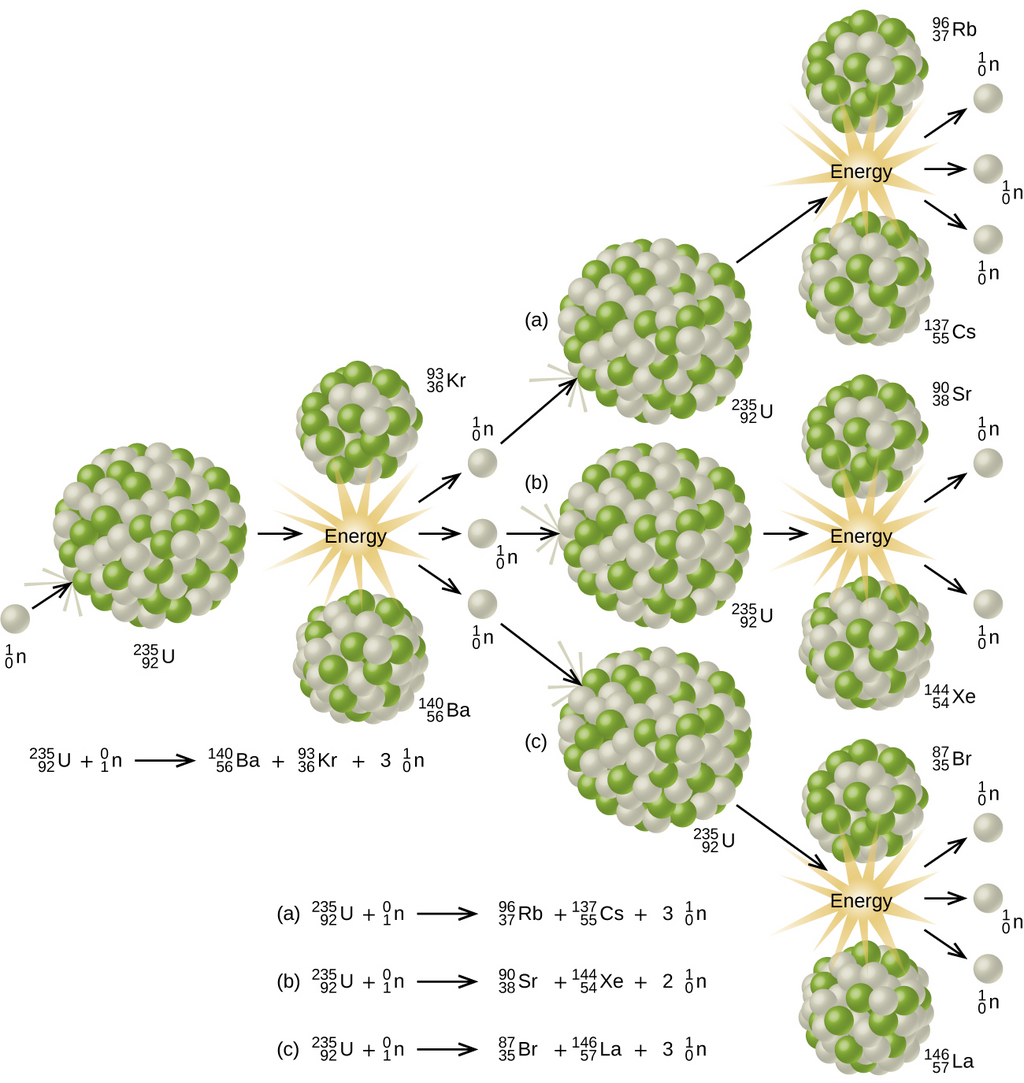
The splitting of one nucleus is interesting, but the real power of fission comes from what’s released along with the fission fragments. The process also frees two or three additional neutrons.
Each of these newly released neutrons can fly off and strike other fissionable nuclei, causing them to split as well. Each of those fissions, in turn, releases more neutrons, which can trigger even more fissions. This cascading effect is the basis for a self-sustaining chain reaction.
Where Does the Energy Come From?
The immense energy released by fission comes from the conversion of mass into energy. If you were to carefully measure the mass of the original nucleus and the incoming neutron, and then measure the combined mass of all the fission fragments and the neutrons released, you'd find something surprising. The total mass after the split is slightly less than the total mass before.
This tiny amount of
missing mass
hasn't actually vanished. It has been converted directly into energy, following Albert Einstein's famous equation:
In this equation, is energy, is the lost mass, and is the speed of light. Because the speed of light () is an enormous number, and it's squared in the equation, even a minuscule amount of mass is converted into a tremendous amount of energy. Most of this energy is released as the kinetic energy of the fission fragments and neutrons flying apart at high speed, which translates into heat.
Let's test your understanding of these concepts.
What is the primary trigger for initiating nuclear fission in a heavy, unstable nucleus like uranium-235?
During a fission event, the total mass of the resulting fission fragments and released neutrons is slightly less than the total mass of the original nucleus and the incoming neutron. This 'lost' mass is...