Notating Piano Expressions
Introduction to Musical Notation
The Musical Canvas
Musical notation is a system that lets us write down sounds. At its heart is the staff: a set of five lines and four spaces. Each line and space represents a specific musical pitch. Higher pitches are written higher on the staff, and lower pitches are written lower.
But the staff alone doesn't tell us which specific notes to play. For that, we need a clef. A clef is a symbol at the beginning of the staff that assigns a particular pitch to one of the lines. For piano, we use two clefs on two staves, which together form the grand staff.
The top staff uses the treble clef (or G-clef), which is for higher notes, typically played with the right hand. The bottom staff uses the bass clef (or F-clef), which is for lower notes, typically played with the left hand.
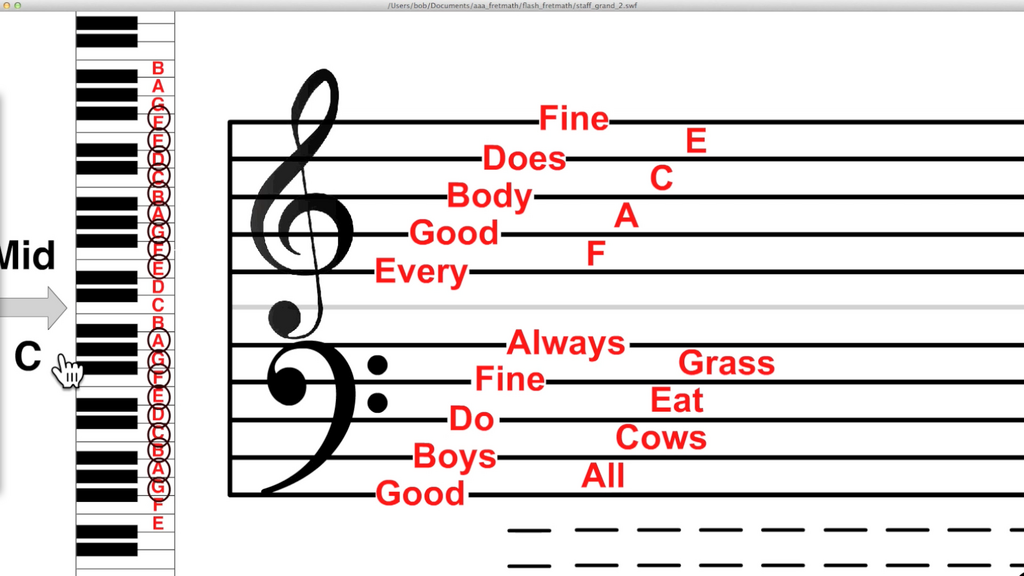
The grand staff gives you a complete map of the notes on the piano. Learning to read the notes on both clefs is the first step to playing any piece of music from a score.
Sound and Silence
Notes tell us two things: what pitch to play and how long to hold it. The duration of a note is shown by its shape. The most common note values are the whole note, half note, and quarter note.
A half note is held for half the duration of a whole note. A quarter note is held for a quarter of the duration of a whole note. This pattern continues with eighth notes, sixteenth notes, and so on.
Music isn't just about sound; silence is equally important. In notation, periods of silence are marked by rests. Each note value has a corresponding rest of the same duration.
| Note Value | Duration | Corresponding Rest |
|---|---|---|
| Whole Note | 4 beats | Whole Rest |
| Half Note | 2 beats | Half Rest |
| Quarter Note | 1 beat | Quarter Rest |
| Eighth Note | 1/2 beat | Eighth Rest |
A whole rest looks like a small rectangle hanging from the fourth line of the staff, while a half rest looks like a rectangle sitting on the third line. This distinction is key to reading rhythms correctly.
Keeping Time
To organize notes and rests into a steady pulse, we use a time signature. This is a pair of numbers at the beginning of a piece of music, right after the clef. The most common time signature is 4/4, often called "common time."
In 4/4 time, the top number tells us there are four beats in every measure. The bottom number tells us that a quarter note gets one beat.
A measure is a segment of music between two vertical lines called bar lines. In 4/4 time, the total duration of all notes and rests in a single measure must add up to four quarter-note beats. You could have one whole note, two half notes, four quarter notes, or any other combination that equals four beats.
Understanding these core elements, the staff, clefs, note values, and time signatures, provides the foundation for reading any piece of piano music. By learning this language, you can begin to decode the composer's intentions and bring the music to life.