No-Code RAG Chatbot Creation
Understanding RAG
Giving Chatbots a Library
Large Language Models (LLMs) are powerful, but they have a fundamental limitation: they only know what they were taught during their training. Their knowledge is frozen in time. An LLM trained in 2023 wouldn't know who won the World Series in 2024 or the details of your company's latest product launch. It's like talking to a brilliant historian who hasn't read a newspaper in a year.
Furthermore, these models don't have access to private, specific information, like your internal company documents or personal emails. How do we give them access to current or proprietary knowledge? This is where Retrieval-Augmented Generation comes in.
Retrieval-Augmented Generation
noun
An AI framework that enhances a language model's response by first retrieving relevant information from an external knowledge source and then using that information to generate a more accurate and context-aware answer.
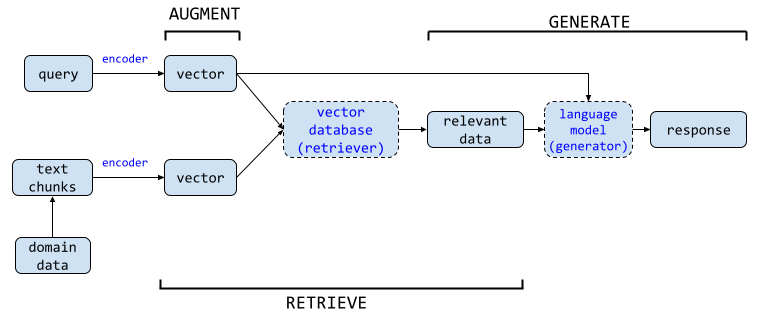
The name sounds complex, but the idea is simple. It combines two processes: retrieving information and generating a response. Instead of just relying on its pre-existing knowledge, the model first retrieves facts from an up-to-date or specialized database. Then, it uses those facts to generate a thoughtful answer.
Retrieval-Augmented Generation (RAG) is an AI framework that connects a language model to an external knowledge repository, allowing the model to fetch and include relevant information when generating an answer.
Think of it like an open-book exam. The LLM is the smart student, and the external data source is the textbook they can consult before writing their essay. This process allows the model to ground its answers in specific, verifiable facts, making its responses much more reliable.
Why RAG Matters
Integrating a retrieval step provides several key benefits, transforming a standard chatbot into a highly capable, specialized assistant.
Up-to-date and Accurate: RAG systems can provide information about recent events because they can pull from data sources that are constantly updated. This also reduces the chance of the model "hallucinating" or making up incorrect facts.
By grounding the LLM in a specific set of documents, you ensure its answers align with the facts you provide. You're not trying to change the model's core training; you're just giving it the right information to work with for a specific query.
Domain-Specific Expertise: A business can connect a chatbot to its own private knowledge base. This could be anything from technical manuals and HR policies to customer support logs. The result is a chatbot that acts as an expert on that specific domain.
RAG in the Real World
Many of the most useful chatbots today rely on RAG. For example, a customer service bot on an e-commerce site doesn't just know about products in general. It uses RAG to access the company's live inventory database to answer specific questions like, "Do you have this shirt in blue?" or "What's the status of my recent order?"
Similarly, an internal helpdesk bot for a large corporation can retrieve information from the latest IT security policies or HR benefits documents. When an employee asks, "What is the company's policy on remote work?" the bot can provide an answer based on the most current handbook, not on outdated information it might have learned during its initial training.
This ability to connect generative AI to specific, current knowledge is what makes RAG so powerful for building practical, real-world applications.
What is the primary limitation of Large Language Models (LLMs) that Retrieval-Augmented Generation (RAG) is designed to address?
The "Retrieval" step in RAG refers to the process of: