Ninth Grade Functions Explained
Understanding Functions
What is a Function?
Think of a vending machine. You press a button for a specific snack—let's say B4 for pretzels. You expect to get pretzels, and only pretzels. You wouldn't be happy if the machine sometimes gave you chips and other times gave you a candy bar for that same button press. The machine's rule is simple: one button, one specific outcome.
In mathematics, a function works just like that vending machine. It’s a rule that takes an input and gives you back exactly one output. For every input, there is a single, predictable result. This reliability is the most important idea behind functions.
The golden rule of functions: each input must have exactly one output.
If you put the number 2 into a function that doubles any number it receives, it will always give you 4. It will never give you 4 on Monday and 5 on Tuesday. This consistency is what makes functions so powerful and useful.
Domain and Codomain
To understand functions fully, we need two more concepts: domain and codomain. They help define the world a function lives in.
domain
noun
The set of all possible inputs that a function can accept.
In our vending machine analogy, the domain is the set of all buttons that correspond to an item in the machine. If a button is for an empty slot, it's not in the domain.
codomain
noun
The set of all potential outputs a function could produce.
The codomain for our vending machine is the entire collection of snacks it is designed to carry, even if some are sold out. It’s the universe of possible results. The actual outputs you can get (the items that are in stock) form a subset of the codomain called the range.
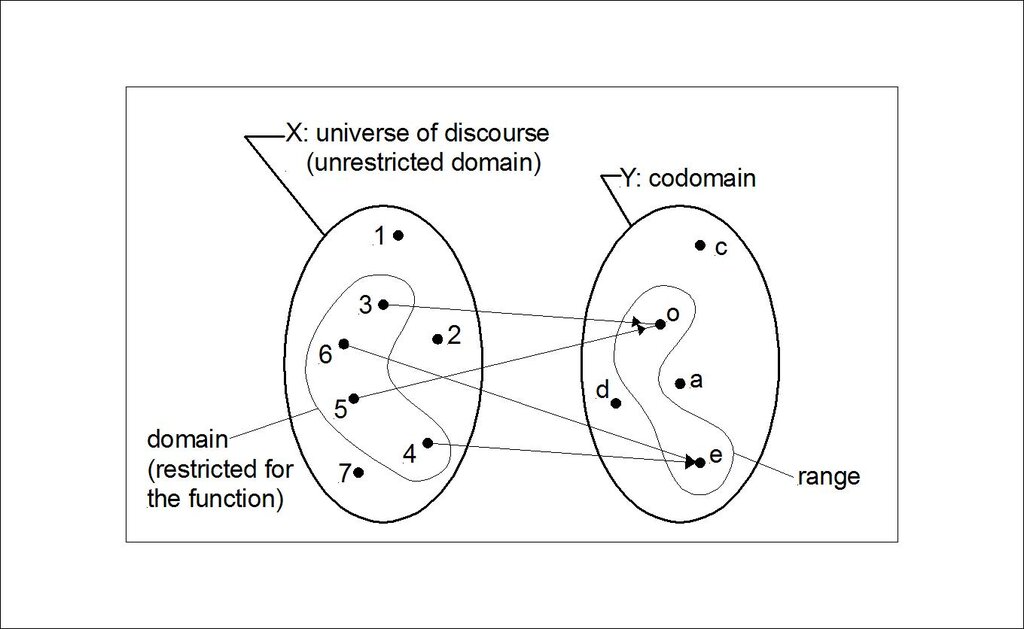
Functions vs. Non-Functions
The key is to remember the "one output" rule. Let's look at some examples to see what is a function and what isn't.
Consider the relationship between people and their birthdays. The input is a person, and the output is their date of birth. Is this a function? Yes, because each person has only one birthday.
Now, what about the relationship between a person and their siblings? The input is a person, and the output is their sibling. This is not a function, because one person can have multiple siblings. The input could lead to several different outputs.
| Relationship | Is it a function? | Why? |
|---|---|---|
| Input: A book's ISBN number. Output: The book's title. | Yes | Each unique ISBN corresponds to exactly one title. |
| Input: An email address. Output: The person who owns it. | Yes | An email address is unique to one person (or account). |
| Input: A movie title. Output: The actors in it. | No | A movie has many actors, so one input yields multiple outputs. |
The difference always comes down to whether the output is ambiguous. If an input can give you more than one result, it’s not a function.
Functions All Around Us
Functions aren't just abstract math concepts; they describe relationships in the world all the time.
Think about driving a car at a steady speed. The distance you've traveled is a function of time. For any specific amount of time you've been driving, you are at one specific distance from where you started. One hour in, you might be 60 miles away. You can't be both 60 miles and 70 miles away at the exact same moment.
Another example is temperature. There's a specific formula to convert Celsius to Fahrenheit. If you input 20°C, the output is always 68°F. It's a reliable, predictable relationship—making it a perfect example of a function.
Ready to check your understanding? Let's see how well you've grasped the idea of a function.
What is the most important rule that defines a relationship as a function?
A person's height is a function of their age. Is this statement true or false?
Understanding functions is the first step toward exploring more complex mathematical relationships that describe our world.