Nietzsche's God is Dead
Introduction to Nietzsche
Who Was Friedrich Nietzsche?
Friedrich Nietzsche was a German philosopher who spent the late 19th century challenging just about every accepted idea on morality, religion, and culture. His writing is bold, often poetic, and designed to provoke. To understand his ideas, it helps to know a bit about the man himself.
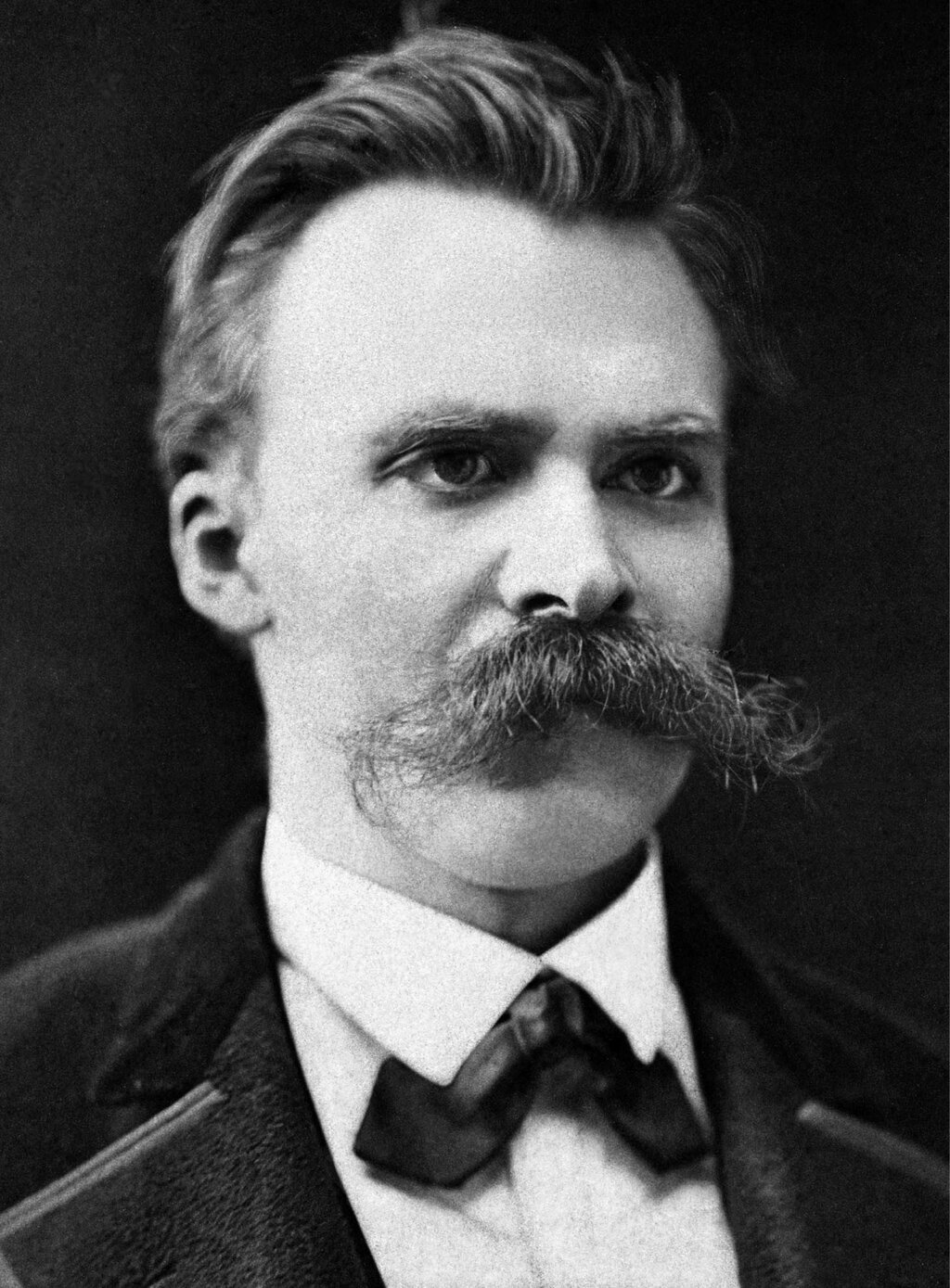
Born in 1844 in a small Prussian village, Nietzsche grew up in a devoutly religious household; his father was a Lutheran pastor. He was a brilliant student and became a professor of classical philology—the study of ancient Greek and Roman texts—at the University of Basel in Switzerland at the remarkably young age of 24.
However, academic life didn't suit him. Plagued by severe health problems, he resigned his professorship in 1879. For the next decade, he lived a nomadic existence, wandering through Italy, France, and Switzerland, writing the books that would make him famous. This period of intense creativity came to an abrupt end in 1889 when he suffered a complete mental collapse, from which he never recovered. He spent the last decade of his life in a state of mental incapacity, cared for by his mother and sister until his death in 1900.
A World in Flux
Nietzsche wrote during a time of immense change in Europe. The 19th century was an era of industrialization, scientific discovery, and political turmoil. Old certainties were crumbling. The authority of the church, which had been the foundation of European society for centuries, was weakening under the rise of scientific rationalism and secular thought. Charles Darwin's theory of evolution, published in 1859, had profoundly shaken traditional religious beliefs about humanity's place in the universe.
This atmosphere of questioning and upheaval is the backdrop for all of Nietzsche's philosophy. He saw a civilization that was losing its traditional values but had not yet found anything to replace them. He believed this created both a great danger and a great opportunity for humanity.
Major Works and Themes
Nietzsche's most productive years resulted in a flurry of influential books. Each has a unique style, from collections of short, sharp aphorisms to a grand, prophetic narrative.
“Friedrich Nietzsche, a German philosopher from the late 19th century, profoundly influenced modern thought with his critique of traditional morality and his advocacy for individualism.”
Two of his most important works are The Gay Science and Thus Spoke Zarathustra.
In The Gay Science (1882), he explores art, morality, and knowledge with a light, experimental touch. It's in this book that he first introduces one of his most famous and misunderstood phrases: "God is dead."
Thus Spoke Zarathustra, written between 1883 and 1885, is completely different. It's a philosophical novel written in a poetic, biblical style. It tells the story of a fictional prophet named Zarathustra who comes down from a mountain to teach humanity. This is where Nietzsche introduces core concepts like the Übermensch (often translated as "Overman" or "Superman")—an ideal figure who creates their own values—and the will to power, the fundamental drive he believed was behind all human action.
For Nietzsche, the will to power isn't about dominating others. It's about self-mastery and the drive to grow, create, and overcome challenges.
Across his work, Nietzsche consistently questioned the origins and value of traditional morality. He argued that what we often call "good" was a set of values created by the weak to restrain the strong. He wanted individuals to break free from this herd mentality and create their own values, a process he called "self-overcoming."
Nietzsche's ideas were radical for his time and remain challenging today. He saw the decline of religious faith not as something to celebrate, but as a crisis that required a new way of thinking about human life and meaning. We will explore his famous declaration about this crisis in the next section.
What was Friedrich Nietzsche's profession before he resigned due to poor health to become a full-time philosopher?
Which historical and intellectual development served as a major backdrop for Nietzsche's philosophy?