NFT Utility Beyond Art
Introduction to NFTs
What Makes Something Non-Fungible?
Let's start with a simple idea: fungibility. Something is fungible if it's interchangeable with another identical item. Think about a dollar bill. If you and a friend each have a one-dollar bill and you swap them, you both still have exactly one dollar. The bills are different pieces of paper, but they hold the same value and can be used in the same way. They're fungible.
Fungible
adjective
Able to be replaced by another identical item; mutually interchangeable.
Now, what about something that isn't fungible? Think about the Mona Lisa. There's only one original. You could have a perfect replica, but it wouldn't be the same thing. It doesn't have the same history, authenticity, or value. The Mona Lisa is non-fungible.
This is where Non-Fungible Tokens, or NFTs, come in. An NFT is a unique digital identifier that can’t be copied, substituted, or subdivided, that is recorded in a blockchain, and that is used to certify authenticity and ownership.
In simple terms, an NFT is like a digital certificate of ownership for a unique item, whether that item is digital or physical.
NFTs vs. Cryptocurrencies
It's a common point of confusion, but NFTs are not cryptocurrencies. While both use similar blockchain technology, their core purpose is different. Cryptocurrencies like Bitcoin or Ethereum are fungible. One Bitcoin is always equal in value to another Bitcoin, just like our dollar bill example. This makes them great for use as currency.
NFTs, on the other hand, are non-fungible. Each one is unique and has a distinct value. You can't trade one NFT for another and assume they're equivalent, just as you wouldn't trade a famous painting for a concert ticket and call it an even swap.
| Feature | Cryptocurrency (e.g., Bitcoin) | Non-Fungible Token (NFT) |
|---|---|---|
| Fungibility | Fungible (Interchangeable) | Non-Fungible (Unique) |
| Divisibility | Divisible into smaller units | Indivisible (Cannot be split) |
| Value | Uniform value per unit | Each token has a unique value |
| Represents | A unit of currency or value | Ownership of a unique asset |
Another key difference is divisibility. You can own a fraction of a Bitcoin, like 0.005 BTC. But you can't own a fraction of an NFT. An NFT represents a whole, single item and cannot be broken down into smaller parts. This indivisibility is crucial for proving ownership of a specific, unique asset.
The Blockchain Backbone
So how does an NFT prove ownership of something that could be easily copied, like a digital image? The answer lies in the blockchain.
A blockchain is a decentralized, distributed, and public digital ledger that is used to record transactions. Think of it as a shared digital checkbook that's duplicated and spread across thousands of computers worldwide. Once a transaction is added to this checkbook, it's incredibly difficult to change.
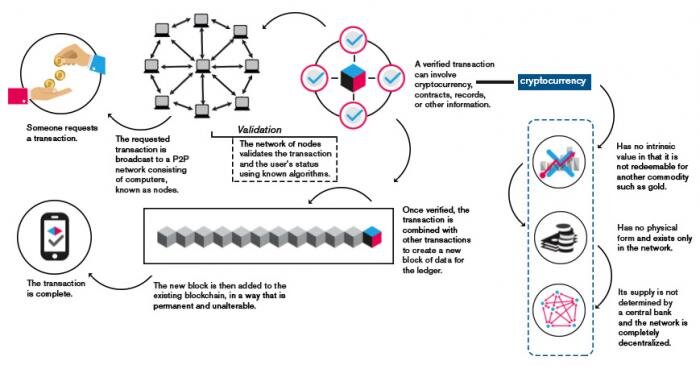
When an NFT is created, or "minted," its information is stored on a blockchain. This information includes a unique ID, its creation date, and a history of every time it has been bought or sold. Because this ledger is public and maintained by a vast network of computers, anyone can verify the authenticity and ownership history of an NFT.
This system of verification is what gives an NFT its power. It provides a secure and transparent way to prove you own the original version of a digital file, even if countless copies of that file exist.
NFTs, or non-fungible tokens, are unique digital assets secured by a blockchain.
Ready to test your knowledge? Let's see what you've learned about the basics of NFTs.
Which of the following best describes something that is fungible?
What is the primary function of a Non-Fungible Token (NFT)?
NFTs introduce a new way of thinking about ownership in the digital world. By understanding their unique, indivisible, and verifiable nature, you're ready to explore their exciting applications.