NFT Utility Beyond Art
Introduction to NFTs
What Makes an NFT Unique?
At its core, a Non-Fungible Token (NFT) is a one-of-a-kind digital certificate of ownership. It lives on a blockchain, which is a secure and transparent digital ledger. Think of an NFT as a digital deed or a title for an item, proving you own the original version.
The key to understanding NFTs is the term "non-fungible." It sounds technical, but the concept is straightforward. Something that is fungible can be replaced by another identical item. A dollar bill is fungible; you can trade it for any other dollar bill, and you still have a dollar. A bitcoin is also fungible; one bitcoin is worth the same as any other bitcoin.
Non-fungible items, however, are unique. They cannot be replaced one-for-one. The Mona Lisa is non-fungible. Your house is non-fungible. There might be copies or similar houses, but there's only one original.
An NFT attaches a unique, verifiable identity to a digital file, making it possible to truly own something in the digital world.
This simple idea has powerful implications. Before NFTs, it was difficult to prove ownership of a digital file. Anyone could copy and paste an image or a song, and the copy would be identical to the original. NFTs solve this by creating a public record of ownership that can't be altered.
Non-fungible tokens (NFTs) turn anything into something that can be digitally collected and traded, from a meme to the source code of the World Wide Web.
How Are They Different from Crypto?
Both NFTs and cryptocurrencies like Bitcoin or Ethereum are built on blockchain technology, but they serve very different purposes. The main difference lies in that concept of fungibility.
Cryptocurrencies are designed to be a form of digital money. Their value comes from being interchangeable, allowing them to function as a consistent medium of exchange. You wouldn't care which specific bitcoin you received in a transaction, as long as you received the correct amount.
NFTs, on the other hand, are designed to be unique. Each NFT represents a specific asset and has its own distinct value. You wouldn't trade a digital artwork NFT for a virtual concert ticket NFT and expect them to be the same. They represent entirely different things with different values.
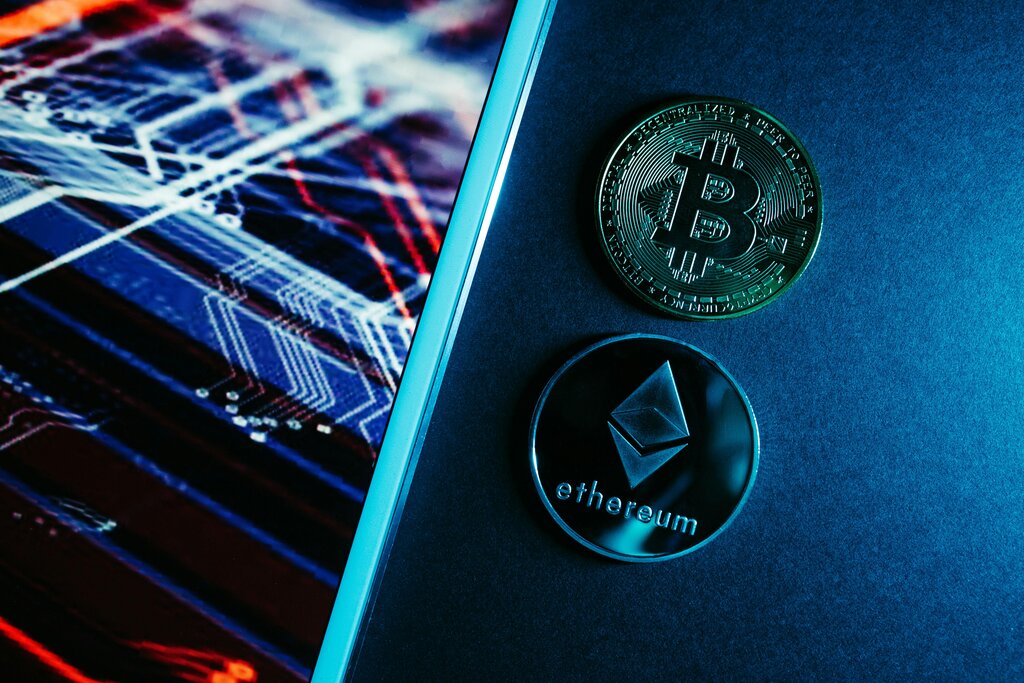
Here's a quick breakdown of the key differences:
| Feature | Cryptocurrency (e.g., Bitcoin) | NFT (Non-Fungible Token) |
|---|---|---|
| Interchangeable | Yes (Fungible) | No (Non-Fungible) |
| Purpose | Digital money, medium of exchange | Digital proof of ownership |
| Value | Uniform; one coin equals another | Unique; each token has a different value |
| Represents | A unit of currency | A specific, unique asset |
| Divisible | Yes, can be broken into smaller units | Generally no, cannot be divided |
The Blockchain Backbone
NFTs wouldn't exist without the underlying technology of the blockchain. A few core principles of blockchain make digital ownership possible.
First is decentralization. Instead of being stored in one central place (like a bank's server), the blockchain ledger is copied and spread across a network of thousands of computers. This means no single person or company can control it or secretly alter the records.
Second is immutability. Once a transaction—like the creation or sale of an NFT—is added to the blockchain, it's permanent. It cannot be changed or deleted. This creates an unbreakable chain of custody, a clear and public history of who has owned the asset from the moment it was created.
Finally, there are smart contracts. These are programs stored on the blockchain that automatically run when preset conditions are met. For an NFT, the smart contract defines its properties, manages ownership transfer, and can even include rules like giving the original artist a percentage of all future sales. It's the code that brings an NFT to life and enforces its rules without needing a middleman.
A Brief History
Though they exploded in popularity in 2021, the idea behind NFTs has been around for nearly a decade. The first experiment, called Colored Coins, appeared on the Bitcoin blockchain around 2012. It was a way to "color" or mark specific bitcoins to represent other assets, like property or stocks.
However, the concept truly took shape on the Ethereum blockchain, which offered more robust smart contract capabilities. In 2017, two projects brought NFTs into the spotlight. The first was CryptoPunks, a collection of 10,000 unique pixel-art characters. Shortly after, a game called CryptoKitties launched, allowing users to buy, sell, and breed unique digital cats.
The game became so popular that it famously slowed down the entire Ethereum network. While it may have seemed silly at the time, CryptoKitties demonstrated that digital items could have real-world value and that people were excited by the idea of verifiable digital scarcity.
These early projects, focused on digital art and collectibles, laid the groundwork for the diverse applications of NFTs we see emerging today.
What is the primary function of a Non-Fungible Token (NFT)?
Which of the following items is the best example of something that is 'non-fungible'?