Next-Generation Sequencing Essentials
Introduction to NGS
Reading the Book of Life, Faster
Imagine trying to read an entire library, but you can only read one word at a time from a single book. That’s what reading DNA used to be like. Scientists had a method, but it was slow and incredibly expensive. Sequencing a single human genome took over a decade and cost billions of dollars.
Next-Generation Sequencing, or NGS, changed everything. It’s a powerful technology that allows us to read DNA and RNA sequences much more quickly and cheaply than ever before. Instead of reading one word at a time, NGS is like having a million tiny machines reading all the books in the library at once, in parallel.
This massive increase in speed and reduction in cost has revolutionized biology and medicine. It unlocked the ability to routinely sequence entire genomes, study complex diseases, and even identify new organisms from an environmental sample.
A Leap in Scale
The traditional method, called Sanger sequencing, was revolutionary in its day. It worked by reading a single fragment of DNA at a time, base by base. While highly accurate for small pieces of DNA, it was not practical for sequencing an entire genome, which in humans contains about 3 billion base pairs.
NGS takes a different approach. It breaks the entire genome into millions of small, manageable fragments. Then, it sequences all of these fragments simultaneously. This parallel process is what makes NGS so powerful. It generates a massive amount of sequence data in a fraction of the time and cost.
| Feature | Traditional Sequencing (Sanger) | Next-Generation Sequencing (NGS) |
|---|---|---|
| Throughput | Low (one DNA fragment at a time) | High (millions of fragments at once) |
| Speed | Slow (days to weeks for one gene) | Fast (hours to days for a whole genome) |
| Cost | High per base | Low per base |
| Application | Sequencing single genes or fragments | Whole-genome sequencing, disease panels, etc. |
The General Workflow
While there are different types of NGS platforms, they all follow the same fundamental three-step workflow: sample preparation, sequencing, and data analysis.
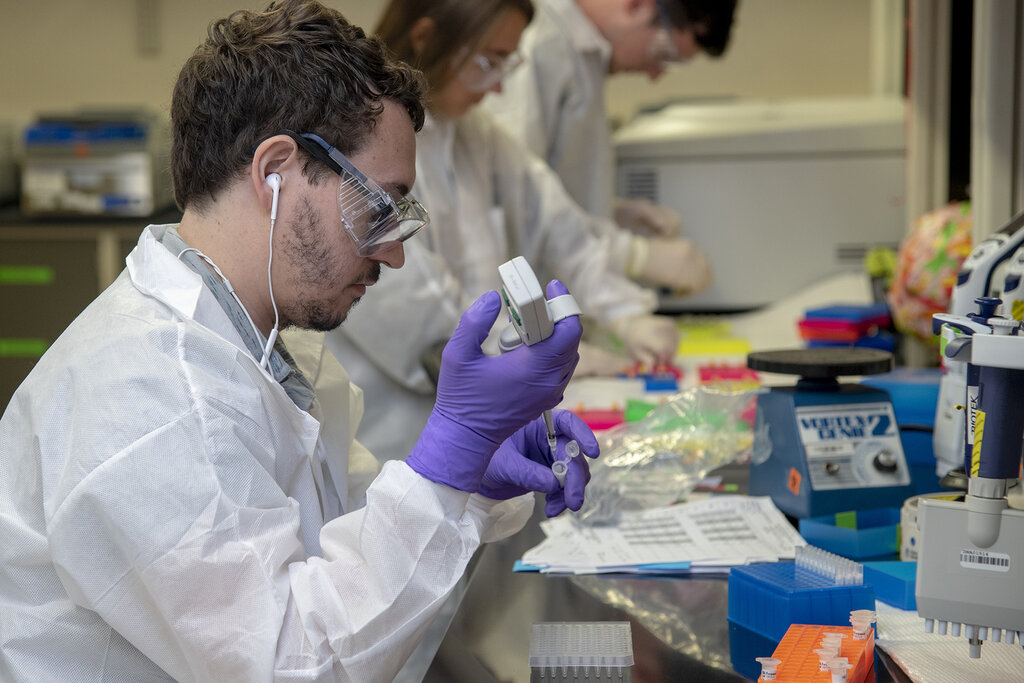
1. Sample Preparation Before DNA can be sequenced, it must be carefully prepared. First, the long strands of DNA are fragmented into shorter pieces of a specific size. Then, small DNA tags called adapters are attached to the ends of these fragments. These adapters act like handles, allowing the fragments to attach to the sequencing machine and providing starting points for the reading process. This entire collection of prepared DNA fragments is called a library.
2. Sequencing This is the reading step. The prepared library is loaded into the sequencing machine. Inside, the fragments attach to a surface called a flow cell. The machine then reads the sequence of bases (A, C, G, and T) for each fragment, one base at a time. As each base is added, it emits a signal, usually a flash of light, which is captured by a camera. This process is repeated millions of times across the entire flow cell, generating a massive dataset of short DNA "reads."
3. Data Analysis After the sequencing run, the result is a huge collection of millions of short, jumbled DNA reads. The final step is to use powerful computers and specialized software to piece this puzzle together. The short reads are aligned to a known reference genome (like the human genome) or assembled from scratch to reconstruct the original DNA sequence. From this final sequence, scientists can identify genetic variations, analyze gene expression, and make new discoveries.
What is the primary advantage of Next-Generation Sequencing (NGS) compared to traditional Sanger sequencing?
Which of the following correctly lists the three fundamental steps of the NGS workflow in order?
This three-step process—prepare, sequence, analyze—is the core of how NGS has transformed our ability to explore the genetic world.