Next Generation Green Energy Systems
High Efficiency Photovoltaics
Beyond Silicon's Ceiling
For decades, silicon has been the undisputed workhorse of the solar industry. It's reliable and relatively cheap. But single-junction silicon cells are approaching their theoretical performance limit. This ceiling, known as the Shockley-Queisser limit, dictates the maximum possible efficiency for a single solar cell material.
Shockley-Queisser Limit
noun
The maximum theoretical efficiency of a single p-n junction solar cell. For crystalline silicon, this limit is approximately 29.4%. It arises because a single material can only efficiently convert photons of a specific energy level (its band gap), while photons with less energy pass through and excess energy from higher-energy photons is lost as heat.
To break past this barrier, engineers are stacking different semiconductor materials together in what are called tandem solar cells. The strategy is to layer materials with different band gaps, allowing the cell to capture a broader range of the solar spectrum. The top layer absorbs high-energy photons (like blue light), while lower-energy photons (like red light) pass through to be absorbed by the bottom layer.
The most promising combination today is a perovskite top cell layered onto a traditional silicon bottom cell. Perovskites are a class of materials with a specific crystal structure that are exceptionally good at absorbing light. This design has shattered efficiency records, with labs like Oxford PV and LONGi pushing efficiencies toward 35%, well beyond what silicon could ever achieve alone.
This layering approach allows the tandem cell to convert more of the sun's energy into electricity, reducing the two main sources of loss defined by the Shockley-Queisser limit: sub-bandgap losses (photons with too little energy) and thermalization losses (excess energy from high-energy photons).
The Two-Sided Panel
Another path to higher energy yield doesn't involve changing the cell chemistry, but rather the panel's physical design. Bifacial panels are designed to capture sunlight on both their front and back sides. This allows them to generate power not just from direct sunlight, but also from light that reflects off the ground or other surfaces behind the panel.
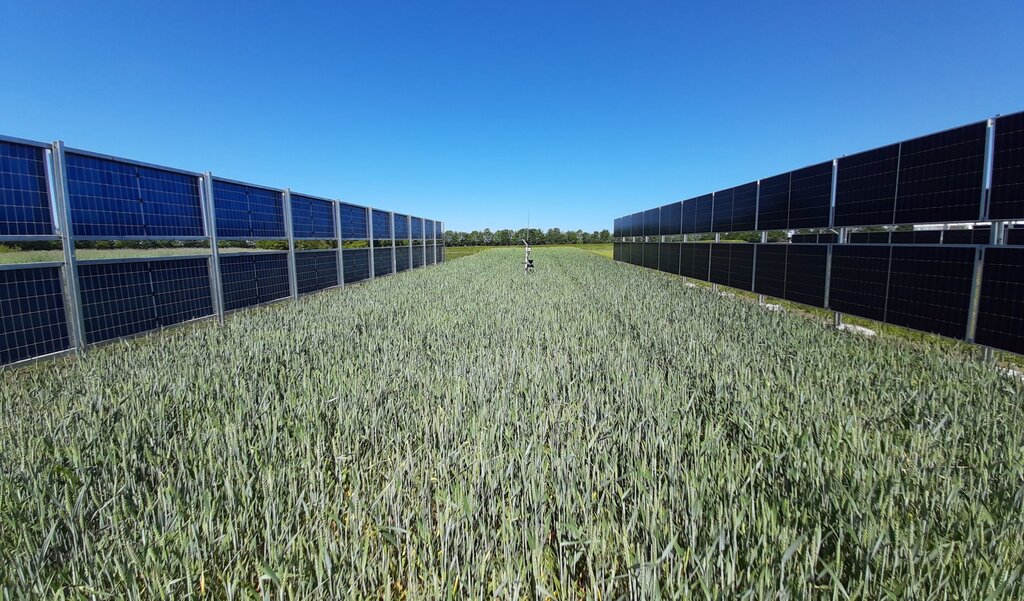
The extra energy produced by the rear side is called bifacial gain. This gain can be significant, sometimes boosting a panel's total energy output by up to 30% compared to a traditional monofacial panel in the same location. The key factor determining bifacial gain is the reflectivity of the surface behind the panel, a property known as albedo.
| Surface | Typical Albedo (%) |
|---|---|
| Fresh Snow | 80 - 95% |
| White Concrete | 70 - 80% |
| Sand | 20 - 40% |
| Grass | 10 - 25% |
| Water | ~10% |
| Asphalt | 5 - 10% |
A panel installed over a white, reflective roof or light-colored sand will have a much higher bifacial gain than one installed over dark soil or grass. Mounting also plays a crucial role. To maximize performance, bifacial panels need to be elevated higher off the ground than monofacial panels to allow more reflected light to reach the rear surface. The tilt angle must also be optimized to balance front-side direct sunlight capture with rear-side reflected light capture.
From Lab to Market
Despite their record-breaking efficiencies, perovskite-silicon tandem cells face a major hurdle on their path to commercialization: durability. Perovskite materials are notoriously sensitive to moisture, oxygen, and heat, which can cause them to degrade relatively quickly. A solar panel is expected to last 25 years or more, and early perovskite cells fell far short of this standard.
Record-breaking efficiency in the lab means little without the stability to last for decades on a rooftop.
The primary engineering challenge is developing advanced encapsulation techniques. This involves sealing the delicate perovskite cell in a protective, airtight barrier that prevents environmental factors from reaching it, without blocking light or adding too much cost. Researchers are also experimenting with different chemical recipes for the perovskite itself to create more inherently stable compounds.
For any new solar technology to succeed, it must be 'bankable'. This means that financial institutions must be confident enough in its long-term performance and reliability to finance large-scale projects. To achieve this, companies must provide extensive data from third-party validators like the National Renewable Energy Laboratory (NREL), proving their panels can withstand years of real-world conditions. Recent NREL benchmarks for 2025 have set stringent durability targets that new technologies must meet before they can achieve widespread adoption.
Companies are making progress. Oxford PV, a spinoff from the University of Oxford, has begun producing the world's first commercial tandem cells, and their initial performance data is promising. Meanwhile, manufacturers like LONGi continue to set new world records for efficiency in laboratory settings, pushing the technology forward.
The transition is underway. While silicon will remain a key player, high-efficiency technologies like tandem and bifacial cells represent the future of solar power, promising more energy from smaller spaces and pushing the boundaries of what's possible.
What fundamental concept defines the maximum theoretical efficiency for a solar cell made from a single semiconductor material?
How do perovskite-on-silicon tandem solar cells surpass the efficiency of traditional silicon-only cells?