Newton's Physics Foundations
Newton's Laws of Motion
Things Keep Doing What They're Doing
Imagine a football sitting on the grass. It won't spontaneously start rolling. It stays put. Now, imagine that same ball rolling across the field. It won't suddenly stop or swerve unless something gets in its way, like friction from the grass or the goalie's boot.
This simple observation is the core of Newton's First Law of Motion, often called the law of inertia. It describes an object's natural tendency to resist changes in its state of motion. If it's at rest, it wants to stay at rest. If it's moving, it wants to keep moving at a constant velocity, which means at the same speed and in the same direction.
An object will remain at rest or in uniform motion in a straight line unless acted upon by an external force.
You feel this law every day. When a bus you're on suddenly brakes, your body continues to move forward. That's your inertia at work. Your body wants to keep moving at the speed the bus was travelling. The bus stops, but you don't, until you grab a handrail or bump into the seat in front of you. That handrail provides the external force needed to change your state of motion.
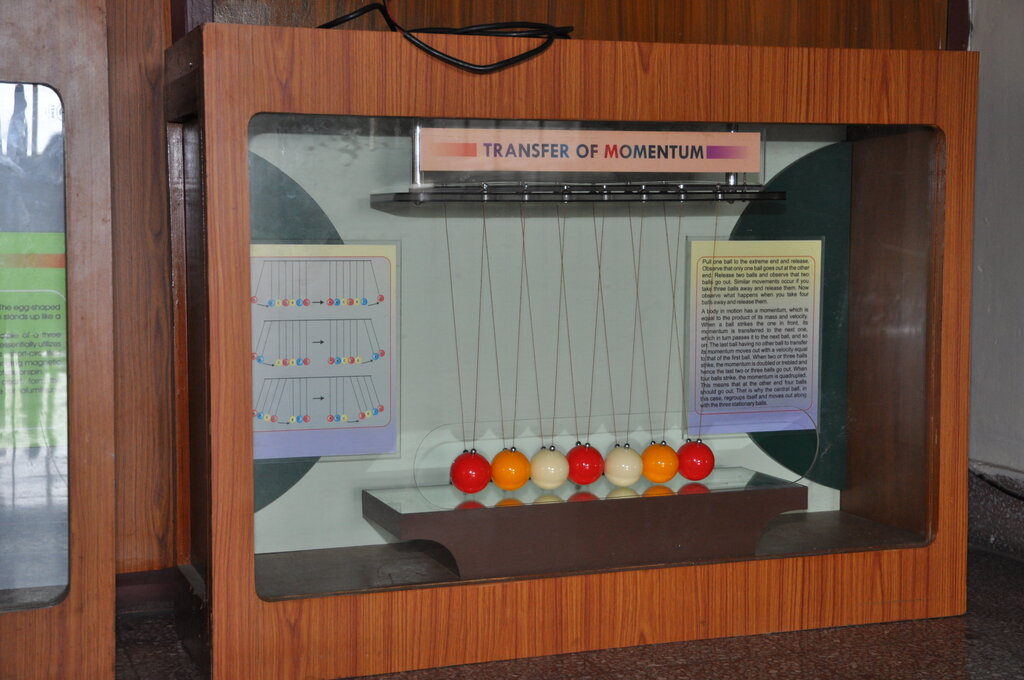
Force, Mass, and Acceleration
The First Law tells us what happens when there's no net force. But what happens when there is one? That's where Newton's Second Law comes in. It provides a precise, mathematical relationship between force, mass, and acceleration.
This law states that the acceleration of an object is directly proportional to the net force acting on it and inversely proportional to its mass. In simpler terms, if you push something, it will speed up. Push it harder, and it will speed up faster. If the object is heavier (has more mass), you'll need to push harder to get the same acceleration.
Think about pushing a shopping trolley. An empty trolley is easy to get moving; a small force results in a large acceleration. But a trolley piled high with groceries has much more mass. You have to exert a much greater force to get it accelerating at the same rate. This is F = ma in action.
Action and Reaction
Forces never exist in isolation. They always come in pairs. This is the essence of Newton's Third Law. It states that for every action, there is an equal and opposite reaction. This means that whenever one object exerts a force on a second object, the second object simultaneously exerts a force back on the first that is equal in magnitude and opposite in direction.
For every action, there is an equal and opposite reaction.
This can be a tricky concept. A common mistake is to think the forces cancel each other out. They don't, because they act on different objects. When a rocket expels hot gas downwards (the action), the gas pushes the rocket upwards with an equal and opposite force (the reaction). The force on the gas makes it shoot downwards, while the force on the rocket makes it launch into the sky.
Another example is swimming. To move forward, a swimmer pushes water backward with their hands and feet. This is the action. The water, in turn, pushes the swimmer forward. This is the reaction. The force on the water pushes it back, and the equal and opposite force on the swimmer propels them through the pool.
Putting It All Together
These three laws don't operate in isolation; they work together to describe nearly all motion in our everyday world. Consider driving a car.
To start moving, the engine causes the tyres to rotate. The tyres push backward on the road (Action). The road pushes forward on the tyres with an equal and opposite force (Reaction), which is the force that moves the car. This is Newton's Third Law.
The forward force from the road is the net force that causes the car to accelerate, according to Newton's Second Law (). The more massive the car, the more force is needed from the engine to achieve the same acceleration.
Once the car is cruising at a constant speed, you might think the forces disappear, but they don't. The forward force from the road is now balanced by opposing forces like air resistance and friction. The net force is zero, so the car's acceleration is zero. It continues to move at a constant velocity, just as Newton's First Law predicts. If the driver hits the brakes, the brake pads create a frictional force that opposes the motion, causing the car to decelerate and eventually stop.
Ready to test your understanding of these fundamental principles?
According to Newton's First Law, an object in motion will stay in motion with a constant velocity unless what happens?
A swimmer pushes backward on the water to move forward. The force the water exerts on the swimmer is the __________.
From the planets orbiting the sun to the simple act of walking, Newton's three laws provide the fundamental framework for understanding motion. They are the bedrock of classical mechanics.