Newton's Laws of Motion
Introduction to Newton's Laws
The Rules of Motion
For centuries, people thought the natural state of any object was to be at rest. If you pushed a box, it would slide for a bit and then stop. To keep it moving, you had to keep pushing. It seemed obvious that motion required a constant force. Then, in the 17th century, Isaac Newton came along and turned this idea on its head. He proposed three fundamental laws that govern how objects move. These laws became the bedrock of classical mechanics, the physics of our everyday world.
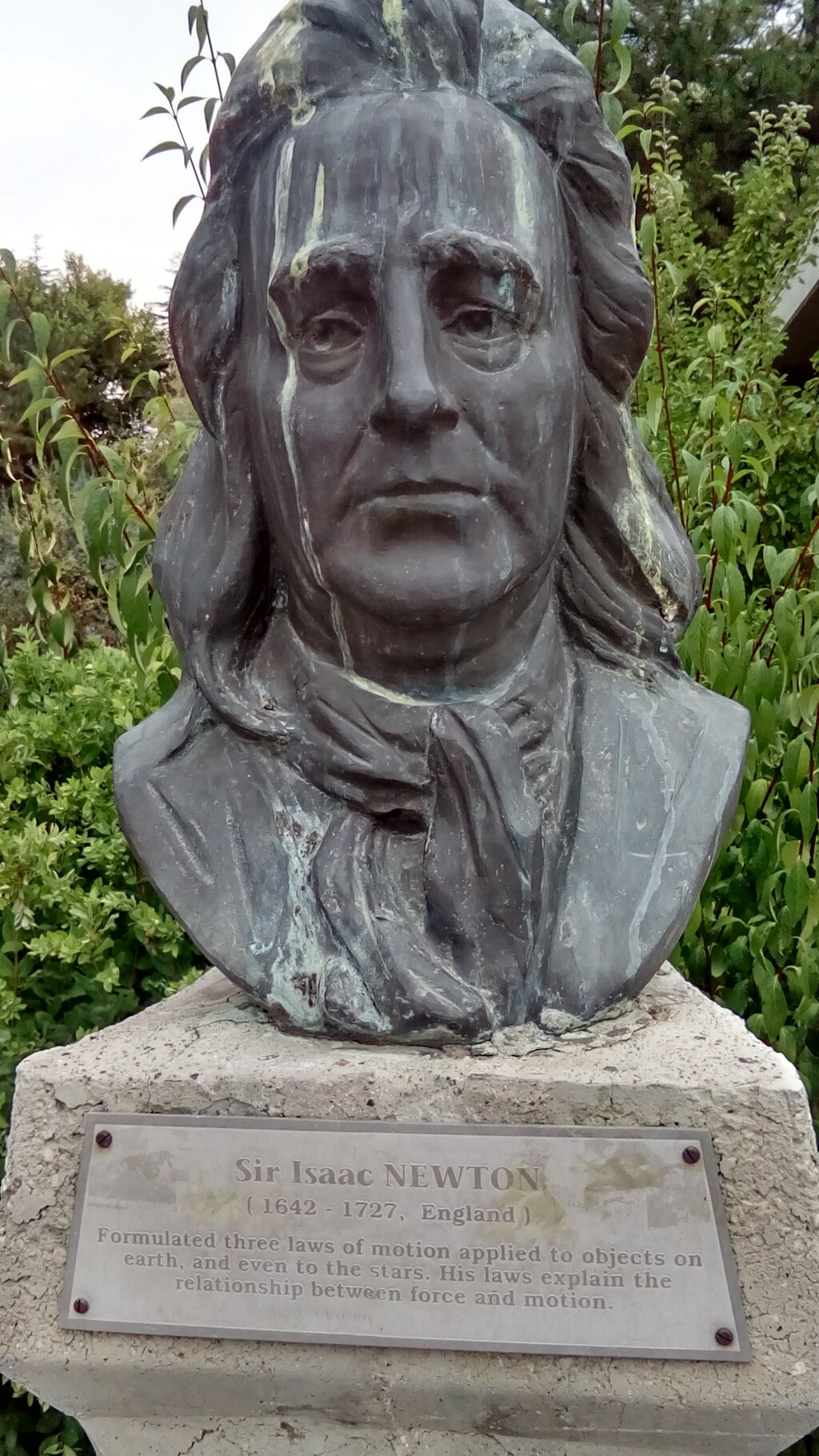
The First Law: Inertia
Newton's first law says that an object will keep doing whatever it's already doing unless an outside force messes with it. If it's sitting still, it will stay still. If it's moving, it will continue moving in a straight line at a constant speed.
Think about a hockey puck gliding across a perfectly smooth sheet of ice. Once you push it, it seems to go on forever. That's the first law in action. The reason a box stops when you push it across the floor isn't because its natural state is rest. It stops because of an outside force you might not see: friction. Friction is what opposes the motion.
This tendency of an object to resist changes in its state of motion is called inertia.
Inertia
noun
The property of matter by which it continues in its existing state of rest or uniform motion in a straight line, unless that state is changed by an external force.
In short: Objects don't change their motion on their own. They need a push or a pull.
The Second Law: Force, Mass, and Acceleration
The first law describes what happens when there's no net force. The second law tells us what happens when there is a net force. It's one of the most famous equations in all of physics.
It states that the acceleration of an object is directly proportional to the net force applied to it and inversely proportional to its mass. This means if you push harder on an object, it accelerates more. It also means if you apply the same push to a more massive object, it accelerates less.
Imagine pushing a small shopping cart and a heavily loaded one. To get the heavy cart moving at the same rate as the light one, you need to push much harder. That's the second law in action. This relationship is captured in a simple, powerful formula.
Here, is the net force, is the mass of the object, and is its acceleration. This equation doesn't just describe motion; it gives us a precise way to calculate it.
The Third Law: Action and Reaction
Newton's third law is often quoted but sometimes misunderstood. It says that for every action, there is an equal and opposite reaction. This means that forces always come in pairs. You can't have a single, isolated force.
If you push on a wall, the wall pushes back on you with the exact same amount of force. When a rocket expels gas downwards (the action), the gas pushes the rocket upwards (the reaction). The forces are equal in strength but point in opposite directions.
This might seem strange. If the forces are equal and opposite, how does anything ever move? The key is that the forces act on different objects. The rocket pushes on the gas, and the gas pushes on the rocket. Since the rocket has much more mass than the gas it expels, the same force produces a much smaller acceleration for the rocket, but it's enough to send it to space.
According to Newton's First Law, what will an object in motion do if no external net force acts on it?
Which of Newton's laws is represented by the formula ?
Together, these three laws provide a complete framework for understanding the motion of objects in the world around us, from a thrown baseball to the orbits of planets.