Newton's Laws of Motion Explained
Introduction to Newton's Laws
The Rules of Motion
In the late 17th century, a brilliant thinker named Isaac Newton changed our understanding of the universe. He published a book called Philosophiæ Naturalis Principia Mathematica, or "Principia" for short. In it, he laid out three fundamental laws that describe how objects move. These weren't just random ideas; they were a complete system for explaining motion, from a falling apple to the orbit of the moon.
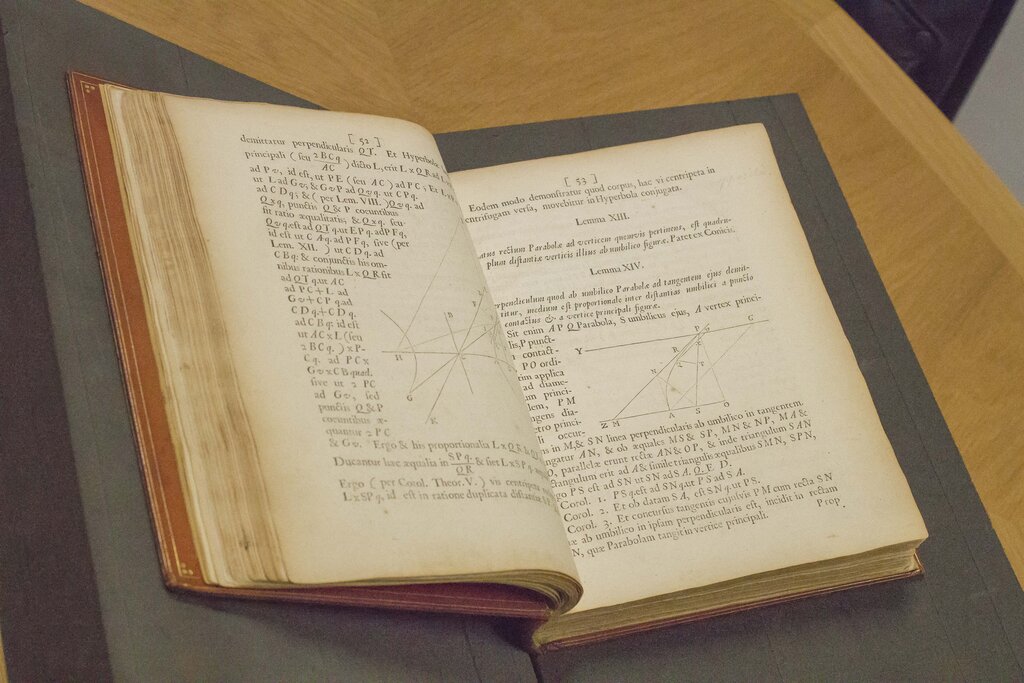
Newton's laws are the foundation of classical mechanics, the branch of physics that deals with the motion of everyday objects. They give us a precise way to connect forces with changes in motion. Let's look at each one.
The First Law: Inertia
Newton's first law states that an object at rest will stay at rest, and an object in motion will stay in motion with the same speed and in the same direction, unless an outside force acts on it. This property of resisting changes in motion is called inertia.
inertia
noun
The tendency of an object to resist a change in its state of motion.
Think about a hockey puck gliding across a smooth sheet of ice. It travels in a straight line at a constant speed for a long time. Why? Because the force of friction is very low. If you slid that same puck across a rough carpet, it would stop quickly because the force of friction is much higher.
The first law tells us that motion doesn't need a cause. Constant, steady motion is just as natural as being at rest. What needs a cause, or a force, is a change in motion, which we call acceleration.
The Second Law: Acceleration
This brings us to the second law, which explains what happens when a force does act on an object. It says that the acceleration of an object is directly proportional to the net force acting on it and inversely proportional to its mass. In simpler terms, the harder you push something, the faster it accelerates. And the heavier something is, the harder you have to push to get it to accelerate at the same rate.
Pushing a small cart is easy. Pushing a heavy car requires a much larger force to get it moving at the same rate.
This law is crucial because it gives us a quantitative relationship between force, mass, and acceleration. It's the key to calculating how an object's motion will change when forces are applied to it.
The Third Law: Action and Reaction
Newton's third law is perhaps the most famous: for every action, there is an equal and opposite reaction. This means that forces always come in pairs. If one object exerts a force on a second object, the second object simultaneously exerts a force back on the first that is equal in magnitude and opposite in direction.
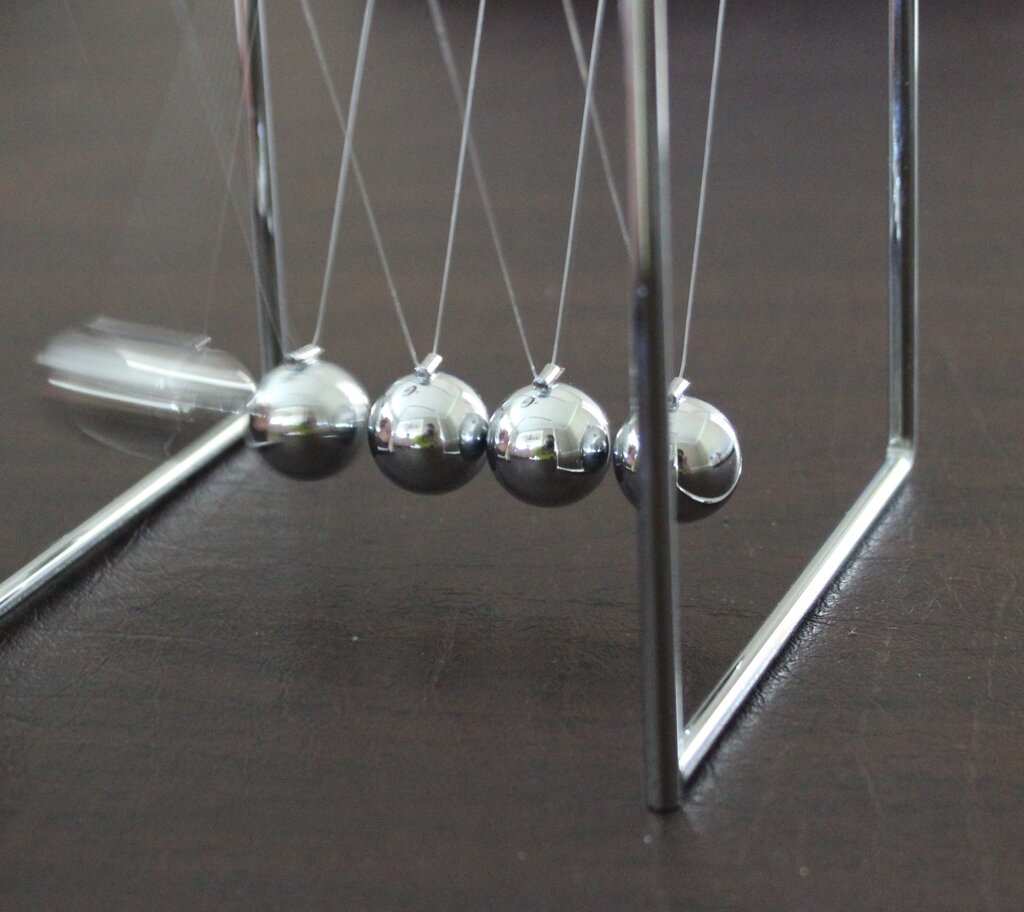
When you stand on the ground, you are pushing down on the Earth, and the Earth is pushing up on you with an equal force. When a rocket expels gas downwards, the gas pushes the rocket upwards. These action-reaction pairs are everywhere, governing every interaction in the universe.
Dynamics introduces the study of motion and the forces that cause it, building on principles from statics and mechanics.
Together, these three laws form a complete framework for understanding why things move the way they do. They were a monumental achievement in the history of science, providing the tools to analyze the mechanics of our world with stunning accuracy.
Ready to check your understanding of these foundational principles?
Which of Newton's laws is also known as the law of inertia?
A hockey puck slides across a frictionless sheet of ice at a constant velocity. This is a direct example of which principle?