Newtonian Mechanics and Applications
Vector Force Summation
Why Direction Matters
You already know that a force is a push or a pull. But in physics and engineering, the magnitude of that push or pull is only half the story. The other half is its direction. Force is a vector, meaning it has both magnitude and direction. Simply adding up the numbers, as you would with scalars like mass or temperature, can give you a wildly incorrect picture of what’s actually happening to an object.
Consider two people trying to move a heavy box. If they both push on the same side, their forces combine, and the box moves. If they push on opposite sides with equal force, the box goes nowhere. The magnitudes are the same, but the directions are different, leading to a completely different outcome. This is the core of vector force summation.
When multiple forces act on a single point, we call it a concurrent force system A classic example is a traffic light hanging from cables. Several cables pull on the central point where they all meet, but the light remains stationary because the forces are balanced. Understanding how to sum these vector forces is the first step to analyzing any structure, from a simple stoplight to a massive bridge.
Breaking Forces Down
Adding vectors graphically, by drawing them head-to-tail, is intuitive but not very practical for complex problems. The standard analytical method is to break each force down into its components along a Cartesian coordinate system (x, y, and z axes).
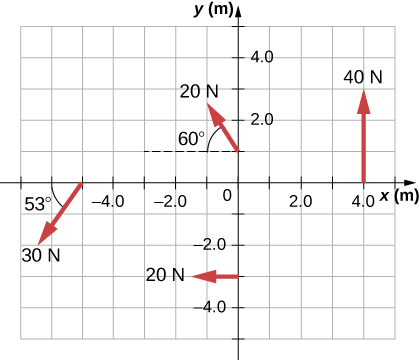
For any force vector in a 2D plane, we can find its horizontal (x-component) and vertical (y-component) effects. This process is called vector decomposition. If we know the force's magnitude, , and the angle, , it makes with the positive x-axis, we can use basic trigonometry to find its components.
Once every force in a system is broken down into its components, the rest is simple arithmetic. You add all the x-components together to get the total x-component of the net force, which we'll call . You do the same for the y-components to find .
and . The symbol (sigma) just means 'sum of'.
Now you have the components of the resultant force, . To find its overall magnitude and direction, we just reverse the process. We use the Pythagorean theorem to find the magnitude and the arctangent function to find the angle.
Forces in 3D and Equilibrium
The real world isn't flat, and forces often act in three dimensions. Think of the cables supporting a large crane boom. They pull up, back, and sideways all at once. The good news is that the same component method works perfectly. We just add a z-axis.
A force vector in 3D can be written using s, which are vectors of length one that point along the x, y, and z axes. They are denoted by , , and , respectively.
To find the resultant of several 3D forces, you sum the components for each axis, just as before:
The resultant vector is . Its magnitude is found using the 3D version of the Pythagorean theorem: .
This brings us to a crucial concept in statics: equilibrium. An object is in equilibrium when it is not accelerating. According to Newton's Second Law (), this happens when the net force is zero. For a particle to be in equilibrium, the vector sum of all forces acting on it must be zero.
For equilibrium, . This means , , and .
In an engineering context, like a cable-stayed bridge, this is the goal. The tension forces in all the cables and the compression force in the tower must perfectly balance the bridge's weight and the load of traffic. If they don't, the bridge will accelerate, which is another word for 'collapse'. By ensuring the sum of the force components in every direction is zero, engineers ensure the structure is stable and safe.
Why is force considered a vector quantity?
A system where multiple forces act on a single point is known as a __________.
By decomposing forces into components, we can turn a complex geometry problem into simple arithmetic. This is the fundamental skill needed to apply Newton's Laws to any real-world scenario involving multiple forces.