Neurotransmission Explained
Neurons and Synapses
The Brain's Messengers
Your nervous system is built from specialized cells called neurons. Think of them as the wiring of your body's internal internet, carrying messages that control everything from your thoughts to your heartbeat. Each neuron is a tiny information processor with three main parts.
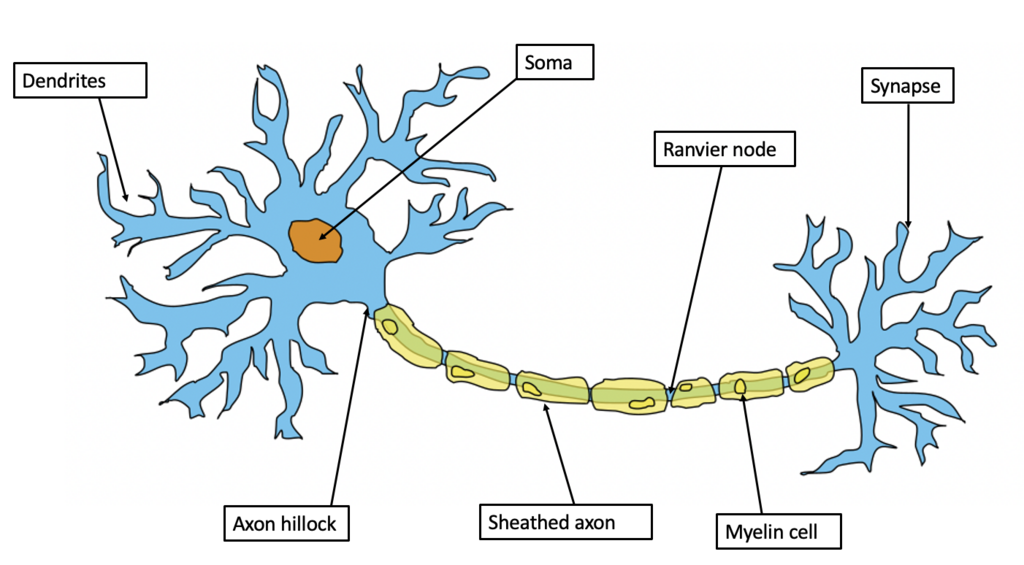
First is the cell body, or soma. This is the neuron's command center, containing the nucleus and other machinery to keep the cell alive and functioning. Branching out from the cell body are dendrites, which act like antennas, receiving signals from other neurons.
Finally, a long, cable-like fiber called the axon extends from the cell body. Its job is to transmit signals away from the neuron, carrying the message to the next cell in the chain. Many axons are wrapped in a fatty substance called the myelin sheath, which acts like insulation on a wire, helping the signal travel much faster.
The Action Potential
How does a neuron send a message? It uses a rapid, temporary change in electrical charge called an action potential. It's an all-or-nothing event. Once the neuron receives enough input at its dendrites to reach a certain threshold, it fires. A wave of electrical activity zips down the axon from the cell body to the axon's tip.
This impulse is not like electricity flowing through a wire. Instead, it's a chain reaction. The signal at one point on the axon triggers the next point, and so on, like a line of falling dominoes. This ensures the message travels the full length of the axon without weakening.
The action potential is the fundamental electrical signal that allows neurons to communicate over long distances.
Crossing the Synapse
But what happens when the signal reaches the end of the line? Neurons don't physically touch each other. There's a microscopic gap between the axon tip of one neuron and the dendrite of the next. This junction is called a synapse, and the gap itself is the synaptic cleft.
An electrical signal can't jump across this gap. To pass the message along, the neuron switches from an electrical signal to a chemical one.
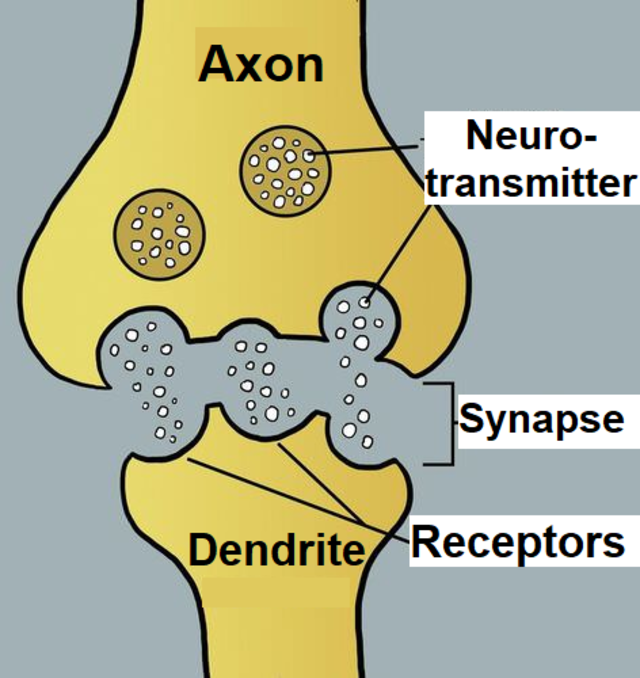
When the action potential arrives at the axon terminal, it triggers the release of chemicals called neurotransmitters. These molecules are stored in tiny sacs called synaptic vesicles. The vesicles merge with the cell membrane and release their contents into the synaptic cleft.
The neurotransmitters drift across the tiny gap and bind to specific proteins called receptors on the dendrite of the receiving neuron. This binding action is like a key fitting into a lock. When the neurotransmitter key unlocks the receptor, it opens a channel, causing a change in the electrical state of the receiving neuron.
If enough neurotransmitters bind and the change is strong enough, it will trigger a new action potential in the second neuron, and the message continues on its way. In this way, a signal is passed from one cell to the next, converting from electrical to chemical and back to electrical again.
Let's check your understanding of how these signals work.
Which part of a neuron is primarily responsible for receiving signals from other neurons?
True or False: The myelin sheath slows down the electrical signal as it travels down the axon.
This elegant process of synaptic transmission is the foundation of all nervous system activity, from simple reflexes to complex thought.