Neuron Structure and Function
Neuron Basics
The Brain's Messengers
Your nervous system is a vast, complex network that controls everything you do, from breathing to thinking. The fundamental units of this network are specialized cells called neurons. Think of them as the electrical wiring of your body, carrying messages at high speeds to and from your brain.
Neurons are fundamental structural and functional building blocks of the brain
These cells are responsible for receiving information from the outside world, processing it, and transmitting commands to your muscles and glands. To understand how the nervous system works, we first need to understand the structure of a single neuron.
Anatomy of a Neuron
While neurons can vary in shape and size, most share three basic parts. Each part plays a critical role in the process of communication.
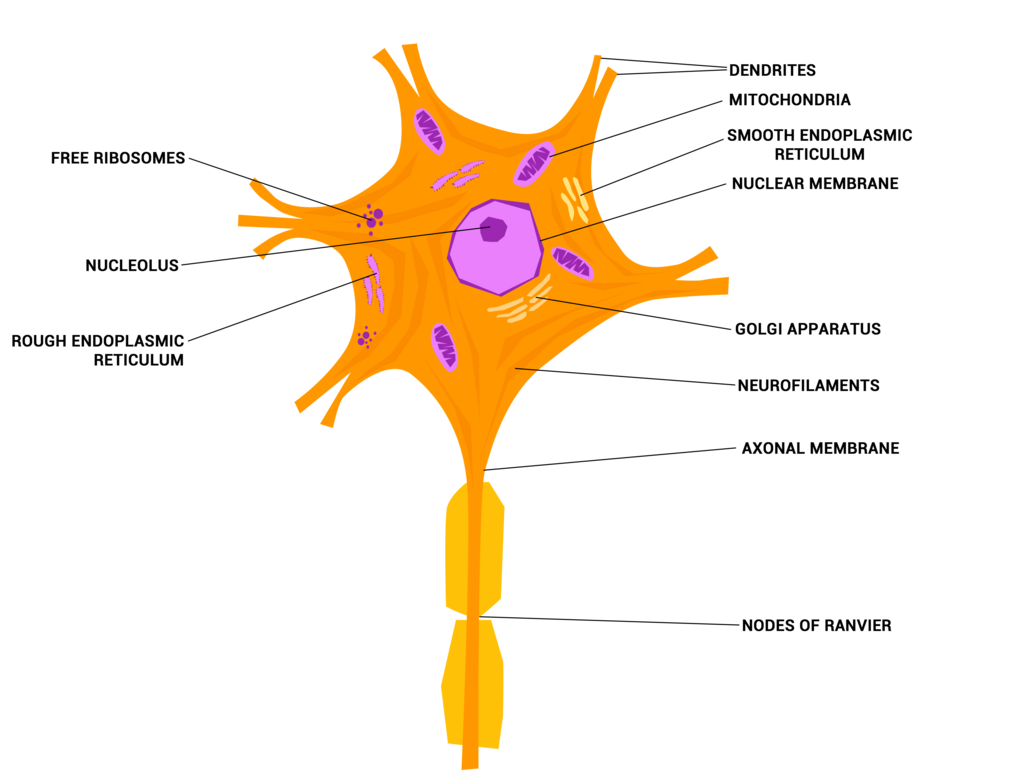
At the center of it all is the cell body, or soma. Like other cells in your body, the soma contains a nucleus, which holds the cell's genetic material. The soma is the neuron's command center, providing the energy and proteins needed to keep the cell alive and functioning.
soma
noun
The cell body of a neuron, which contains the nucleus and other organelles.
Branching out from the cell body are dendrites. These extensions look like the branches of a tree, and their job is to receive incoming signals from other neurons. You can think of them as the neuron's antennas, constantly listening for messages.
The third part is the axon, a long, cable-like projection that carries signals away from the cell body to other neurons, muscles, or glands. It acts as the primary transmission line of the nervous system. Many axons are insulated by a fatty substance called myelin, which helps speed up the electrical signal.
How Neurons Talk
Communication happens in a one-way flow. A signal is received by the dendrites, processed in the cell body, and then sent down the axon to its end. At the axon's tip, the message is passed to the next neuron's dendrites, and the process repeats.
Dendrites listen, axons talk. This simple rule governs the flow of information throughout the entire nervous system.
This chain of communication, from one neuron to the next, is what allows you to feel, think, and act. Billions of these tiny messengers work together in intricate circuits to create the complex symphony of the human experience.
What is the primary function of a neuron's dendrites?
Which part of the neuron contains the nucleus and is considered the cell's 'command center'?
That's a quick look at the basic building block of your nervous system. Grasping this structure is the first step toward understanding how your brain works.