Neuromorphic Vision Applications
Introduction to Neuromorphic Vision
A New Way of Seeing
Most cameras work like a flipbook. They capture a series of full pictures, or frames, at a set rate—perhaps 30 or 60 frames every second. Whether the scene is a bustling city street or an empty, silent room, the camera captures everything, frame by frame. This method generates a massive amount of data, much of which is redundant because most things in a scene don't change from one moment to the next.
Neuromorphic vision turns this idea on its head. Instead of copying a camera, it copies the eye. Our visual system doesn't process the world in static frames. It's exceptionally good at noticing change: movement, a flicker of light, something new appearing. Neuromorphic vision systems are built on this same principle.
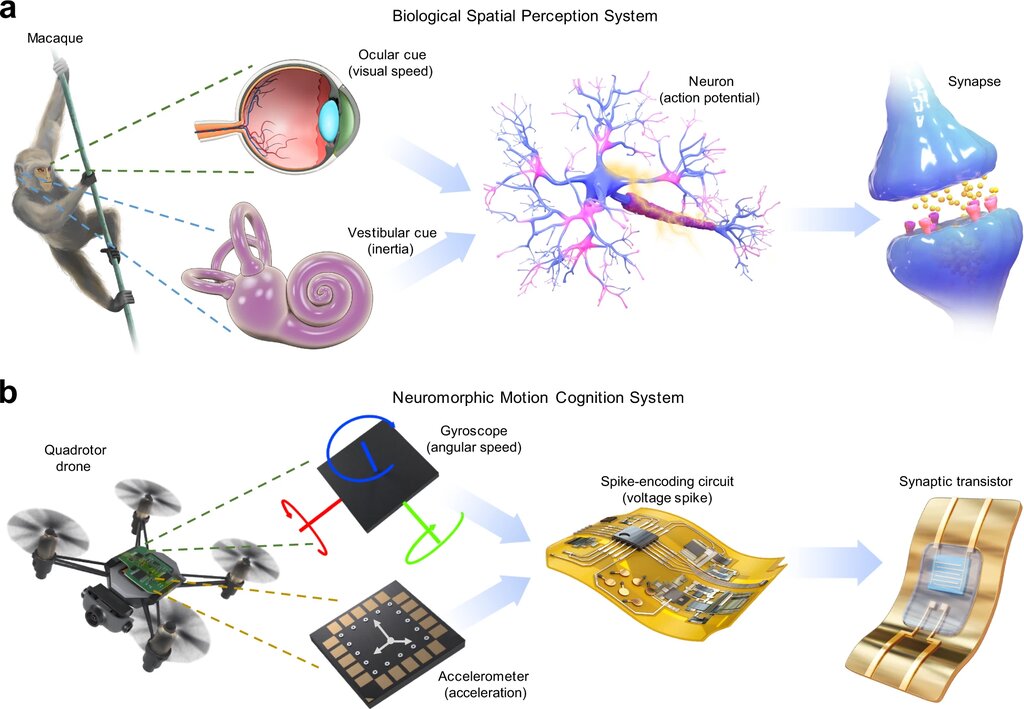
These systems don't use frames. Each pixel on a neuromorphic sensor is an independent agent. It has its own circuitry and watches for changes in the light hitting it. When a pixel detects a significant change in brightness, either lighter or darker, it fires off a signal. This signal is called an "event."
If nothing in a pixel's view changes, it stays silent. It doesn't waste energy or processing power recording the same unchanged information over and over. This fundamental difference makes neuromorphic vision incredibly fast and efficient.
| Feature | Traditional Vision (Frame-Based) | Neuromorphic Vision (Event-Based) |
|---|---|---|
| Data Output | A sequence of full image frames | A continuous stream of pixel-level events |
| Data Redundancy | High (captures static background repeatedly) | Low (only reports changes in the scene) |
| Power Consumption | High (constant processing of frames) | Low (pixels are mostly idle) |
| Latency | Limited by frame rate (e.g., 16-33ms) | Extremely low (microseconds) |
| Dynamic Range | Limited | Very high (adapts to bright and dark scenes) |
The Event-Based Approach
Let's dig into what an event actually is. Imagine a single pixel on a neuromorphic sensor. It constantly monitors the light intensity it sees. When that intensity crosses a certain threshold, the pixel generates a tiny packet of data.
This packet, the event, contains three key pieces of information:
The result is a sparse but rich stream of data that precisely describes motion and change in a scene. Because each event is timestamped with microsecond precision, the system can understand the dynamics of a scene far better than a traditional camera, which blurs fast movements between frames.
This event-driven model allows neuromorphic chips to process data more like humans do—fast, adaptive, and efficient.
Where Neuromorphic Vision Shines
The unique properties of event-based sensors open up applications where traditional cameras struggle. Their low power consumption is ideal for devices that need to run for long periods on batteries, like environmental sensors or 'always-on' security systems.
Their incredible speed and low latency make them perfect for high-speed robotics and drone navigation. A drone using a neuromorphic sensor can react to obstacles almost instantly, much faster than one processing video frames. These sensors also have a very high dynamic range, meaning they can see details in scenes with both very dark shadows and extremely bright areas simultaneously, a situation that often blinds conventional cameras.
From autonomous vehicles that need to react in fractions of a second to scientific instruments capturing fleeting biological events, neuromorphic vision provides a powerful new tool. By focusing on change rather than static imagery, it offers a more efficient and dynamic way for machines to perceive the world around them.
Ready to check your understanding?
What is the fundamental difference between how a traditional camera and a neuromorphic sensor perceive a scene?
A single "event" from a neuromorphic sensor contains a packet of data. Which of the following is NOT part of that data packet?
By mimicking the efficiency of biological eyes, neuromorphic vision represents a significant leap forward in how machines can perceive and interact with their environment.