Neural Networks Demystified
Introduction to Neural Networks
What Are Neural Networks?
At its core, an artificial neural network is a computational model inspired by the way brains work. It's a method in artificial intelligence that teaches computers to process data in a way that mimics human thought.
Imagine you're learning to recognize a cat. You don't follow a rigid list of rules. Instead, you learn from seeing many examples. Your brain identifies patterns—pointy ears, whiskers, a certain type of tail—and gets better with each new cat you see. Neural networks do something similar. They learn by example, identifying complex patterns in data without being explicitly programmed for that specific task.
They are the backbone of many AI applications we use daily, from voice assistants to facial recognition on our phones.
Inspired by the Brain
The concept for artificial neural networks came directly from studying the human brain. Our brains are made of billions of cells called neurons, which are connected to each other, forming a massive network. These neurons receive signals, process them, and pass them on to other neurons. This intricate web is how we think, learn, and remember.
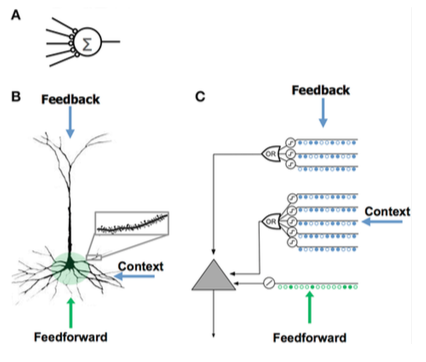
An artificial neural network tries to simulate this structure. It's built from simple, interconnected processing units, also called neurons or nodes. Let's look at the basic building blocks.
neuron
noun
In an artificial neural network, a neuron (or node) is a fundamental processing unit. It receives input signals, performs a simple computation, and then passes an output signal to other neurons.
These artificial neurons are connected by links, much like synapses connect biological neurons. Each connection has a specific strength or importance, known as a weight. A higher weight means the signal from one neuron has a stronger influence on the next. Think of it like a group project: the input from a team member you trust more (higher weight) will have a bigger impact on your final decision.
There's one more key component: the bias. A bias is a sort of thumb on the scale. It's an extra input that can make a neuron more or less likely to activate, regardless of its weighted inputs. This helps the network make better decisions by providing a baseline adjustment.
A Brief History
The idea of creating an artificial brain is not new. The journey of neural networks has been a rollercoaster of excitement, disappointment, and eventual triumph.
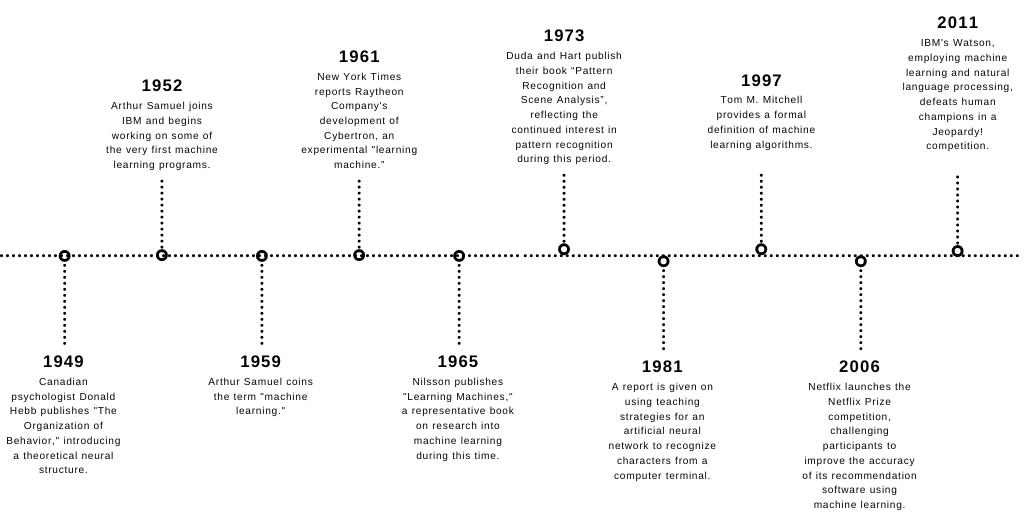
The story begins in 1943, when neurophysiologist Warren McCulloch and logician Walter Pitts proposed the first mathematical model of a neuron. A few years later, in 1958, psychologist Frank Rosenblatt created the Perceptron. This was one of the first and simplest types of neural networks, capable of learning to make binary classifications, like deciding if an image contains a cat or not.
However, early excitement faded. The limited computing power of the time and some key theoretical limitations led to a period known as the "AI winter" in the 1970s and 80s, where funding and interest in the field dried up.
Things started to change in the late 1980s and picked up speed in the 2000s. Three key factors brought neural networks back into the spotlight: the availability of massive amounts of data (thanks to the internet), the development of powerful processors (like GPUs), and breakthroughs in network training algorithms. These advancements paved the way for the deep learning revolution we see today.
The Power of Networks
So, why are neural networks so important in AI? Their real power lies in their ability to learn complex, non-linear patterns directly from data. Unlike traditional programming where a human has to define all the rules, a neural network can figure out the rules on its own.
This makes them incredibly versatile. They are used for image and speech recognition, natural language processing (like the technology behind chatbots), medical diagnosis, and even composing music or creating art. They excel at tasks that are easy for humans but difficult to define with a simple set of instructions.
By building systems that can learn and adapt, neural networks have pushed the boundaries of what's possible in artificial intelligence.