Neural Network Fundamentals
Introduction to Neural Networks
What Is a Neural Network?
At its core, an artificial neural network is a computational model inspired by the web of neurons in the human brain. It's a method for finding patterns in data. Instead of being explicitly programmed with rules, a neural network learns them on its own by looking at many examples. Think of it like teaching a child to recognize a cat. You don't list out rules like "has pointy ears, whiskers, and a tail." You just show them pictures of cats, and eventually, they learn to identify one on their own. Neural networks do something similar, but with data.
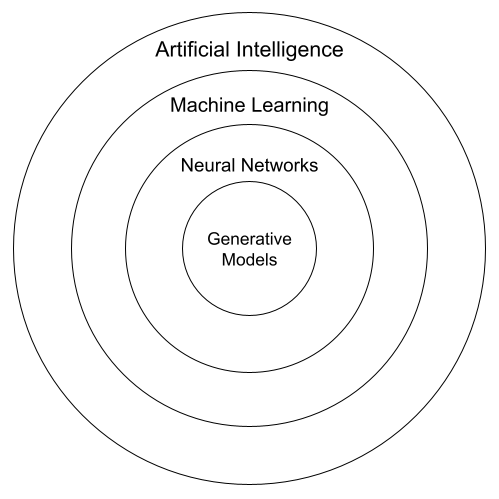
These networks are the foundation of what we now call "deep learning." They consist of layers of interconnected nodes, or "neurons," that process information. The "deep" in deep learning simply means the network has many layers, allowing it to learn complex patterns from vast amounts of data.
Inspired by the Brain
The original idea for neural networks came from trying to mimic how our own brains work. A biological neuron receives signals through branches called dendrites. If the combined signals are strong enough, the main cell body, or soma, fires an electrical pulse down a cable called an axon to other neurons. This is a vast simplification, but it captures the key idea: a neuron is a small decision-making unit that receives inputs and produces an output.
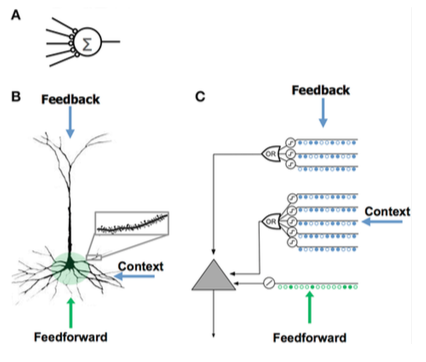
Artificial neural networks are built from a digital version of this concept. They aren't made of biological tissue, but of mathematical functions. Each artificial neuron takes in numerical inputs, processes them, and passes a numerical output to other neurons.
The Artificial Neuron
The fundamental building block of a neural network is a single artificial neuron, sometimes called a perceptron. It's a simple calculator with a few key parts.
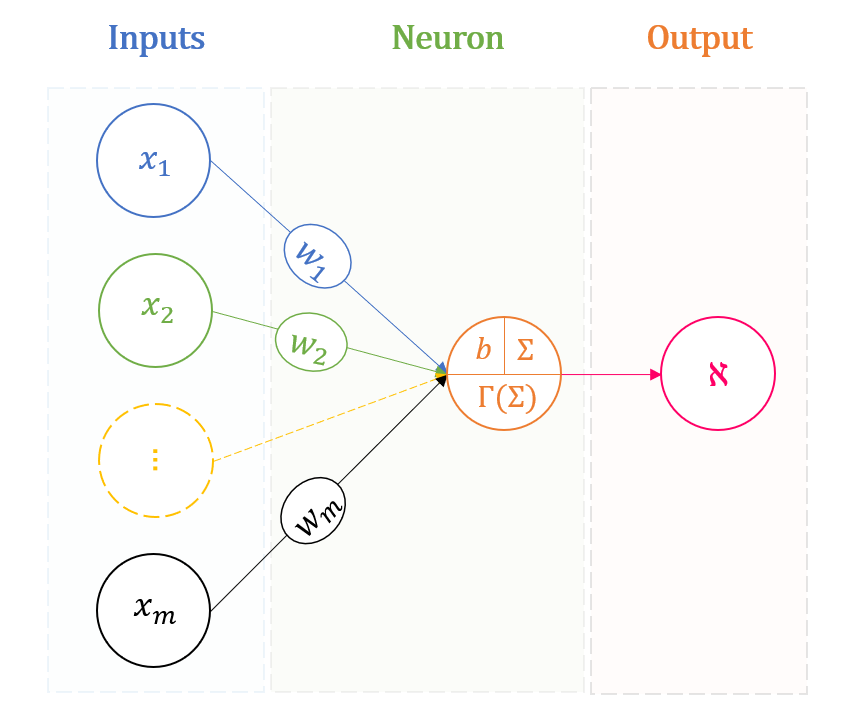
First, it has inputs. These are just numbers that represent some piece of data. For example, if we were analyzing an image, the inputs could be the brightness values of individual pixels.
Each input is multiplied by a weight. A weight is a number that signals how important that input is. A large positive weight means the input is a strong signal for the neuron to activate. A negative weight means the input is a signal for it not to activate. The network learns by adjusting these weights.
Next, all the weighted inputs are added together. A special value called a bias is also added to this sum. The bias acts like a thumb on the scale. It makes it easier or harder for the total sum to reach the threshold needed for the neuron to fire, regardless of its inputs. It gives the network more flexibility.
The core calculation inside a neuron is simple: sum up all the (input × weight) products, and then add the bias.
The Activation Function
After the neuron calculates its weighted sum, it needs to decide what to do with it. This is where the activation function comes in. It takes the final sum and produces the neuron's actual output.
You can think of it as a gatekeeper or a dimmer switch. Some simple activation functions are like an on/off switch: if the sum is above a certain threshold, the output is 1; otherwise, it's 0. This is called a step function.
More common activation functions are smoother, like the Sigmoid function shown above. It squashes any input number into an output between 0 and 1. This is useful because the output can be interpreted as a probability. The activation function is crucial because it introduces non-linearity into the network, allowing it to learn much more complex patterns than a simple linear model could.
A Brief History
The idea of artificial neurons isn't new. The first mathematical model was proposed in 1943 by Warren McCulloch and Walter Pitts. In 1958, Frank Rosenblatt created the Perceptron, a simple neural network that could learn to recognize patterns. This sparked a huge wave of excitement.
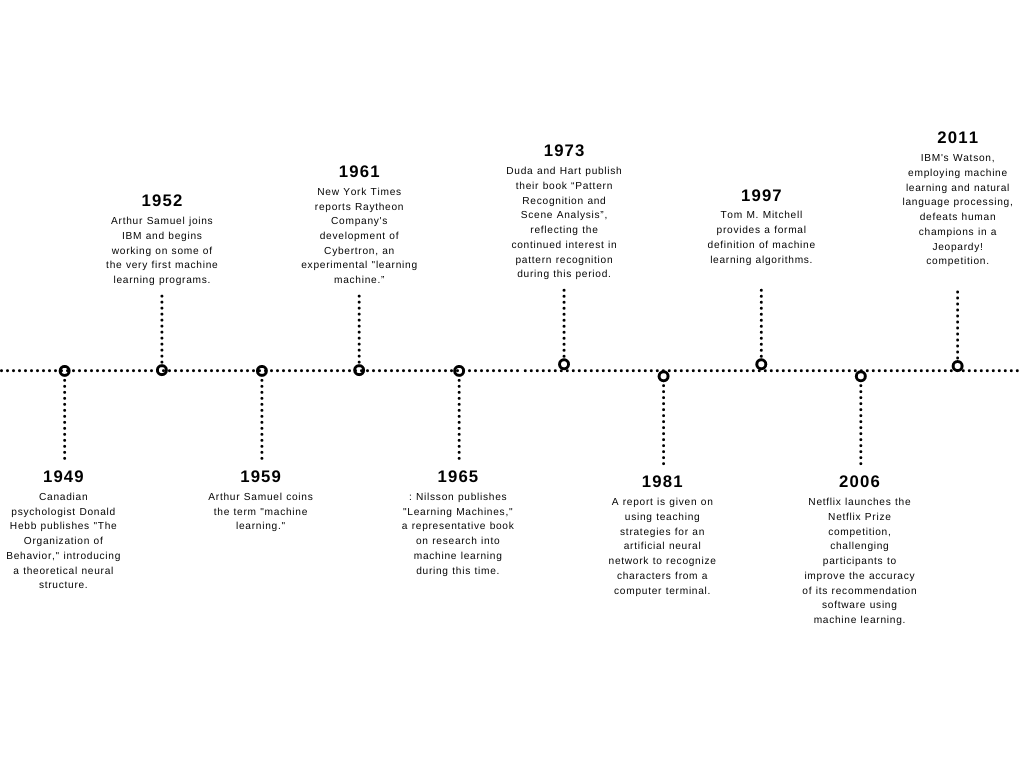
However, progress stalled for several decades in a period known as the "AI winter." Early computers were not powerful enough to run large networks, and researchers hit theoretical roadblocks. It wasn't until the 2000s and 2010s that things took off again. The combination of massive datasets (thanks to the internet) and powerful specialized hardware (like GPUs) finally made it possible to train the deep, multi-layered networks that researchers had envisioned decades earlier. This rebirth of neural networks is what we now call the deep learning revolution.
Now, let's test your understanding of these foundational concepts.
What is the primary function of an artificial neural network?
In the context of an artificial neuron, what is the role of a 'weight'?
Understanding these basic components—the neuron, weights, biases, and activation functions—is the first step to grasping how modern AI works.