Networking Nodes Explained
Network Basics
What is a Network?
At its core, a computer network is just a group of devices connected together. The goal is simple: to share information and resources. Think of it like a conversation between friends. For them to talk, they need to be connected, whether by being in the same room or on a phone call. Similarly, computers need connections to share things like files, printers, or an internet connection.
A computer network connects multiple devices so they can communicate and share resources, like an internet connection or a printer.
These devices can be anything from laptops and smartphones to servers and specialized hardware. The connections can be physical, like an Ethernet cable, or wireless, like Wi-Fi. Without networks, every computer would be an isolated island, unable to access the vast ocean of information we call the internet.
Networks Big and Small
Networks aren't all the same size. They're designed to fit the needs of their environment, from a single room to the entire globe. We generally classify them into three main types based on their geographical reach.
LAN
noun
A Local Area Network (LAN) is a network confined to a small area, like a single building, office, or home. It's the network you use every day to connect your personal devices.
Next, we have Metropolitan Area Networks, or MANs.
MAN
noun
A Metropolitan Area Network (MAN) is larger than a LAN and typically spans a city or a large campus. It's often used to connect several LANs together.
Finally, the largest of them all is the Wide Area Network.
WAN
noun
A Wide Area Network (WAN) extends over a large geographical area, such as a country or even the entire planet. A WAN connects multiple LANs and MANs.
The Key Players
To make these networks function, we need specific hardware. While there are many components, a few are fundamental to nearly every network.
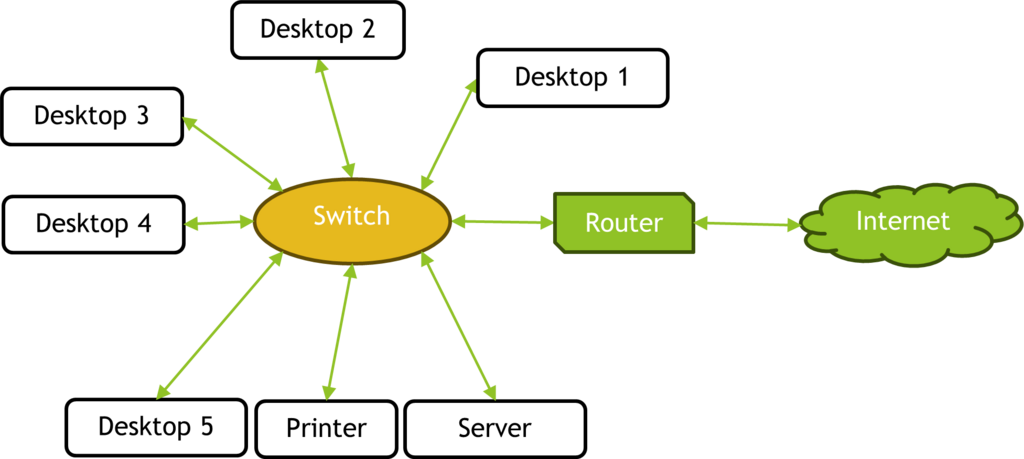
First are the devices you use every day.
End Devices: These are the computers, smartphones, printers, and servers that people actually use. They are the originators or destinations of information on the network.
To connect multiple end devices within the same local network, we use a switch.
Switches: A switch is like a traffic cop for a single neighborhood (a LAN). It knows which devices are connected to its ports and forwards data only to the intended recipient. This creates efficient, direct lines of communication within the local network.
But what if you need to send information to a device on a different network? That's where routers come in.
Routers: A router is a smarter device that acts as a gateway between different networks. It's like the central post office for a city, figuring out the best path to send a package (your data) to its final destination, whether it's across town or across the world.
Your home Wi-Fi device is actually a combination of a router, a switch, and a wireless access point all in one box. It switches communications between devices in your home (LAN) and routes traffic to and from the internet (WAN).
What is the fundamental purpose of a computer network?
Which piece of hardware is specifically designed to connect devices on different networks, such as your home network and the internet?
Understanding these basic building blocks—what networks are, their different sizes, and the core hardware that runs them—is the first step to seeing how the digital world is connected.