Networking Models and Communication
Networking Basics
What is a Network?
At its core, a computer network is just a group of two or more computers connected so they can share information and resources. Think of it like a conversation. For two people to talk, they need to be connected, whether by being in the same room or on the same phone call. Computers are no different. They need a connection to exchange data, whether that's an email, a website, or a video stream.
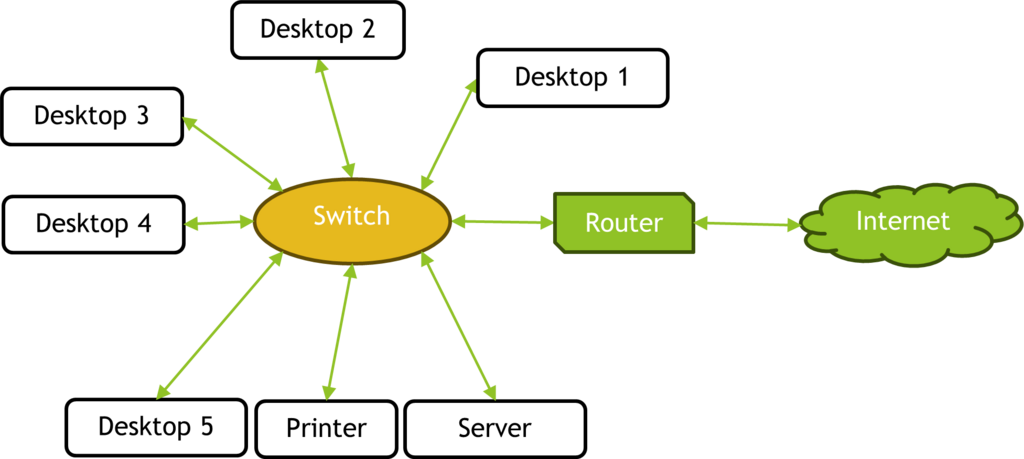
These connections can be simple, like linking a few devices in your home, or incredibly complex, spanning the entire globe. The size and purpose of a network determine how it's built and what kind of hardware it needs. We generally classify these networks based on the geographical area they cover.
Networks Big and Small
The smallest and most common type of network is a Local Area Network, or LAN. This is the network in your home, your office, or a single school building. It connects devices that are physically close to each other, usually within a few hundred feet. Your Wi-Fi network is a perfect example of a LAN. It lets your laptop, phone, and smart TV all talk to each other and share a single internet connection.
A LAN connects devices in a limited area like a home or office.
On the other end of the scale is a Wide Area Network, or WAN. A WAN connects devices over a large geographical area, like a city, a country, or even across continents. It's often a network of other networks, linking multiple LANs together. The most famous example of a WAN is the internet itself, which is a massive, global network connecting billions of devices.

Sitting between these two is the Metropolitan Area Network, or MAN. As the name suggests, a MAN covers a metropolitan area like a city or a large campus. It's bigger than a LAN but smaller than a WAN. A common use for a MAN is connecting the different office buildings of a single organization across a city.
The Network's Building Blocks
To make these networks function, we need specialized hardware. You've probably heard of routers and switches, but let's clarify what each one does.
A hub is the simplest of these devices. It's a central point that connects all the devices on a network. When a hub receives data from one device, it broadcasts that data to every other device connected to it. It’s like shouting in a crowded room; everyone hears you, but only the intended person listens. Hubs are older technology and aren't very efficient because they create a lot of unnecessary traffic.
Hubs broadcast data to all devices, switches send it only to the intended device.
A switch is a smarter version of a hub. It knows the specific address of each device connected to it. When a switch receives data, it sends it directly to the intended device, not to everyone. This is like whispering a message to a specific person in that crowded room. Switches are much more efficient than hubs and are the standard for most modern LANs.
A router has a different job. While switches create networks, routers connect networks. Your home router, for instance, connects your private LAN to the internet (a massive WAN). It acts as a traffic director, figuring out the best path for data to travel from your computer to a server on the other side of the world and back.
How Data Travels
When data moves across a network, we need ways to measure its journey. Two key concepts are bandwidth and latency.
Bandwidth
noun
The maximum amount of data that can be transferred over a network connection in a given amount of time. It's often measured in megabits per second (Mbps).
Think of bandwidth as the width of a highway. A wider highway can handle more cars at once, just as higher bandwidth can handle more data. Streaming a 4K movie requires a lot of bandwidth, while sending a simple email requires very little.
Latency
noun
The delay in data communication. It's the time it takes for a piece of data to travel from its source to its destination. It's often measured in milliseconds (ms).
If bandwidth is the highway's width, latency is the travel time. Even on a wide-open highway, it still takes time to drive from one city to another. Low latency means data travels very quickly with minimal delay, which is critical for real-time applications like video calls and online gaming. High latency causes that annoying lag.
Finally, for all these components to work together, they need a shared set of rules. These rules are called protocols. A protocol is a standardized way of doing things. It defines how devices should format data, address each other, and transmit information. Without protocols, the internet would be chaos; it would be like people from different countries trying to have a conversation without a common language.
Ready to test your knowledge? Let's see what you've learned about the fundamentals of networking.
What is the primary purpose of a computer network?
The network that connects all the computers, printers, and servers within a single office building is best described as a:
Understanding these basic concepts—what networks are, their different sizes, the hardware that builds them, and the principles of data transmission—is the first step to understanding the digital world.