Networking Fundamentals
Introduction to Computer Networks
What Is a Computer Network?
At its heart, a computer network is just a group of devices connected together. Think of it like a conversation. For two people to talk, they need to be able to hear each other. For two computers to share information, they need a connection. This connection allows them to pass data back and forth, from sending a simple message to streaming a movie.
Computer networking is simply connecting computers and devices so they can share information.
The main purpose of networking is to share resources. That might mean sharing an internet connection among all the devices in your home. It could be sharing a single printer with an entire office, or sharing files and documents without needing to email them back and forth. Networks make our digital lives convenient and efficient.
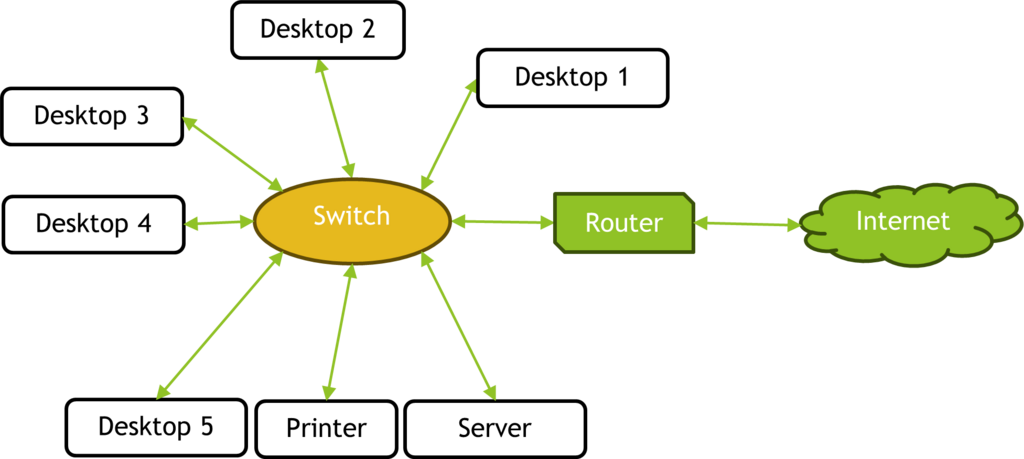
The Building Blocks
Every network, from the small one in your home to the global internet, is built from the same fundamental components. Understanding these parts is the first step to understanding how networks operate.
Node
noun
Any device on a network that can send, receive, or forward information.
A node is the most basic unit of a network. It's a generic term for any participant. Your computer is a node. So is your smartphone, your printer, a web server, or a smart thermostat. If it's connected to the network, it's a node.
Next are the networking devices. These are specialized pieces of hardware that manage the flow of traffic between nodes. They act as the network's traffic controllers, making sure data gets where it needs to go. Two of the most common are switches and routers.
- Switches create a network by connecting nodes within the same location, like an office or a home. They allow devices on the same network to talk to each other directly.
- Routers connect different networks together. The router in your home, for example, connects all of your devices (your local network) to the internet (a massive, global network).
Finally, all these devices need a way to communicate. This is handled by transmission media, the physical or wireless path that data travels along. Think of them as the roads and highways of the network.
| Media Type | How it Works | Common Examples |
|---|---|---|
| Wired | Data travels as electrical signals or light pulses through physical cables. | Ethernet cables, Fiber optic cables |
| Wireless | Data travels as radio waves through the air. | Wi-Fi, Bluetooth |
The Goals of Networking
Why do we go through the trouble of building and maintaining these complex networks? It's because they help us achieve several important goals.
Convenience & Efficiency: Networks make it easy to access information and use shared devices. Instead of copying a file to a flash drive and walking it over to another computer, you can send it instantly over the network. This saves time and effort.
Resource Management: A network allows many users to share expensive resources. A single high-quality printer can serve an entire office, which is much cheaper than buying a printer for every employee.
Security: While networking introduces security challenges, it also provides tools to solve them. A properly managed network can control who has access to which information, protecting sensitive data from unauthorized users.
Reliability: Networks can be designed to be resilient. If one path for data fails, another can often be used. For important data, it can be automatically backed up to another machine on the network, ensuring it isn't lost if one computer fails.
Scalability: A well-designed network can grow. You can add new nodes and devices without having to redesign the entire system from scratch. This allows networks to expand as a home or business grows.
Let's test what you've learned about these fundamental concepts.
What is the primary purpose of a computer network?
In a home network, which device is responsible for connecting all your local devices to the global internet?
Understanding these core ideas—what a network is, its basic parts, and its goals—provides the foundation for everything else you'll learn about computer networking.