Networking Fundamentals Explained
OSI and TCP/IP Models
Models for Communication
When you send an email or load a webpage, countless complex operations happen behind the scenes. To manage this complexity, engineers created conceptual frameworks called networking models. Think of them as blueprints for how data should travel across a network.
These models break down the entire communication process into smaller, manageable parts called layers. Each layer has a specific job, and it only communicates with the layers directly above and below it. This layered approach ensures that devices made by different manufacturers can still talk to each other, a concept known as interoperability. The two most important models are the OSI model and the TCP/IP model.
The OSI model is a conceptual framework that standardizes how different network devices communicate.
The OSI Model
The Open Systems Interconnection (OSI) model is a seven-layer framework that provides a detailed, theoretical look at networking. It’s an excellent tool for understanding and troubleshooting, even though it's not what the modern internet is strictly built on.
Imagine sending a package internationally. You write a letter (Application), maybe translate it (Presentation), seal it in an envelope, and decide to track its delivery (Session). You put the full destination address on it (Network), and then the local mail carrier picks it up based on your street address (Data Link). The carrier uses roads and planes to move it (Physical). The OSI model works in a similar, layered way.
| Layer | Name | Function | PDU (Protocol Data Unit) |
|---|---|---|---|
| 7 | Application | Provides network services directly to user applications. | Data |
| 6 | Presentation | Translates, encrypts, and compresses data. | Data |
| 5 | Session | Establishes, manages, and terminates connections. | Data |
| 4 | Transport | Provides reliable or unreliable delivery and error correction. | Segment/Datagram |
| 3 | Network | Moves packets from source to destination; provides logical addressing. | Packet |
| 2 | Data Link | Organizes bits into frames; provides hop-to-hop delivery. | Frame |
| 1 | Physical | Transmits raw bits over a physical medium. | Bit |
The TCP/IP Model
While the OSI model is a detailed guide, the TCP/IP model is the practical, streamlined framework that the internet actually uses. It's often shown with four layers, combining several of the OSI model's functions.
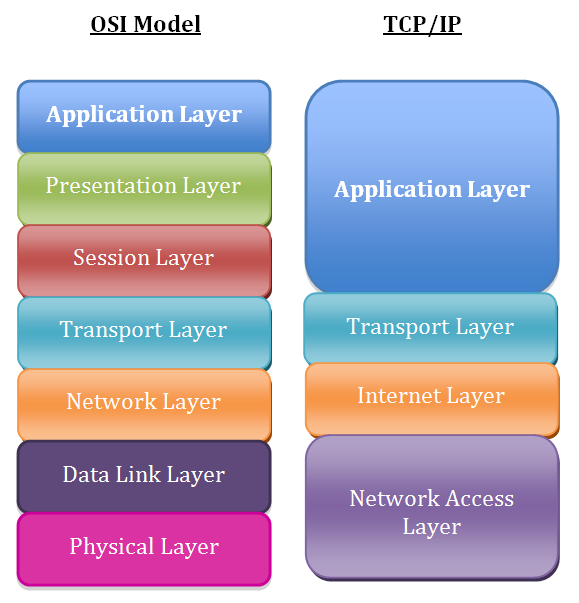
Here’s how the two models relate:
-
Application Layer: In TCP/IP, this single layer handles the jobs of the OSI model's Application, Presentation, and Session layers. It's where protocols like HTTP (for web browsing) and SMTP (for email) operate.
-
Transport Layer: This layer maps directly to the OSI Transport layer. It manages the connection between devices, using protocols like TCP (Transmission Control Protocol) for reliable, ordered data delivery, or UDP (User Datagram Protocol) for faster, less reliable delivery.
-
Internet Layer: This corresponds to the OSI Network layer. It's responsible for packaging data into IP packets and routing them across the network. The Internet Protocol (IP) lives here.
-
Network Access Layer: This combines the OSI Data Link and Physical layers. It deals with the physical hardware, such as cables and network interface cards, that make communication possible.
The TCP/IP model is the foundational network protocol architecture for the internet.
Why Layering Matters
Breaking network communication into layers provides several key benefits.
First, it creates abstraction. A web developer writing code for the Application layer doesn't need to know how data is physically sent over a fiber optic cable. They just trust the lower layers to do their jobs. This separation of concerns simplifies development and innovation.
Second, it promotes standardization. Different companies can design products for any layer, and as long as they follow the rules, everything will work together. You can use a network card from one company with a router from another.
Finally, it makes troubleshooting much easier. When a problem occurs, a network technician can investigate layer by layer. Is the cable unplugged? That's a Layer 1 problem. Is the IP address incorrect? That's a Layer 3 issue. This systematic approach is far more efficient than randomly guessing.
Memorizing OSI layers isn’t just about passing exams—it’s about developing a mental framework for troubleshooting network issues.
Ready to test what you've learned? Let's review the key concepts.
Now, let's see how well you can apply these concepts.
What is the primary purpose of using a layered networking model like OSI or TCP/IP?
Which layer of the TCP/IP model combines the functions of the OSI model's Application, Presentation, and Session layers?
Understanding these models provides a solid foundation for grasping how data travels from your screen to a server halfway around the world and back again.