Network Polling Explained
Introduction to Network Communication
How Data Travels
When you send an email or load a webpage, you're sending and receiving information over a network. But this information doesn't travel as one big chunk. Instead, it's broken down into tiny pieces called packets.
Think of it like sending a large puzzle through the mail. You wouldn't mail the whole assembled puzzle. You'd break it apart, put the pieces into several small, numbered boxes, and mail them individually. At the other end, the recipient reassembles the puzzle using the numbers on the boxes.
Computers do the same thing. A file, a webpage, or a video is chopped into small packets. Each packet contains a piece of the data, along with addressing information, like the digital equivalent of a mailing address and a return address. These packets then travel across the internet, hopping between specialized computers called routers, which act like traffic directors, guiding each packet toward its final destination. When they all arrive, the receiving computer puts them back together in the correct order.
This process happens incredibly fast. Even though packets might take different routes and arrive out of order, the system is designed to put them back together seamlessly.
The Rules of the Road
For this packet-switching system to work, all connected devices need to speak the same language. This common language is a set of rules called a protocol.
A protocol defines how data should be formatted, addressed, transmitted, and received. Without protocols, the internet would be a chaotic mess where no device could understand another. There are many different protocols, each designed for a specific task.
Protocols are the grammar of network communication, ensuring every device understands how to interpret the signals it receives.
Two of the most fundamental protocols are TCP and UDP. They handle how data is sent and received, but they do it in very different ways.
TCP (Transmission Control Protocol) is like sending a certified letter. It's reliable. TCP establishes a connection, numbers the packets, and checks to make sure every single one arrives at the destination. If a packet gets lost, TCP sends it again. This makes it perfect for things like sending emails or loading webpages, where you need all the data to be intact.
UDP (User Datagram Protocol) is more like sending a postcard. It's fast and simple. UDP just sends the packets out and hopes for the best. It doesn't check if they all arrived, and it doesn't re-send lost packets. This might sound bad, but it's great for real-time applications like video calls or online gaming, where speed is more important than a few lost pixels or a split-second of garbled audio.
| Feature | TCP (Transmission Control Protocol) | UDP (User Datagram Protocol) |
|---|---|---|
| Reliability | High (guarantees delivery) | Low (no guarantee) |
| Speed | Slower | Faster |
| Connection | Requires a connection | Connectionless |
| Use Case | Web browsing, email, file transfers | Video streaming, online gaming, DNS |
The Client-Server Model
Most network communication follows a simple pattern called the client-server model. In this model, there are two main roles: the client and the server.
- A client is a device that requests information or a service. Your computer, smartphone, or tablet is usually a client.
- A server is a powerful computer that stores information and provides services to clients. Servers wait for requests and respond to them.
Think of a restaurant. You, the customer, are the client. You make a request by ordering from the menu. The waiter and kitchen staff are the server. They receive your request, prepare your food, and serve it to you.
When you type a website address into your browser, you're acting as the client. Your browser sends a request over the internet to a web server. The server finds the requested webpage and sends it back to your browser, which then displays it on your screen.
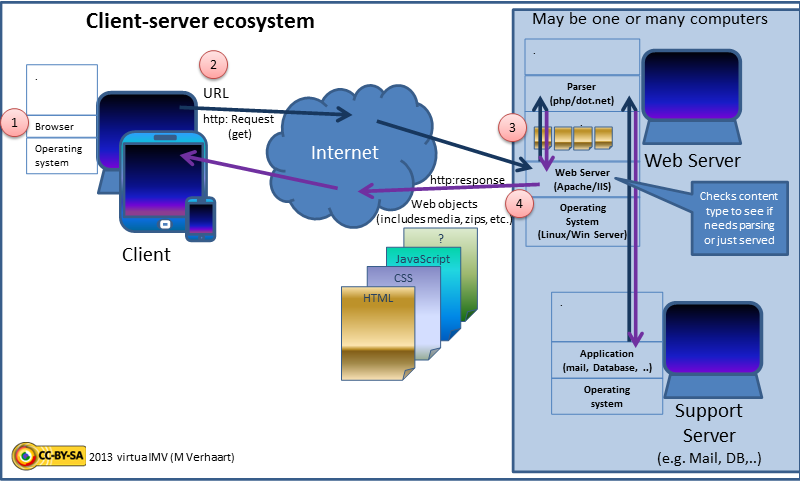
This request-and-response cycle is the foundation of how we access almost everything online, from social media feeds to streaming movies. It's a simple but powerful system for organizing communication across the vast network of the internet.
When data is sent over the internet, it's broken down into small pieces. What are these pieces called?
Which protocol is like sending a certified letter, ensuring all data arrives in the correct order by re-sending lost packets?
Understanding how data is broken down, the rules it follows, and the roles devices play is the first step to understanding the complex world of networking.