Negative Group Delay Explained
Introduction to Group Delay
The Signal Envelope's Journey
Imagine a complex signal, like a snippet of music or a data packet, traveling through a system like a filter or a long cable. This signal isn't a single, simple wave. It's actually a combination of many different sine waves, each with its own frequency. These waves are all bundled together, creating an overall shape or amplitude modulation. This shape is often called the signal's envelope.
Group delay measures the time it takes for this envelope to pass through the system. It's not about the delay of any single wave inside the bundle, but the delay of the group as a whole. If a system has a constant group delay, the signal's envelope comes out the other side undistorted, just delayed in time. But if different frequencies in the group are delayed by different amounts, the shape of the envelope gets warped. This is a crucial concept in fields like telecommunications and audio engineering, where preserving the signal's shape is essential for clarity.
Group Delay vs Phase Delay
To understand group delay better, it helps to compare it with a related idea: phase delay. While group delay tracks the envelope of the signal, phase delay tracks a single frequency component within that envelope.
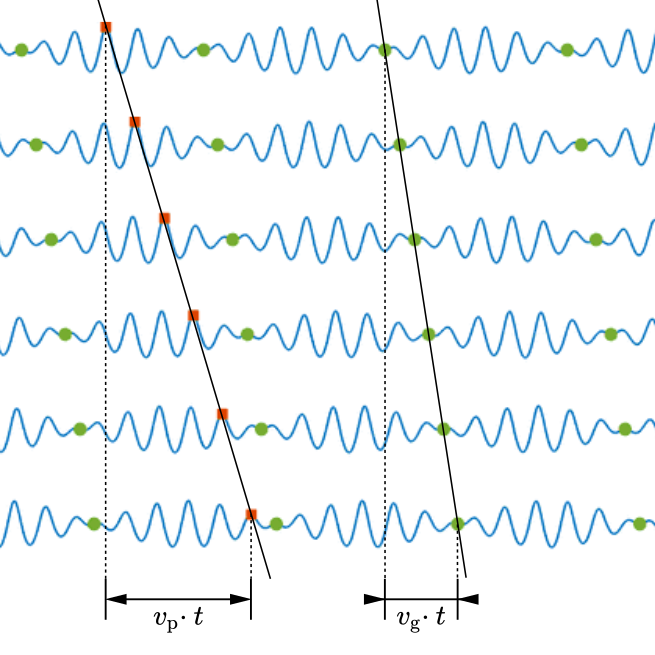
Think of a group of runners in a race. Phase delay would be the time it takes for one specific runner (a single frequency) to reach the finish line. Group delay is the time it takes for the center of the whole pack of runners (the signal envelope) to cross the line. The two might not be the same. The runner in the lead might be much faster than the average speed of the group.
In short: Phase delay is the time delay of a single frequency's phase. Group delay is the time delay of the signal's amplitude envelope.
When a system has a perfectly linear phase response, the group delay and phase delay are equal. This is the ideal scenario for many applications, as it means all parts of the signal travel together in lockstep, preventing distortion.
The Math Behind the Delay
Mathematically, group delay is derived from the phase response of a system, which is typically denoted as , where is the angular frequency ().
Phase delay, , is the most straightforward calculation. It's the total phase shift at a given frequency divided by that frequency.
Group delay, , is a bit different. It’s defined as the negative rate of change of the phase with respect to frequency. In calculus terms, it's the negative derivative of the phase shift with respect to angular frequency.
This derivative tells us how the phase delay changes as the frequency changes. If the phase response is a straight line (linear phase), its derivative is a constant. This means the group delay is the same for all frequencies, and the signal's envelope passes through without distortion.
Why It Matters
The concept of group delay is critical in many real-world systems.
| System | Why Group Delay Matters |
|---|---|
| Audio Systems | In speakers and audio filters, non-constant group delay can cause audible distortion, especially in bass frequencies, making music sound "muddy" or less sharp. |
| Digital Communications | When transmitting digital data (like in Wi-Fi or 5G), the signal is often a complex pulse. Group delay distortion can smear these pulses, causing bits to interfere with each other and leading to errors. |
| Optical Fibers | Different frequencies (colors) of light travel at slightly different speeds through an optical fiber. This effect, called dispersion, is a form of group delay that limits how fast data can be sent over long distances. |
Engineers work hard to design systems with a flat group delay response across the frequencies of interest. This ensures that all parts of the signal's envelope arrive at the destination at the same time, preserving the integrity and fidelity of the original information.
What does group delay measure?
If a system causes different frequencies in a signal to be delayed by different amounts, the shape of the signal's envelope gets warped.