NEET Stoichiometry PYQ Mastery
Introduction to Stoichiometry
Chemistry's Recipe Book
Think about baking a cake. You need a specific amount of flour, sugar, and eggs to get one cake. If you want two cakes, you double the ingredients. Chemical reactions work in a very similar way. They follow a precise recipe, and stoichiometry is the tool we use to read that recipe.
Stoichiometry
noun
The calculation of reactants and products in chemical reactions.
In short, it's the study of the quantitative, or measurable, relationships between the substances involved in a chemical reaction. To understand these relationships, we need to start with the fundamental laws that govern them.
The Three Fundamental Laws
Three basic laws form the foundation of stoichiometry. They describe how matter behaves in chemical reactions and are essential for any calculation you'll perform.
- Law of Conservation of Mass
This is perhaps the most fundamental concept in chemistry. It states that matter cannot be created or destroyed in a chemical reaction. The total mass of the substances you start with (the reactants) must equal the total mass of the substances you end up with (the products).
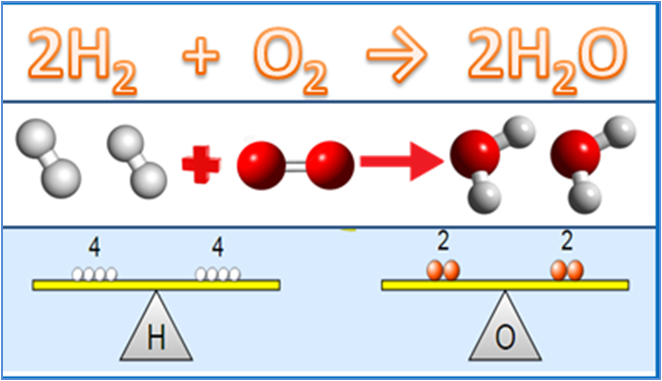
Imagine burning a piece of wood. It might seem like the wood just disappears, leaving only a small pile of ash. But the mass isn't lost. It has been converted into ash, smoke, and gases like carbon dioxide and water vapor. If you could capture and weigh all of those products, their total mass would be the same as the original piece of wood plus the oxygen it used from the air to burn.
- Law of Definite Proportions
This law states that a given chemical compound always contains its component elements in a fixed ratio by mass, regardless of its source or method of preparation.
Water () is a perfect example. Pure water always consists of 11.1% hydrogen and 88.9% oxygen by mass. This means the ratio of the mass of oxygen to the mass of hydrogen is always about 8:1. It doesn't matter if the water comes from an ice cap, a river, or a laboratory—the ratio is constant.
- Law of Multiple Proportions
Things get interesting when two elements can combine to form more than one compound. This law, proposed by John Dalton, helps us make sense of it. It states that if two elements form more than one compound, the ratios of the masses of the second element which combine with a fixed mass of the first element will always be ratios of small whole numbers.
Let's look at carbon and oxygen. They can form two common compounds: carbon monoxide (CO) and carbon dioxide ().
| Compound | Mass of Carbon | Mass of Oxygen | Ratio of Oxygen Mass |
|---|---|---|---|
| Carbon Monoxide (CO) | 12 g | 16 g | 1 |
| Carbon Dioxide () | 12 g | 32 g | 2 |
If we fix the mass of carbon at 12 grams, we see that 16 grams of oxygen are needed for carbon monoxide, while 32 grams are needed for carbon dioxide. The ratio of the masses of oxygen in the two compounds is 32:16, which simplifies to a simple whole-number ratio of 2:1. This simple ratio is a hallmark of chemical combinations.
Putting It Together
These laws allow us to make powerful predictions. For instance, in the reaction to form water, we know that 2 grams of hydrogen () will react with 16 grams of oxygen () to produce 18 grams of water ().
Using this simple relationship derived from the law of definite proportions, we can perform basic stoichiometric calculations. If you want to produce 36 grams of water, how much hydrogen and oxygen would you need? Since you're doubling the product, you must double the reactants.
This is the core of stoichiometry: using known mass ratios to calculate the amounts of other substances in a reaction. It's the essential arithmetic of chemistry.
Time to check your understanding of these core concepts.
The statement 'matter cannot be created or destroyed in a chemical reaction' is a summary of which fundamental law?
If 10 grams of element A react completely with 25 grams of element B, how many grams of product will be formed?