NEET Alternating Current Mastery
Phasors and RMS
Representing AC with Phasors
Alternating current (AC) isn't constant. Both voltage and current rise and fall in a smooth, repeating sinusoidal pattern. To analyse AC circuits effectively, we need a simpler way to represent these oscillating quantities than drawing sine waves every time. This is where phasors come in.
A phasor is a rotating vector. Its length corresponds to the peak value (amplitude) of the AC quantity, like peak voltage () or peak current (). The phasor rotates anticlockwise at an angular frequency () equal to that of the alternating current. At any moment in time, the vertical projection of the phasor gives you the instantaneous value of the voltage or current.
This gives us the equations for instantaneous voltage () and current ():
Here, and are the peak values, is the angular frequency, and is the phase difference between the current and voltage, which we'll explore next.
Phase Difference
In AC circuits containing components like inductors or capacitors, the current and voltage waveforms are not always perfectly aligned. The offset between their peaks is called the phase difference, denoted by (phi).
If the current reaches its maximum value before the voltage does, we say the current leads the voltage. If it reaches its maximum after the voltage, it lags behind. This relationship is constant for a given circuit and is represented by the angle between the voltage and current phasors.
For example, if the current leads the voltage by radians (30°), the equations would be:
The positive sign on indicates a lead. A negative sign would indicate a lag.
Peak, Average, and RMS
An AC signal has several key values we use to describe it.
Peak Value (): This is the maximum amplitude of the sine wave, the highest point it reaches in either the positive or negative direction.
Average Value: If you average a sine wave over one complete cycle, the result is zero. The positive half-cycle perfectly cancels out the negative half. So, we often talk about the average value over a half-cycle. This is found to be about 63.7% of the peak value.
While the average value is useful in some contexts, like rectification, it doesn't tell us about the power delivered by the current. An AC current with an average of zero still delivers power and can light a bulb. For this, we need a more meaningful measure: the Root Mean Square (RMS) value.
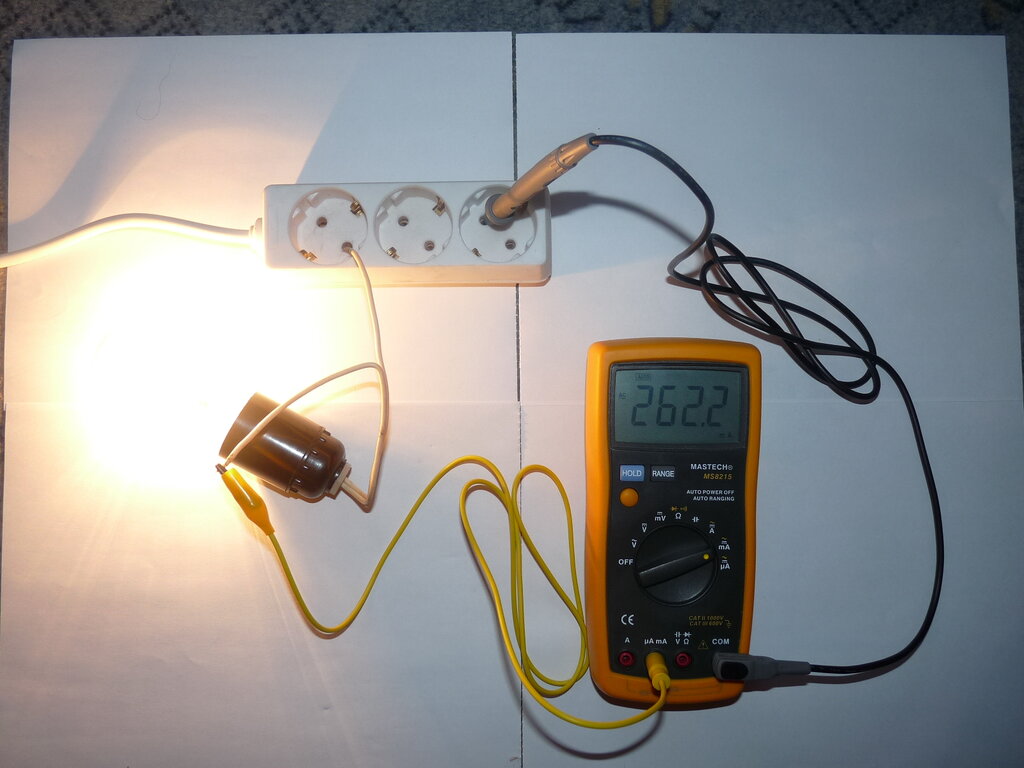
The RMS value of an AC current is the value of the direct current (DC) that would produce the same heating effect (power) in the same resistor. It's the effective value of the AC. To find it, you (1) square the instantaneous current, (2) find the mean (average) of that squared value over a full cycle, and then (3) take the square root.
This process might sound complex, but for a sinusoidal waveform, it simplifies to a very convenient relationship.
When you see an AC voltage or current value given without any qualifier (like 'peak'), it almost always refers to the RMS value. The 230V mains supply in the UK is an RMS value; its peak voltage is actually .
Ready to test your understanding? Let's work through some questions.
What does the length of a phasor represent in an AC circuit?
If the current in an AC circuit is described by the equation , what is the relationship between the current and the voltage (assuming voltage is the reference at )?
By using phasors and RMS values, we can analyse complex AC circuits with the same algebraic tools we use for DC circuits, making our calculations much more manageable.