NCERT Class 12 Physics Mastery
Electrostatics
Charges and Fields
At the heart of electricity are electric charges. These are fundamental properties of matter, much like mass. We label them as positive or negative. You've seen this in action when a balloon sticks to a wall after you rub it on your hair. Rubbing transfers charge, and suddenly objects that were neutral now attract or repel each other.
The basic rule is simple: like charges repel, and opposite charges attract. Two positive charges will push each other away, as will two negative charges. But a positive and a negative charge will pull toward one another.

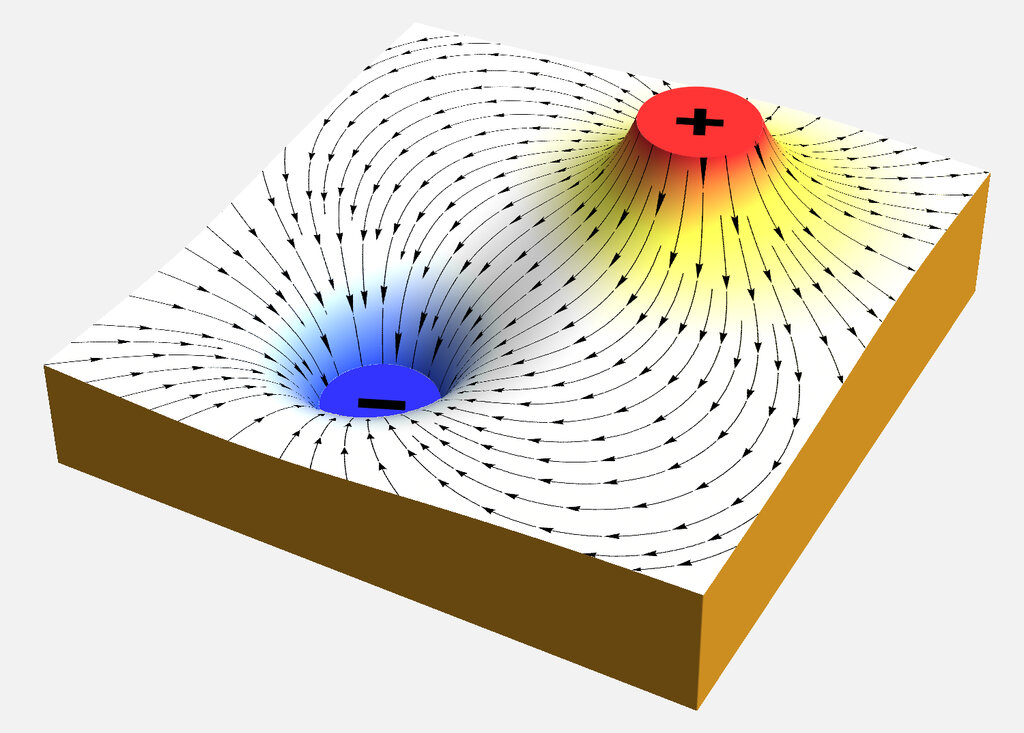
A charge doesn't just interact with things it's touching. It creates an influence in the space around it called an electric field. Think of it like the heat from a fire. You don't have to touch the flames to feel its effect. The farther you are, the weaker the warmth. Similarly, an electric field, often denoted by , is a region of space around a charged object where another charge would feel a force. The field is strongest near the charge and gets weaker as you move away.
By convention, we draw electric field lines to show the direction of the force that would be exerted on a small, positive test charge. So, for a positive source charge, the field lines point outward. For a negative source charge, they point inward.
Calculating the Force
How strong is the push or pull between two charges? In the 18th century, Charles-Augustin de Coulomb determined the relationship, now known as Coulomb's Law. He found that the force is proportional to the product of the two charges and inversely proportional to the square of the distance between them.
This formula should look familiar. It has the same form as Newton's Law of Universal Gravitation. Both are inverse-square laws, meaning the force weakens with the square of the distance. Double the distance, and the force becomes one-fourth as strong. The main difference is that gravity is always attractive, while the electric force can be either attractive or repulsive.
The electric force between two protons is about $10^{36}$ times stronger than the gravitational force between them. This is why electromagnetism, not gravity, governs the world of atoms and molecules.
The electric field at a certain point is defined as the force that a tiny positive test charge would experience at that point, divided by the magnitude of the test charge itself. This gives us a measure of the field's strength independent of the charge we're using to measure it.
Using Coulomb's law, the electric field from a single point charge at a distance is:
Gauss's Law
Calculating the electric field for complex arrangements of charges by summing up the contribution from every single charge can be incredibly difficult. Luckily, there's a more elegant way for situations with symmetry: Gauss's Law.
Gauss's Law relates the electric field on a closed surface, called a Gaussian surface, to the net electric charge enclosed by that surface. It states that the total electric flux out of a closed surface is equal to the charge enclosed divided by a constant, the permittivity of free space.
flux
noun
In the context of electric fields, flux is a measure of the total number of electric field lines passing through a given surface.
While the formula looks intimidating, its application is powerful. If we can choose a clever Gaussian surface where the electric field is constant and perpendicular to the surface (like a sphere around a point charge, or a cylinder around a long charged wire), the math simplifies dramatically. It allows us to find the electric field for symmetrical charge distributions much more easily than with Coulomb's Law alone.
Gauss's Law elegantly relates the net charge enclosed within a Gaussian surface to the patterns of electric field that flow over its faces (Electric Flux).
Potential and Capacitors
Just as an object has gravitational potential energy in a gravitational field, a charged particle has electric potential energy in an electric field. The electric potential, often just called voltage, is the potential energy per unit charge. It's measured in volts (V).
Think of electric potential as electrical "pressure." A high potential area will push positive charges toward a low potential area, just as high water pressure pushes water through a pipe. A difference in electric potential is required for charge to flow.
This leads us to a crucial device: the capacitor. A capacitor is a component that stores electrical energy in an electric field. The simplest version consists of two parallel conductive plates separated by an insulating material called a dielectric. When a voltage is applied across the plates, positive charge builds up on one plate and negative charge on the other, creating an electric field between them.
capacitance
noun
The ability of a system to store an electric charge. It is the ratio of the change in an electric charge in a system to the corresponding change in its electric potential.
Capacitance () is the measure of how much charge () a capacitor can store for a given voltage ().
The capacitance of a parallel-plate capacitor depends on its geometry, specifically the area of the plates () and the distance between them (). It also depends on the dielectric material placed between them.
Inserting a dielectric increases the capacitance. The material becomes polarized in the electric field, which reduces the overall field strength between the plates. This allows more charge to be stored for the same voltage. The energy stored in a capacitor is proportional to its capacitance and the square of the voltage.
What happens when two objects with negative electric charges are brought near each other?
According to Coulomb's Law, if you triple the distance between two point charges, the electric force between them becomes...
These core principles of electrostatics form the foundation for understanding nearly all electrical phenomena.