NCERT Class 11 Plant Development
Growth Phases and Kinetics
How Plants Grow in Number
Plant growth isn't just about getting bigger; it's a precisely regulated process that can be described with mathematics. At the cellular level, growth is an irreversible increase in size. For a plant, this means producing new cells, which primarily happens in specific regions of active cell division called meristems located at the tips of roots and shoots. The way this cell population increases follows distinct patterns.
meristem
noun
A region of plant tissue, found chiefly at the growing tips of roots and stems and in the cambium, consisting of actively dividing cells forming new tissue.
One simple pattern is arithmetic growth. In this model, following cell division (mitosis), one daughter cell continues to divide while the other differentiates and matures, losing its ability to divide. It’s a steady, linear process. If you plot the length of a root elongating over time, you’d see a straight line.
However, most growth in organisms, including the early stages of plant development, is not linear. It’s geometric, or exponential. In this case, both daughter cells from a division retain the ability to divide again. This leads to a rapid, compounding increase in the number of cells.
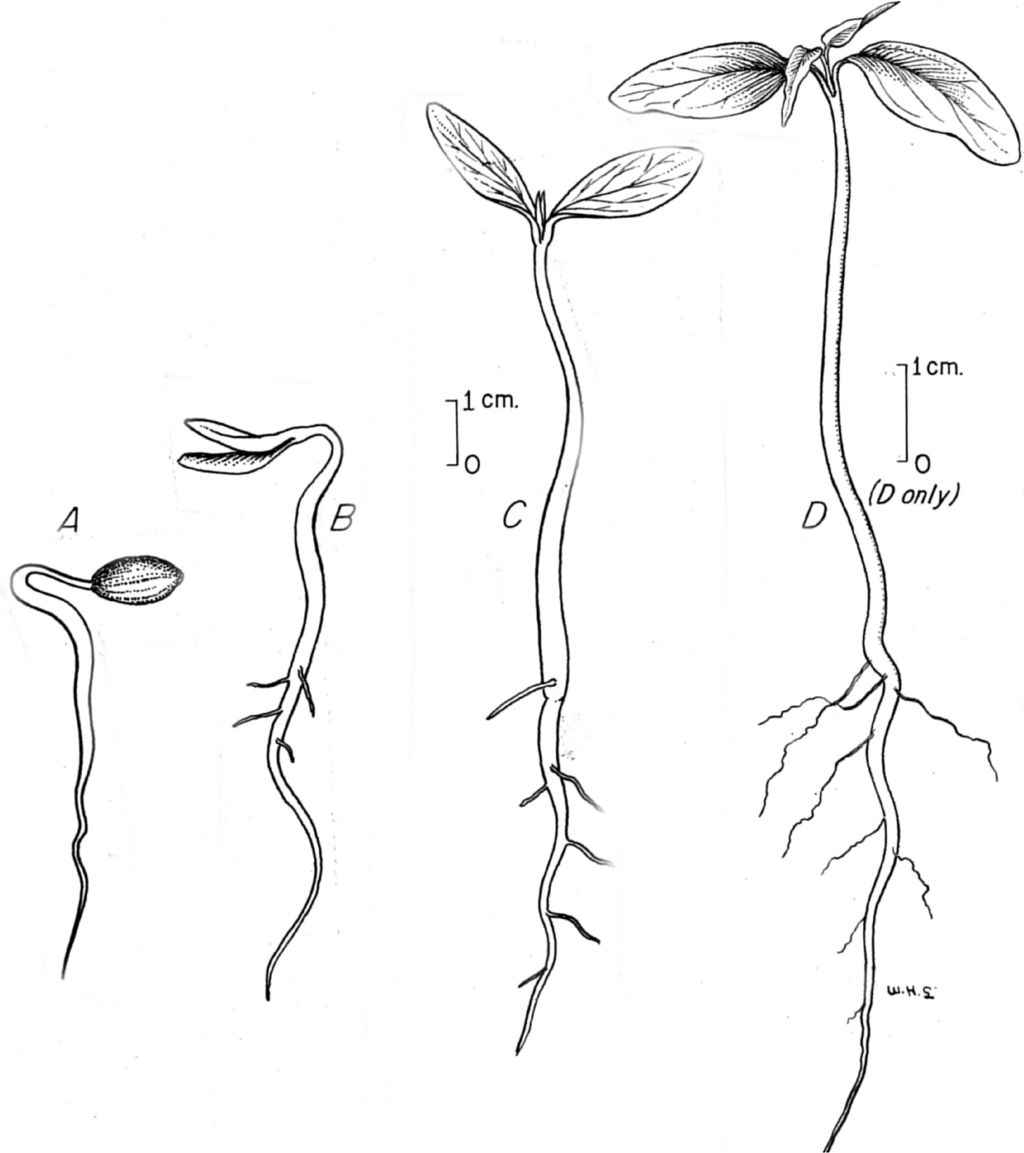
This initial phase of growth is common in unicellular organisms growing in a nutrient-rich culture or the early development of a plant from a zygote. The growth is slow at first (the lag phase), then accelerates rapidly.
The Sigmoid Curve
Geometric growth can't continue forever. In the real world, resources like nutrients, water, and space are limited. As a plant grows larger, it faces these limitations, causing the growth rate to slow down. When you plot the growth of an organism or a plant part in this environment over time, the result is a classic S-shaped or sigmoid curve .
This curve has three phases:
- Lag Phase: The initial period where growth is slow. The plant is adapting to its environment, and cell division is just beginning.
- Log Phase (Exponential Phase): A period of rapid, geometric growth where cell division is at its maximum. The plant has abundant resources and is expanding quickly.
- Stationary Phase: Growth slows down as resources become limited or internal factors restrict further expansion. The growth rate becomes zero, and the plant reaches a mature size.
Measuring Growth
To compare growth meaningfully, we use two different metrics: absolute growth rate and relative growth rate.
Absolute Growth Rate (AGR) is the total growth per unit of time. It measures the simple increase in size. For example, if a leaf grows by 5 cm² in a week, its AGR is 5 cm²/week.
Relative Growth Rate (RGR) is the growth per unit of time expressed per unit of initial size. It’s a measure of efficiency—how effectively the existing tissue is producing new tissue.
Consider two leaves, A and B. Leaf A starts at 5 cm² and grows to 10 cm² in a week. Leaf B starts at 50 cm² and grows to 55 cm² in the same week. Both have an absolute growth rate of 5 cm²/week. But their relative growth rates are very different.
- Leaf A RGR: (5 cm² / 5 cm²) per week = 100% per week
- Leaf B RGR: (5 cm² / 50 cm²) per week = 10% per week
Leaf A is growing much more efficiently relative to its starting size. This concept is crucial for understanding how a small seedling can rapidly increase its biomass.
Conditions for Growth
For a plant to grow, it needs the right conditions. These are not just nice-to-haves; they are essential inputs for the physiological processes that drive expansion and the creation of new tissue.
Water is critical. It maintains turgor pressure in cells, which is the force that powers cell enlargement. It also acts as a medium for enzymatic activities needed for growth. Without enough water, cells can't expand, and growth halts.
Oxygen is required for aerobic respiration, the process that releases energy from stored food. This energy (in the form of ATP) fuels all the metabolic activities involved in growth. This is why waterlogged soils, which lack oxygen, are detrimental to root health and overall plant growth.
Nutrients, both macro (like nitrogen, phosphorus, potassium) and micro (like iron, manganese), are the building blocks. They are assembled into protoplasm, the living substance of the cell. A deficiency in any essential nutrient can stunt growth, acting as the limiting factor that brings on the stationary phase of the sigmoid curve.
Finally, optimal temperature, light, and gravity also influence growth patterns and rates, guiding everything from germination to the final form of the mature plant.
Let's see how well you've grasped these concepts of plant growth.
What is the primary difference between arithmetic and geometric growth in a population of cells?
In a typical sigmoid growth curve for a plant, what characterizes the stationary phase?
By understanding these quantitative aspects, we can better appreciate how plants efficiently build themselves from simple resources, navigating environmental limits to achieve their final form.