Navigating the Tech Startup Ecosystem
Startup Basics
What Makes a Startup Tick?
A startup isn't just a new business. While a new restaurant and a new software app are both new, they operate on fundamentally different principles. A local restaurant has a proven business model. A startup, on the other hand, is a temporary organization searching for a business model that is repeatable and scalable.
startup
noun
A company in its early stages of operations, founded by one or more entrepreneurs who want to develop a product or service for which they believe there is demand. These companies generally start with high costs and limited revenue.
The key ingredients are growth and innovation. A startup aims to grow exponentially, not linearly. It does this by creating something new or by radically improving something that already exists, often using technology. This creates a high degree of uncertainty. Founders don't know if their idea will work, who their customers will be, or how to make money. The goal is to answer these questions as quickly as possible.
The Startup Journey
Every startup follows a path from a simple idea to a fully-fledged company. This journey can be broken down into distinct stages, each with its own goals and challenges.
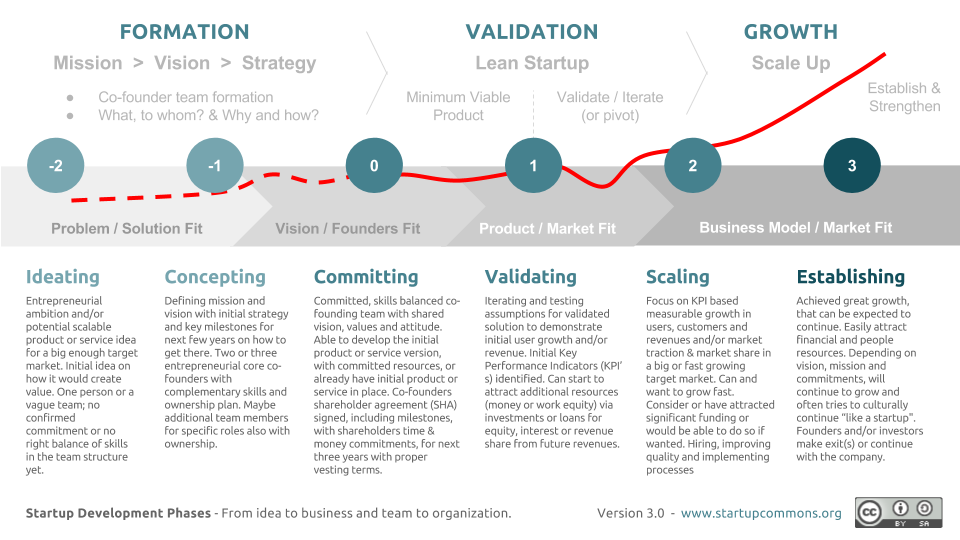
The first stage is Ideation. This is the spark. It begins with identifying a problem or a need. What's a frustration you have? What could be done better? The goal here isn't to have a perfect business plan, but to brainstorm potential solutions to a meaningful problem.
Next comes Validation. An idea is just a guess until it's tested. In this stage, founders talk to potential customers to see if the problem they identified is real and if their proposed solution is something people would actually use, and hopefully, pay for. The aim is to find "problem-solution fit" by building a Minimum Viable Product (MVP), a basic version of the product with just enough features to get feedback.
The validation stage is all about learning. The goal is to confirm or deny your core assumptions before you spend a lot of time and money building the wrong thing.
Once the idea is validated, the startup enters the Growth stage. With a product that a core group of users loves, the focus shifts to finding a reliable way to get more customers. This means experimenting with marketing, refining the sales process, and trying to achieve "product-market fit," where you've proven you can satisfy a broad market.
Finally, there's Scaling. This is where the business model gets put to the test. Scaling means pouring resources into what works to grow the company rapidly. It involves hiring more people, expanding into new markets, and building efficient processes to handle the increased demand without breaking. It's about turning a successful product into a large, sustainable business.
Common Hurdles
The path is rarely smooth. Startups operate under constant pressure and face unique challenges. One of the biggest is simply building something people want. Many founders fall in love with their solution before fully understanding the problem, leading to a product nobody uses.
Another major challenge is the team. A startup needs a small group of dedicated people who can wear many hats and adapt quickly. Finding the right co-founders and early employees with the right mix of skills and shared vision is critical. Finally, there is the challenge of execution. A brilliant idea is worthless without the ability to turn it into a reality. This involves making smart decisions every day, managing limited resources, and adapting when things inevitably go wrong.
The key factor to remember is that not all startups follow a linear path, and each company encounters numerous challenges during the critical stages of expansion.
Let's check your understanding of these core concepts.
What is the primary characteristic that defines a startup?
A founder has an idea for a new app and builds a basic version with just enough features to get feedback from a small group of users. In which stage of the startup journey is this founder?
Understanding these stages and challenges is the first step in navigating the world of startups. It's a journey of continuous learning and adaptation.