Navigating Double Exceptionality ADHD and Giftedness in Adults
Understanding Twice-Exceptionality
The Twice-Exceptional Brain
Some people are gifted. They might have a high IQ, exceptional creativity, or a deep talent in a specific area. Others have a learning disability or a developmental disorder, like ADHD, which creates unique challenges in their daily lives. But what happens when someone is both?
This is called twice-exceptionality, often shortened to "2e." A twice-exceptional person has the characteristics of a gifted student with the potential for high achievement, and the characteristics of a person with a disability. They are exceptional in two different ways.
Twice-Exceptional
adjective
A term used to describe individuals who are both gifted and have a learning disability, developmental disorder, or other condition that presents challenges.
The challenge for 2e individuals is that their strengths can mask their weaknesses, and their weaknesses can hide their strengths. A brilliant student who can't stay organized might be seen as lazy or unmotivated, not as someone who is gifted but also struggling with ADHD. Conversely, their ability to creatively solve problems might compensate for a learning disability, making it harder for anyone to spot their underlying challenge.
Imagine trying to drive a sports car with a faulty steering wheel. You have all the power, but directing it where you want to go is a constant struggle. That's a glimpse into the 2e experience.
Giftedness and ADHD
The combination of giftedness and ADHD is one of the most common forms of twice-exceptionality. This pairing creates a complex profile of traits that can seem contradictory. An adult with giftedness and ADHD might be able to focus intensely on a passion project for hours (hyperfocus) but get distracted after five minutes of a routine task. They might generate a dozen innovative ideas but struggle to execute a single one.
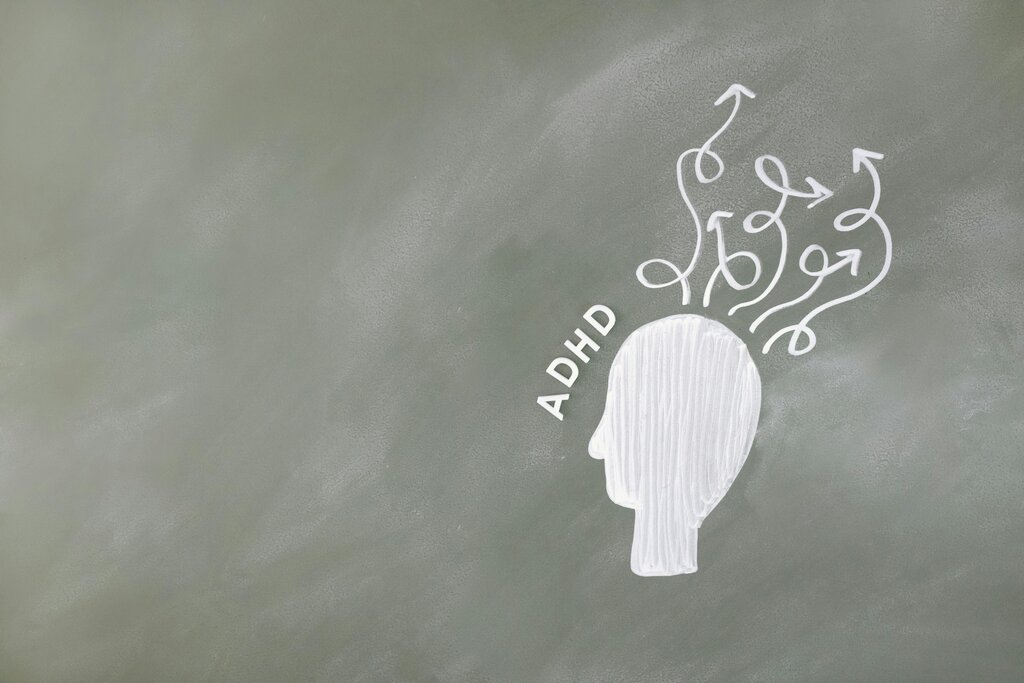
Because they are often misunderstood, many 2e adults go undiagnosed. Their intelligence allows them to develop coping mechanisms that hide their ADHD-related challenges. They might be seen as quirky, inconsistent, or not living up to their potential, while the internal battle to manage their conflicting traits goes unnoticed. As a result, it's difficult to know the exact prevalence of twice-exceptionality in adults, but it is widely considered to be underidentified.
This internal tug-of-war can be exhausting. It's not uncommon for 2e adults to struggle with anxiety, frustration, and low self-esteem from a lifetime of feeling out of sync with expectations. Understanding this unique cognitive profile is the first step toward recognizing their true abilities and challenges.
| Gifted Trait | Corresponding ADHD Challenge |
|---|---|
| High creativity & idea generation | Difficulty with planning & follow-through |
| Intense focus on interests (hyperfocus) | Inattention to routine or boring tasks |
| Rapid learning & problem-solving | Impulsivity & poor self-regulation |
| High verbal ability | Tendency to interrupt or speak out of turn |
| Sensitivity & emotional intensity | Emotional dysregulation & frustration |
Let's review the key term from this section.
Now, let's check your understanding of these concepts.
What does the term "twice-exceptional" (2e) describe?
Why is it often difficult to identify a twice-exceptional individual?
Recognizing twice-exceptionality is about seeing the whole person—the combination of incredible strengths and significant challenges that define their unique way of experiencing the world.