Navigating AI Models
AI Model Fundamentals
What Is an AI Model?
An artificial intelligence (AI) model is a program designed to find patterns in data. Think of it as a specialized brain for a computer. It doesn't memorize information like a database. Instead, it learns the underlying rules and relationships from the examples it's shown.
Its purpose is to use this learned knowledge to make predictions, classify information, or create new content when it sees new, unfamiliar data. For instance, a model trained on thousands of cat photos learns the common features of a cat—pointed ears, whiskers, a certain eye shape. When you show it a new photo, it uses that learned pattern to decide if it's looking at a cat.
Inside a Model's Architecture
At a high level, many AI models are built with layers of interconnected nodes, often called artificial neurons. When you give a model some input, like a sentence or an image, the data passes through these layers. Each layer processes the information and passes it to the next, with each step helping to recognize more complex and abstract features.
Imagine an assembly line. Raw data goes in one end. The first layer might spot simple things like edges and colors. The next layer might combine those to recognize shapes. Subsequent layers could identify more complex objects like eyes or a nose, until the final layer assembles these features to make a conclusion, like identifying a face.
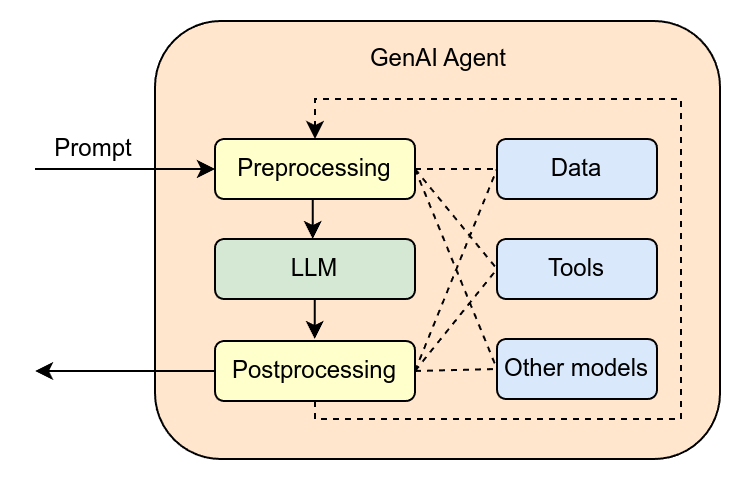
This layered structure allows the model to build a sophisticated understanding from simple building blocks, whether it's processing language, images, or sounds.
How Models Learn
Models aren't built smart; they're trained to be smart. This training process is a lot like studying for an exam. The model is given a massive dataset—for example, a collection of text from the internet or a library of medical images.
The process generally follows these steps:
- Input: The model is fed a piece of data from its training set.
- Prediction: It makes a guess based on its current knowledge. Early on, these guesses are mostly random and incorrect.
- Feedback: The model's prediction is compared to the correct answer. The difference between the two is calculated as an "error."
- Adjustment: The model then tweaks its internal connections to reduce this error. It essentially asks, "How can I adjust my thinking to get closer to the right answer next time?"
This cycle of predicting, getting feedback, and adjusting is repeated millions or even billions of times. With each iteration, the model becomes slightly more accurate, gradually refining its ability to recognize patterns until its predictions are consistently reliable.
Think of it as a sculptor chipping away at a block of marble. Each piece of feedback is a tap of the chisel, slowly revealing the desired form.
Big vs. Small Models
AI models come in all shapes and sizes, largely depending on their intended purpose. The two main categories you'll encounter are large, general-purpose models and smaller, task-specific models.
Large Language Models (LLMs) are the giants of the AI world. They are trained on vast, diverse datasets covering nearly every topic imaginable. This broad training gives them a wide range of capabilities, from writing essays and code to answering complex questions and translating languages. They are generalists, designed to handle many different tasks without needing special training for each one.
Smaller, Task-Specific Models are specialists. They are trained on narrower, more focused datasets to perform a single job exceptionally well. Examples include models designed solely for detecting spam emails, identifying tumors in X-rays, or controlling a factory robot. They are smaller, faster, and more efficient for their specific application.
| Feature | Large Language Models (LLMs) | Smaller, Task-Specific Models |
|---|---|---|
| Training Data | Massive and diverse (e.g., a large portion of the internet) | Narrow and focused (e.g., medical images) |
| Capabilities | General-purpose; can perform many different tasks | Specialized; excels at one or a few tasks |
| Size & Speed | Very large, can be slower and more resource-intensive | Smaller, faster, and more efficient for its job |
| Example | Answering general knowledge questions | Identifying fraudulent credit card transactions |
Choosing between a large or small model depends entirely on the problem you're trying to solve. If you need a versatile tool for a wide range of creative or analytical tasks, an LLM is a great choice. But if you have a single, well-defined problem that requires speed and precision, a smaller, specialized model is often the better solution.
What is the primary function of an AI model?
The text compares an AI model's structure to an assembly line. In this analogy, what do the final layers of the model accomplish?
Understanding these core concepts—what models are, how they're built and trained, and how they differ in size and scope—is the first step to harnessing their power.