Natural Selection A Universal Pattern
Introduction to Natural Selection
The Engine of Evolution
Life is incredibly diverse. From the smallest bacterium to the largest whale, organisms are exquisitely suited to their environments. But how did this happen? The primary answer is a process called natural selection. It's not a conscious force making decisions, but rather an outcome of simple, observable facts about life.
Natural selection, the process that shapes evolution, tells us that, as populations reproduce and change, those species best adapted to their environment survive.
At its core, natural selection is the process where organisms with traits better suited to their environment are more likely to survive, reproduce, and pass those advantageous traits to their offspring. Over many generations, this can lead to significant changes in a population, and even the rise of new species.
The Three Key Ingredients
For natural selection to occur, three conditions must be met. Think of them as the essential ingredients in a recipe for evolution.
- Variation: Individuals within a population are not identical. They have different traits, like variations in color, size, or speed. This diversity is the raw material for change.
This variation arises from random mutations in DNA and the shuffling of genes during sexual reproduction. Without these differences, there would be nothing for selection to act upon.
- Competition: Organisms produce more offspring than can possibly survive. This leads to a 'struggle for existence' where they compete for limited resources like food, water, and mates. They also face threats from predators and disease.
This doesn't always mean head-to-head combat. Competition can be as simple as which plant gets more sunlight or which bird is better at finding seeds.
- Inheritance: The traits that give an organism an advantage in the struggle for survival must be heritable. That is, they can be passed down from parent to offspring through genes.
If a beneficial trait couldn't be inherited, it would die with the individual, and the population wouldn't change over time. It's the combination of variation, competition, and inheritance that drives the process forward.
A Classic Example
One of the most famous examples of natural selection in action is the story of the peppered moth in England during the Industrial Revolution.
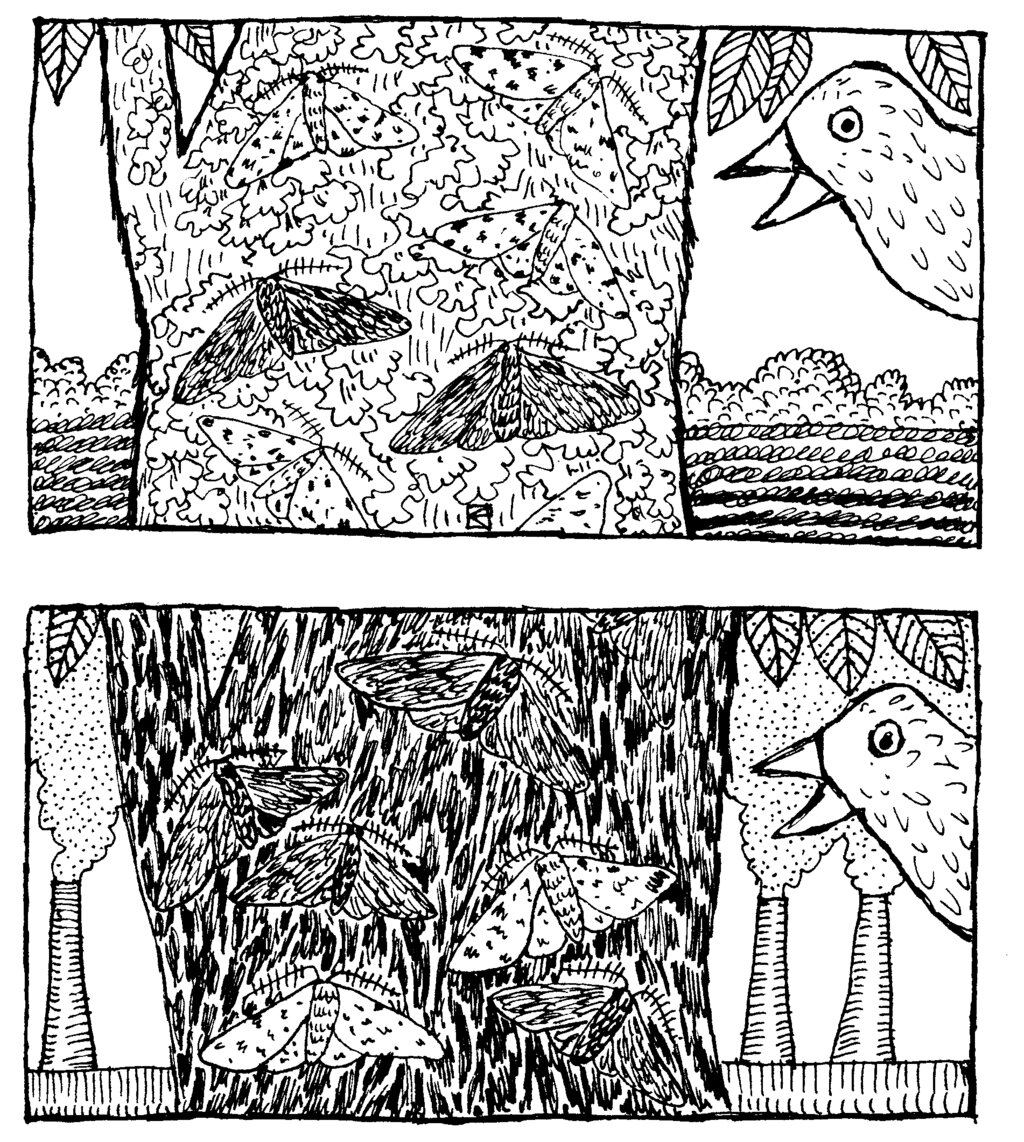
Before the 1800s, most peppered moths were light-colored with dark spots. This coloring provided excellent camouflage against the lichen-covered trees they rested on, hiding them from predatory birds. A rare, dark-colored variant existed, but it stood out against the light bark and was easily eaten.
Then, the Industrial Revolution began. Factories poured out soot, which killed the lichen and blackened the tree trunks. Suddenly, the tables turned.
| Environment | Fittest Moth | Reason for Advantage |
|---|---|---|
| Pre-Industrial (Clean Air, Light Bark) | Light-colored | Camouflaged from birds |
| Post-Industrial (Sooty Air, Dark Bark) | Dark-colored | Camouflaged from birds |
The light moths became easy targets against the dark bark, while the dark moths were now perfectly camouflaged. As a result, the dark moths survived and reproduced at a higher rate. They passed on their genes for dark coloration to their offspring. Over several decades, the population shifted dramatically, with the dark form becoming the most common. This is natural selection in a nutshell.
Ready to check your understanding?
Which of the following best describes the process of natural selection?
In the case of the peppered moths, what was the primary environmental change that drove the shift in the moth population's coloration?
By understanding these core principles, we can see how natural selection isn't a random process. It's a powerful mechanism that sorts through random variation to produce adaptations, shaping the incredible diversity of life we see around us.