Narendra Modi: A Political Journey
Early Life and Political Beginnings
From Vadnagar to the Sangh
Narendra Modi's story begins in Vadnagar, a small town in Gujarat. Born in 1950, his early life was modest. He was the third of six children, and his family ran a tea stall at the local railway station, where he often helped out. This upbringing instilled a sense of discipline and hard work from a young age.
In school, Modi was known as an average student but a skilled debater with a keen interest in theatre. It was during these formative years that he first encountered the Rashtriya Swayamsevak Sangh (RSS), a Hindu nationalist volunteer organisation.
At the age of eight, Modi began attending the local RSS shakha, or branch. The RSS's focus on discipline, patriotism, and Hindu cultural identity resonated with him. This early association would shape his worldview and lay the groundwork for his entire political career. The organisation provided him with a structured environment and a strong ideological framework.
Rashtriya Swayamsevak Sangh
noun
Commonly known as the RSS, it is an Indian right-wing, Hindu nationalist, volunteer organisation. It is the progenitor and leader of a large body of organisations called the Sangh Parivar (the "family of the Sangh").
A Life as a Pracharak
After completing his schooling, Modi's commitment to the RSS deepened. Around the age of 20, he left home to become a pracharak—a full-time RSS propagandist and organiser. This was a significant life choice, demanding celibacy and a life of austerity dedicated entirely to the organisation's cause.
His life as a pracharak involved extensive travel across India. He spent time in the Himalayas, a period he describes as one of spiritual reflection. During the Emergency (1975-1977), when the RSS was banned, Modi went underground, organising resistance, printing pamphlets, and helping move political activists to safe houses. These experiences honed his organisational skills and strategic thinking.
As a pracharak, Modi's duties ranged from mundane tasks like cooking and cleaning at RSS offices to organising large-scale campaigns and meetings.
Entering Formal Politics
In 1985, the RSS assigned Modi to its political wing, the Bharatiya Janata Party (BJP). This marked his formal entry into electoral politics. His reputation as a master strategist quickly grew within the party's Gujarat unit.
He played a crucial role in organising two significant events that boosted the BJP's profile: L.K. Advani's 1990 Ram Rath Yatra and Murli Manohar Joshi's 1991-92 Ekta Yatra (Unity March). His meticulous planning was instrumental in the BJP's victory in the 1995 Gujarat Assembly elections, a turning point for the party in the state.
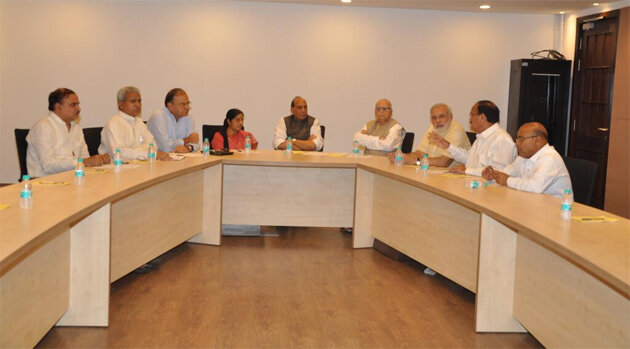
Recognised for his organisational acumen, Modi was appointed as the BJP's National Secretary and transferred to New Delhi in 1995. He was later promoted to General Secretary in 1998, a position he held until 2001. During this time, he managed party affairs in several states, further cementing his influence. His early years, from the tea stall in Vadnagar to the inner circles of the RSS and BJP, forged the political ideology and strategic discipline that would define his subsequent rise to power.
In which town in Gujarat did Narendra Modi spend his childhood?
At what age did Narendra Modi first encounter the Rashtriya Swayamsevak Sangh (RSS)?