Nanobananas Explained
Introduction to Nanotechnology
What is Nanotechnology?
Nanotechnology is the science of the extremely small. It involves manipulating matter on an atomic and molecular scale. The prefix "nano" comes from the Greek word for dwarf, and in science, it means one-billionth. A nanometer (nm) is one-billionth of a meter.
To put that in perspective, a single sheet of paper is about 100,000 nanometers thick. A strand of human hair is about 80,000 nm wide. A red blood cell is about 7,000 nm across. We're talking about a scale far smaller than what a standard microscope can see.
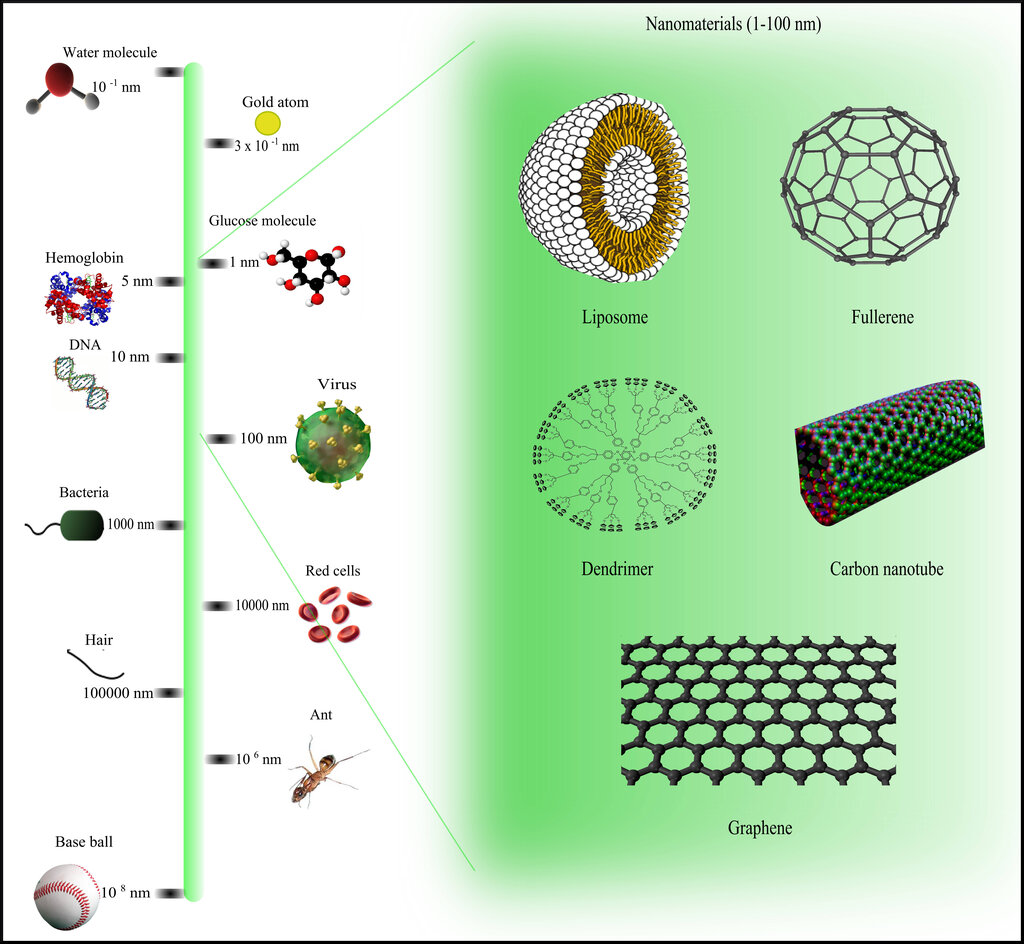
At this tiny scale, the rules of the game change. The properties of materials—like their color, strength, conductivity, and reactivity—can be very different from their properties at a larger, or "bulk," scale. Nanotechnology is the art and science of using these unique properties to design and build new materials and devices. It's a field that brings together physics, chemistry, biology, and engineering to work at the very foundation of matter.
A Brief History
The idea of working at the nanoscale isn't new. In a 1959 lecture called "There's Plenty of Room at the Bottom," physicist Richard Feynman imagined a day when scientists could manipulate individual atoms and molecules. He proposed that we could write the entire Encyclopedia Britannica on the head of a pin. At the time, it was pure theory. There were no tools to make it happen.
Feynman's talk planted a seed, challenging scientists to think about the possibilities of the miniature world.
The field began to take shape in the 1970s and 80s. In 1974, Japanese scientist Norio Taniguchi first used the term "nanotechnology." A huge breakthrough came in 1981 when Gerd Binnig and Heinrich Rohrer at IBM invented the scanning tunneling microscope (STM). For the first time, scientists could not only "see" individual atoms but could also move them around. This invention earned them the Nobel Prize in Physics and opened the door to the practical manipulation of matter at the nanoscale.
The Nanoscale Difference
Why does matter behave so differently at the nanoscale? Two main factors are at play: quantum effects and a much greater surface area to volume ratio.
Let's start with an example. Gold is a familiar material. We know it as a yellowish, chemically stable metal used in jewelry. But when you break gold down into nanoparticles, its properties change entirely. Gold nanoparticles can appear red, purple, or blue depending on their size. They also become excellent catalysts, speeding up chemical reactions.
This color change is due to quantum effects. At the nanoscale, the electrons within the material are more confined, which changes how they interact with light. This affects a material's optical, magnetic, and electrical properties.
More importantly, for many applications, is the increase in surface area. Imagine a single cube of sugar. It has six sides, which make up its surface area. Now, imagine crushing that cube into a fine powder. The total volume of sugar is the same, but you have exposed countless new surfaces. The total surface area has increased enormously.
At the nanoscale, this effect is extreme. A larger proportion of a nanoparticle's atoms are on its surface compared to a bulk material. Since the surface is where chemical reactions happen, nanomaterials are much more reactive. This high surface area is a key reason why they are so useful as catalysts and sensors.
Types of Nanomaterials
Nanomaterials are often categorized by their dimensions. Think of them as building blocks, each with a different shape and size.
Nanoparticles
noun
Materials where all three dimensions are at the nanoscale (typically 1-100 nm). They are also known as zero-dimensional (0D) nanomaterials.
These are essentially tiny specks of material. Quantum dots, which are used in vibrant TV displays, are a common example.
Nanofibers
noun
Materials with two dimensions at the nanoscale and one dimension that is much larger. They are one-dimensional (1D) nanomaterials.
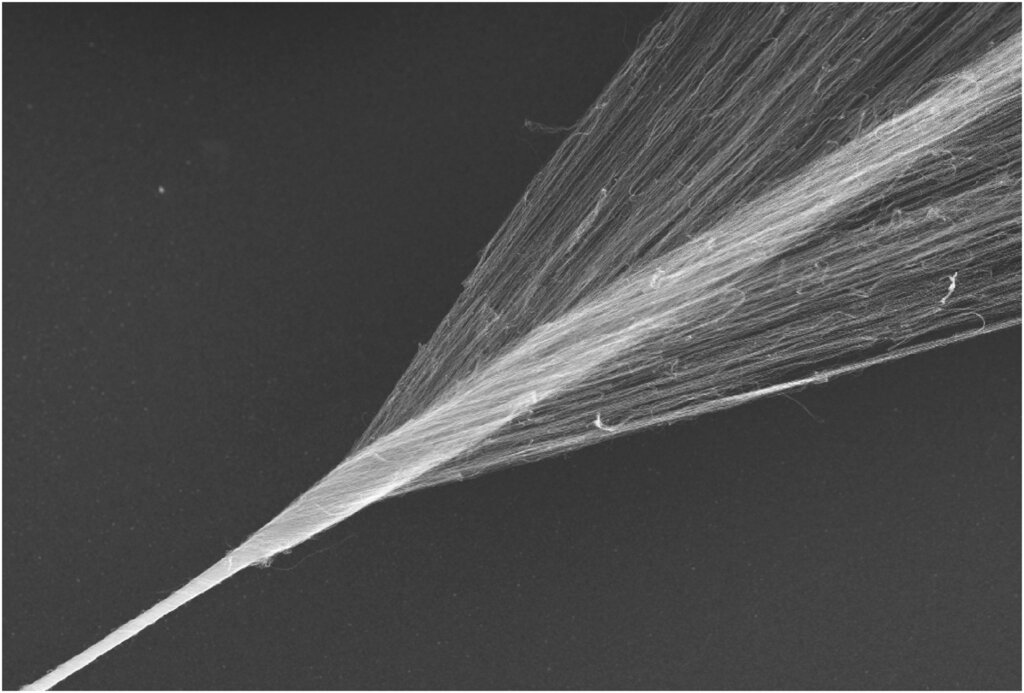
These materials are shaped like long wires, rods, or tubes. Carbon nanotubes are a famous example. They are incredibly strong—stronger than steel—and have amazing electrical properties.
Nanofilms
noun
Materials with only one dimension at the nanoscale. Also known as nanocoatings or nanolayers, they are two-dimensional (2D) nanomaterials.
These are ultra-thin sheets of material, often just one or a few atoms thick. Graphene, a single layer of carbon atoms arranged in a honeycomb lattice, is the most well-known example. It's the strongest material ever tested, highly conductive, and nearly transparent.
These tiny materials are the fundamental components of nanotechnology, and their unique properties are opening up new possibilities across countless fields.